How to explain redundancy in an interview, from the hiring side
Eli Gunduz··11 min read
Share
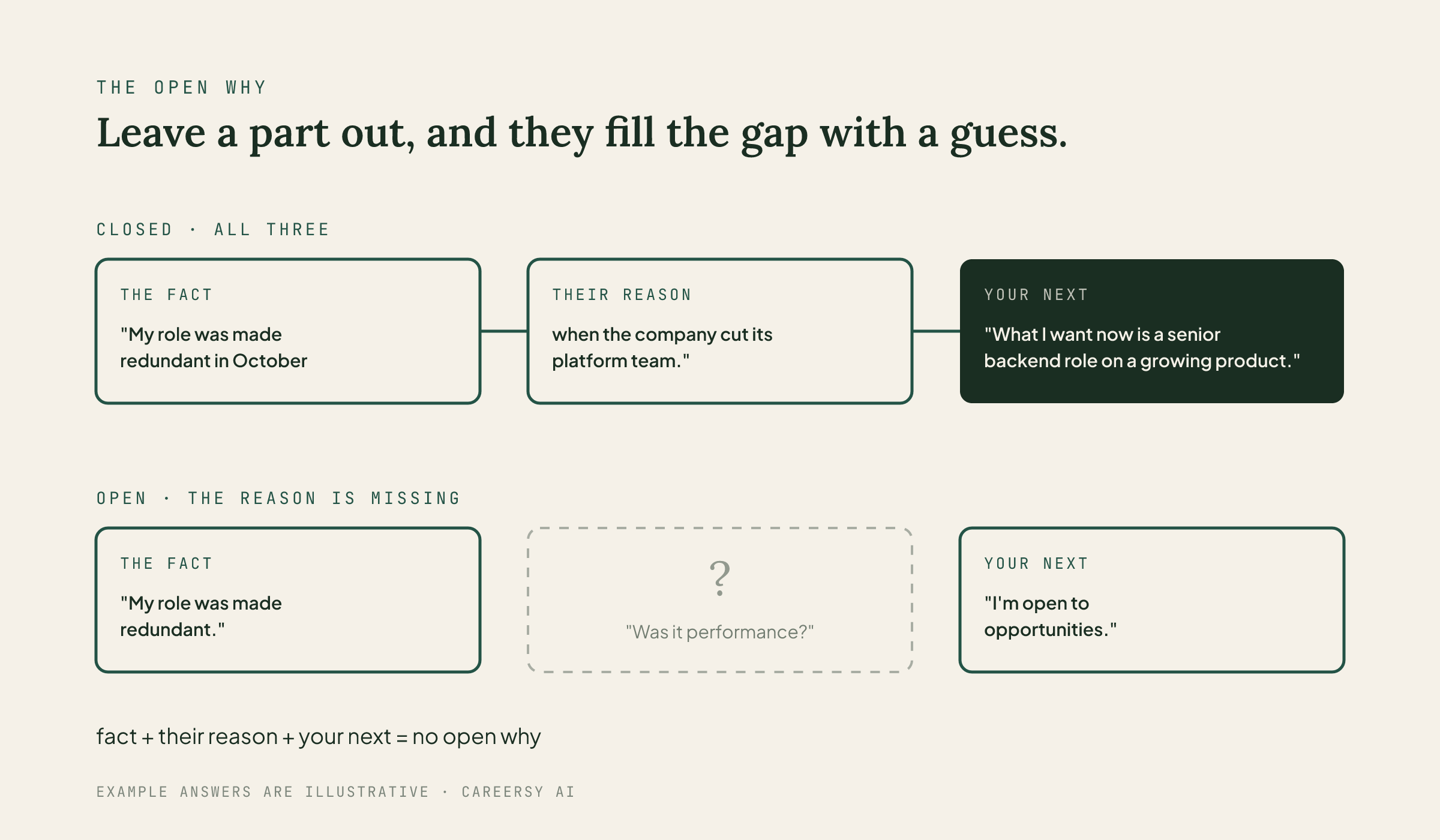
The open why. Say the fact, their reason and what you want next. Leave one out and they fill the gap with a guess.
A client was practising her answer to "why are you looking for a new role?" before a product owner interview. "I had to finish up my contract," she started. "I had to take a six month break."
I stopped her there. Her contract had simply ended, but redundancy answers trip on the same two words, "I had to." When someone says "I had to finish up my contract," the first thing in my head is: why?
"Don't you think it's better to say 'I decided'?" I asked. She tried it again. She'd decided to finish the contract to look after family, and the break had given her time to work out what she wanted next. Same facts, said in a couple of sentences, and then she stopped.
Every answer about leaving a job does one of two things. It closes the question, or it leaves a why open.
An open why doesn't stay empty. The person across the table fills it in, and they fill it with the guess that's safest for them.
Their safest guess is the one that hurts you most. A recruiter who sends you to a hiring manager is putting their name next to yours. If you turn out to be the person who was let go for performance, it's the recruiter who looks careless. So when something's unclear, they assume the risky version and move to the next CV. That isn't cruelty. It's how they protect a shortlist of five. It works in reverse too: give them the business part, and a redundancy reads as what it is.
The sum: fact + their reason + your next = no open why.
An open why gets filled with the worst guess.
How to explain redundancy in an interview, in two sentences
The client from the start of this post described her finished answer as "a couple of sentences and I stop there." That's about the right length when someone asks "why are you looking?" or "why did you leave?" The first sentence deals with the past, and the second points at the job in front of you.
Prompt
"My role was made redundant in [month] when [company] [the business reason, in one clause].""What I'm looking for now is [the role], because [one reason that matches this job]."
A filled-in example (illustrative):
"My role was made redundant in October when the company cut its platform team after two quarters of flat revenue. What I'm looking for now is a senior backend role on a product that's growing, because that's where I've done my best work."
Then stop talking. This is the part people find hardest.
The third sentence is where it goes wrong. It's usually "but it wasn't about my performance," or two minutes of backstory about the reorg. Nobody had asked about performance. You've just put the idea in the room yourself. The longer the answer runs, the more it sounds like there's something to explain.
You might be thinking: "Shouldn't I make it sound positive?"
The second sentence is where the positive goes. Be plain about the redundancy, because it's a fact, and in 2026 a common one. Part 1 lists nine rounds of tech cuts in Australia this year. The energy goes into what you want next and why this role fits. That's the part they'll remember.
"Why was your role chosen?"
This is the follow-up most people haven't prepared.
In a CV session in June, a client who was still in his job but worried about cuts told me what he was seeing at his company. All of it was about the business: money, customers, a product bet that hadn't worked. I'd asked because an interviewer would ask him the same thing. "No one can argue against that one," I told him.
That's the shape of a closed answer to "why your role?" It's about the business, in facts anyone could check: money, a product that stopped, a function that moved, a team that was cut. Pick the one that fits and say which kind of cut it was:
A whole team or function: "They closed the [team] and moved the work to [another office / a vendor / nobody]."
A share of the company: "It was a company-wide cut of around [a fifth], across every function."
A product or project: "They stopped [the product], and the team that built it went with it."
One sentence, then back to what you want next.
"Why were you let go and not others?"
This is the one that feels like an accusation, and it's the one where people say too much. I don't have a client session to point to on this one, so it's the reasoning.
The honest answer is usually that you weren't told the criteria. Don't guess at them out loud, and don't criticise the people who decided. Say what you do know:
"They kept a smaller team focused on [what stayed]. My work was on [what stopped], so my role went with it."
If it really was a cut where some people in your team stayed and you can't say why, say that, and point at something they can check:
"I wasn't told how they chose. My last review rated me [the real rating], and my manager is happy to be a reference."
Only offer the reference if your manager has actually agreed. Ask them this week, before anyone else does.
Your answer has to match the reference check. In one session a client asked me what his old company would say if a recruiter called. My answer was that they'd say "Yes, he was made redundant," and that's the end of it, unless he'd told the interviewer a different story.
"Was it voluntary?"
Part 1 of this series says calling a redundancy voluntary when you didn't choose it is the version that causes trouble. That still holds. But there's one case where the word is true.
Some companies offer packages and ask for volunteers before they choose anyone. If the package was offered to volunteers and you put your hand up for it, "I took a voluntary redundancy" is accurate. The grey zone is signing paperwork for a package that never felt like a choice. A client raised exactly that one with me in a CV session, and this is the question that settles it.
Was the package offered to volunteers, and did you put your hand up for it? Then it's voluntary. Were you told your role was going, with the paperwork after? Then it's a redundancy, whatever you signed, and the reference check will say so.
Explaining the gap after a redundancy
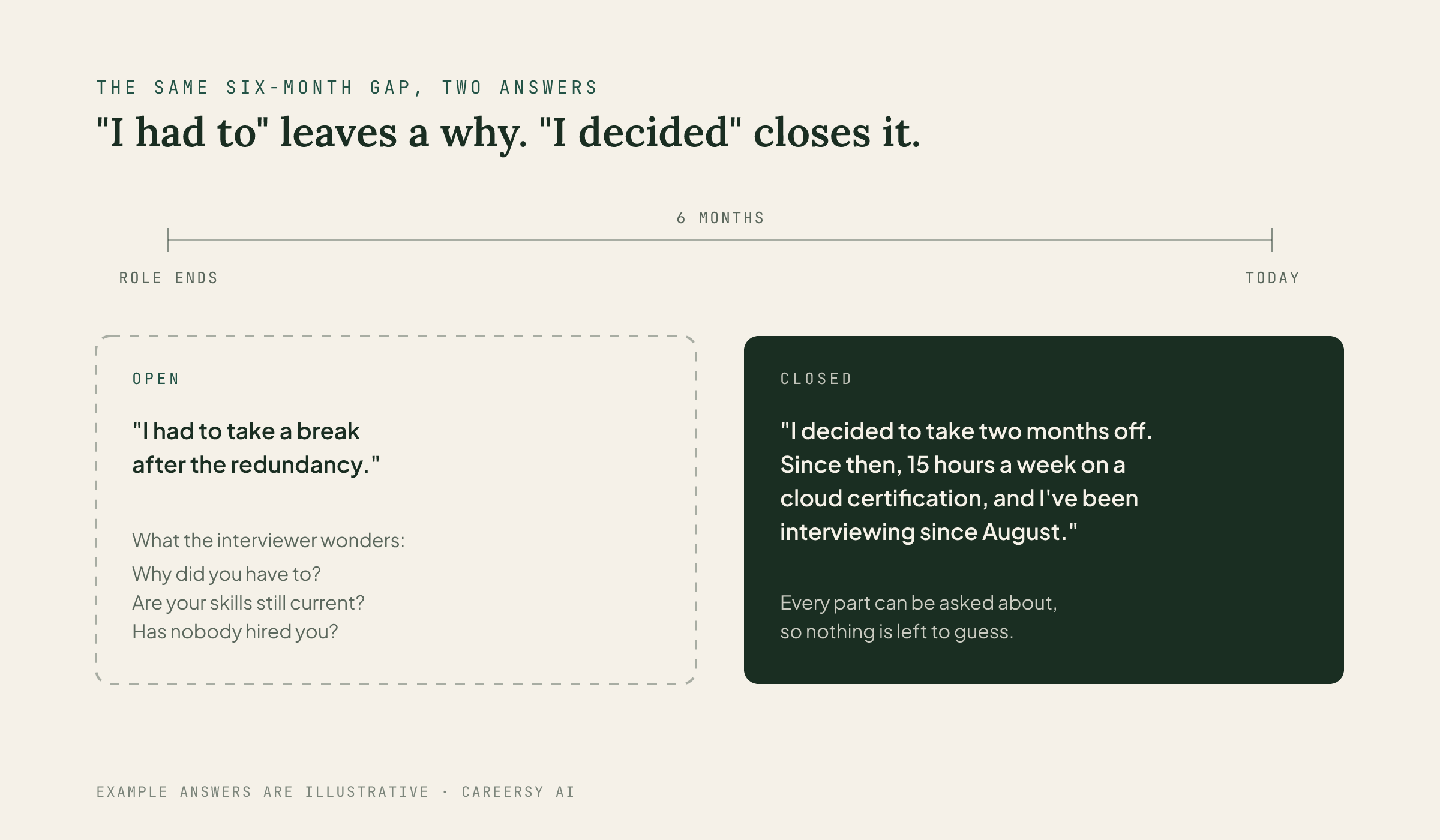
A gap is an open why with a date on it. The interviewer looks at your last role's end date, does the maths, and wonders what happened in between.
The fix is the one from the start of this post: change "I had to" into "I decided," then say what the time went into.
Put a number on the time. In a CV session with a client coming back from a long break, I told him: say how long, 15 hours a week or whatever it really was. Name the hours and the thing. "Fifteen hours a week on a cloud certification and one small project I can show you" gives the interviewer something to ask about.
A filled-in example (illustrative):
"After the redundancy I decided to take two months off first, which I'd never done in nine years. Since then I've spent about 15 hours a week on [the course or project], and I've been interviewing for [the role] since [month]."
If the gap is long, say the search part too. "I've been interviewing since August" tells them you've been looking the whole time.
A second redundancy
I don't have a client session on this one to point to, so here's the reasoning rather than a story.
Two redundancies in two years makes the interviewer wonder something new: do you keep picking companies that are about to cut? That's the open why, and the facts usually close it. Through 2025 and 2026, Australian tech companies cut roles in round after round. Canva's November 2026 round alone affected about a fifth of the company. If each of your two redundancies has its own business reason, say both, one sentence each.
Then close the new why by saying what you check now:
"Both were company-wide cuts, [company A] after [reason] and [company B] after [reason]. This time I'm asking every company about revenue and team growth before I accept, which is part of why this role stood out."
Then actually ask about it in the interview.
Recruiter screen versus panel
The words barely change. What changes is who's listening and what they're checking.
Recruiter screen
Panel
Who's asking
The recruiter, early in the call
The hiring manager, sometimes a peer
What they're checking
Is it safe to put you in front of the hiring manager?
Will you solve the problem this team has?
How long your answer is
Your two sentences
Your first sentence, then their problem
The follow-up to expect
"Why are you looking?" and your salary expectations
"Why was your role chosen?"
What happens to your answer
The recruiter passes it on to the hiring manager
It may have reached them already. Don't spend your panel time on it
On a recruiter screen, give them a line they can repeat word for word. Whatever you say is what the hiring manager hears second-hand, so make it easy to pass on. For the other question that comes up in that call, how to answer salary expectations covers the number.
In a panel, the redundancy is old news by the time you walk in. Say your first sentence if it comes up, answer the "why your role?" follow-up if they ask, and get back to the work. If it goes quiet after the panel, what to do when there's no response after an interview covers the follow-up.
Where this doesn't work
You were dismissed for performance or misconduct. That isn't a redundancy, and calling it one will come apart at the reference check. It needs a different answer, and if the dismissal itself is in dispute, talk to Fair Work first.
You resigned before the cut. Then you resigned. Say why you decided to go, in the same two-sentence shape.
The interviewer knows your old company well. Someone who worked there may know more about the cut than you do. Keep to your role and what you saw, and don't fill in the bits you weren't told.
Practise it before the first call
Say your two sentences out loud until they sound like you, then get someone to ask you "why your role?" and "why not the others?" without warning.
Then use the two sentences on your next recruiter screen. If the recruiter moves straight on to your experience, the why is closed. If they ask a follow-up about why you left, find the part that was missing and add it before the next call.
For a specific interview, Careersy AI works out what each stage of an Australian and New Zealand tech interview is really testing, company by company. Then it drills you on the answers until they land in the room. If you'd rather do it by hand, how to prepare for a job interview with AI has the prompts.
The short version
"Why are you looking?" Fact, their reason, what you want next. Two sentences, then stop.
"Why your role?" The business reason, and what kind of cut it was.
"Why not others?" What stayed, what stopped, and a reference who's agreed.
"Was it voluntary?" Only if the package was offered to volunteers and you put your hand up.
The gap: "I decided," then what the hours went into, with a number.
A second redundancy: both reasons, then what you check now.
FAQ
How do you explain redundancy in an interview?
Say the word, give the company's reason in one sentence, then say what you want next, and stop. For example: "My role was made redundant in October when the company cut its platform team. What I'm looking for now is a senior backend role on a growing product."
Should I say I was made redundant or that I left?
Say you were made redundant. If a recruiter calls your old employer, that's what they'll hear, so a softer version that doesn't match is what causes trouble. "Voluntary redundancy" is only accurate if the package was offered to volunteers and you put your hand up for it.
How do I answer why my role was chosen?
Keep it about the business: a team or function closed, a company-wide cut, or a product that stopped. Say which kind of cut it was in one sentence, then go back to what you want next.
How do I explain a gap after being made redundant?
Use "I decided" rather than "I had to," then say what the time went into, with a number, like 15 hours a week on a course or project. If you've been interviewing, say since when.
Is a second redundancy a red flag?
Not if each one has its own business reason. Give both in one sentence each, then say what you now check before accepting a role, such as revenue and team growth, and ask about it in the interview.
redundancymade redundantinterview questionswhy did you leavetech layoffs australia