Made redundant from a tech job in Australia? What to do from the rumour to the offer
Eli Gunduz··17 min read
Share
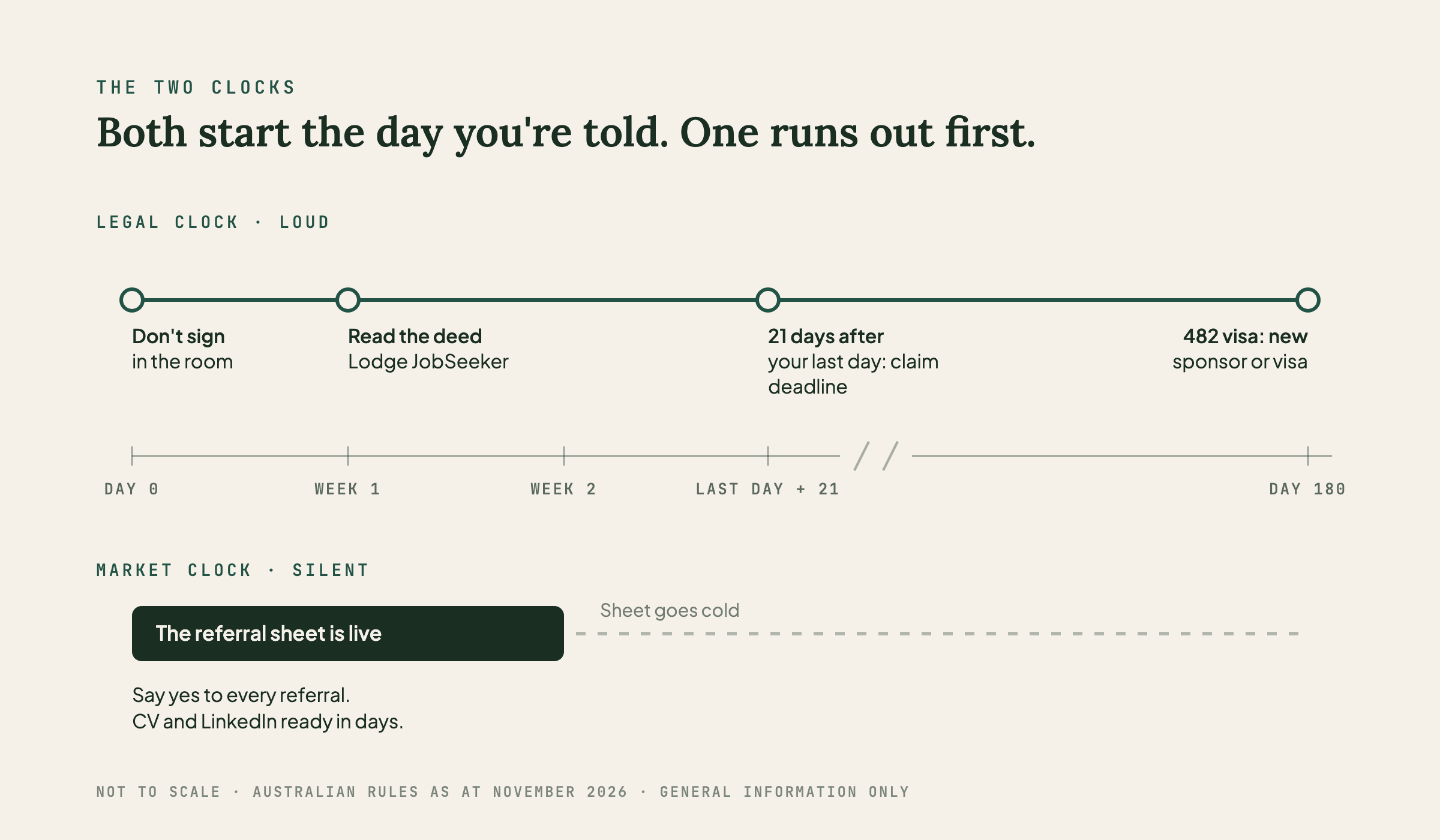
The two clocks. Two clocks start the day you're told. The paperwork one is fixed. The hiring one runs out first.
Applying is the one thing that feels like progress. "I need to do something," he'd said, twice in one sentence. We agreed he'd hold off until his CV and LinkedIn were ready, and only start applying after that.
Nothing in this guide is about whether you were good at your job. A redundancy is a decision about roles.
What I told him is this whole guide in one moment. A redundancy starts two clocks at once, and most people spend the first week on the wrong one.
The Two Clocks
The legal clock is the paperwork. You have 21 days to challenge a dismissal. There's a deed to read before you sign. Your laptop and accounts get switched off on a date someone else picked. And if you're on a 482 visa, there's a 180-day countdown.
The market clock is the hiring side. When a company lets a group of people go, a spreadsheet usually goes around with their names, emails and what each person is looking for. Former managers and colleagues start referring people from it. From what I've seen, it stays live for two weeks, give or take.
The sum is simple: legal clock (fixed dates) + market clock (about two weeks) = the first fortnight is the one you can't get back.
The legal clock is loud. It comes with letters, meetings and formal language, and it takes all your attention. The market clock makes no noise at all.
The market clock is the one that runs out first.
You might be thinking: "Shouldn't I be applying everywhere right now? Every week out of work costs me money."
The money worry is real, and Stage 2 covers what you're owed and when it lands. But the fastest way back to a pay cheque is a referral, and referrals start in conversations. So the first fortnight goes on getting your CV ready and saying yes to people. The cold applications only wait a few days.
This is general information, not legal, tax, financial or migration advice. Redundancy pay, tax and visa rules depend on your contract, award and situation, and the figures below are as at November 2026. For your own case, talk to Fair Work, a tax agent or a registered migration agent.
Who's been hit in Australian tech this year
If you're reading this, you might be in one of these rounds. The figures come from company statements and news reports. Where the company wouldn't confirm a number, the row says "reported".
Company
When
What was announced
Canva
November 2026
1,271 people affected (about 22%), including some moved to new roles or asked to relocate
Heidi Health
November 2026
About 108 people, around 18%
Culture Amp
June 2026
About 70 roles, after 60 in November 2025
Trend Micro (Sydney)
May 2026
45 engineering roles (reported)
Swyftx
April 2026
About 37 roles (reported)
Envato
March 2026
Up to 200 roles (reported)
Atlassian
March 2026
About 1,600 roles worldwide, about 480 in Australia
WiseTech Global
February 2026
About 2,000 roles over roughly two years, close to 30% of staff
Xero
February 2026
250 roles at risk (reported) while creating about 280 new ones
The big banks and Telstra have also been running tech cuts through 2026, in small rounds, month by month.
I work at Atlassian, so for that row I'm sticking to what the company has said publicly.
Stage 1: The rumour, before anything is official
Right now you still have full access to everything. That's why this is when people make the mistake that costs them most. They start saving things "just in case".
Don't forward anything to your personal email. Not one file.
In April 2026, the WA Supreme Court granted an injunction, a court order, against a former employee. They had forwarded about 19 work emails, with attachments, to personal accounts. The company's IT team found the emails with a Microsoft tool built to track exactly that. In another 2026 case, a nurse sent 85 work emails to her personal iCloud. The Fair Work Commission found this gave her employer a valid reason related to serious misconduct. She called them backups. Serious misconduct can cost you your notice and your redundancy pay. That makes forwarding files the most expensive "just in case" there is.
Maybe you're wondering: "What if the rumour's wrong? Isn't it a bit paranoid to start now?"
Nothing in this stage breaks a rule or tells anyone what you're doing. Collecting your own payslips and writing your wins from memory is worth doing even if the rumour comes to nothing. You'll want both at your next review anyway.
The mine-or-theirs test
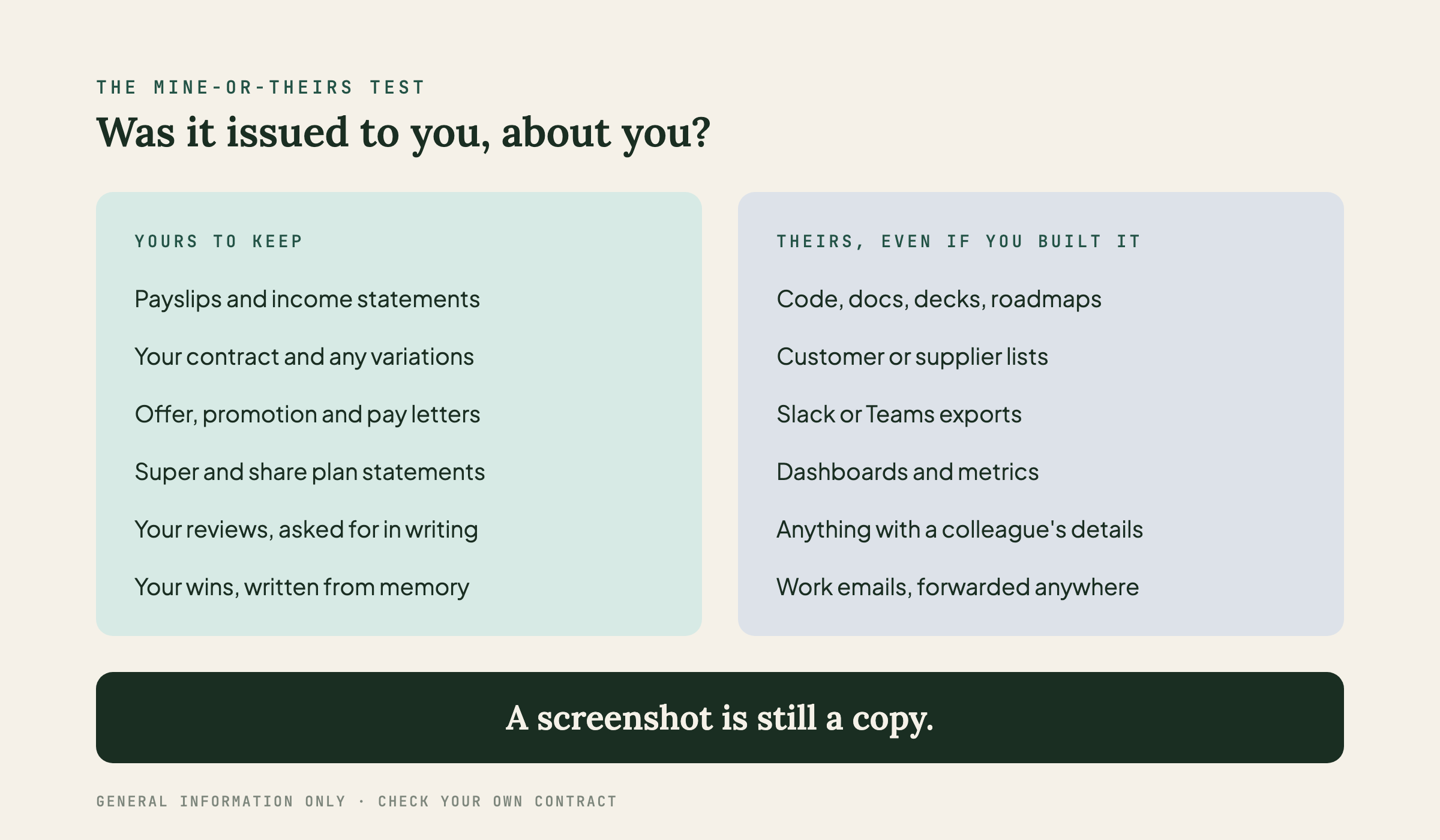
Before you keep anything, ask one question: was it issued to me, about me? Mine = about you, issued to you. Theirs = everything else, in any format.
Yours to keep:
Payslips and your last group certificate or income statement
Your employment contract and any variation letters
Your offer letter, promotion letters and pay review letters
Your super statements and any share plan statements in your own accounts
Your own performance reviews. Ask HR for copies in writing, so the request is on the record.
Theirs, even if you built it:
Code, docs, decks, roadmaps
Customer or supplier lists
Slack or Teams exports
Dashboards and metrics
Anything with a colleague's personal details on it
A screenshot is still a copy.
So how do you keep your wins without taking their data? You write them down from memory, tonight, on your own laptop. If it comes from your head, it's yours. If it comes from an exported dashboard, it's theirs.
You might be thinking: "But my performance numbers are about me. Can't I forward those?"
The court in that WA case looked at exactly this argument. It decided that internal emails aren't part of your employee record. "It's about me" isn't a licence to keep work email threads. Ask HR for your reviews in writing, and write the numbers down from memory.
Here's a filled-in example of one line (illustrative):
Rebuilt the payments retry service with two other engineers over one quarter. Failed checkouts dropped from roughly 4% to under 1%. Owned the rollout and the on-call runbook.
No customer names, no internal figures you'd need a dashboard to check. Rough numbers you remember are fine, because you'll be asked to explain them in an interview anyway.
What you should see: by the end of the week, a single document on your own laptop with five to ten lines like that one, plus a folder of your payslips and letters.
Stage 2: The day it lands, and the legal clock
You'll usually get a meeting, a letter and a date.
Don't sign anything in the room. A deed of release is a document you sign. It usually gives you extra money, and in return you give up your right to make a claim. Take it home. Ask how long you have to sign it.
The 21-day window. If you think the redundancy isn't genuine, you have 21 days from your last day to make a claim with the Fair Work Commission. It can be an unfair dismissal claim or a general protections claim. A redundancy is genuine when the job itself is no longer needed. The company must also have consulted you if your award required it, and it must not have been reasonable to move you to another role in the company. Unfair dismissal claims have an income limit of $190,100 from 1 July 2026. That limit doesn't apply if an award covers you. If you work at a tech company and have a relevant degree or equivalent experience, you may sit under the Professional Employees Award, whatever you earn. The award excludes roles that are mainly managing people. It also generally doesn't cover IT staff at banks or retailers. To claim unfair dismissal, you also need at least six months' service (12 months at a small business). General protections claims have no income cap.
What you're owed, at minimum. Under the National Employment Standards:
Years of service
Redundancy pay (minimum)
1 to under 2
4 weeks
2 to under 3
6 weeks
3 to under 4
7 weeks
4 to under 5
8 weeks
5 to under 6
10 weeks
6 to under 7
11 weeks
7 to under 8
13 weeks
8 to under 9
14 weeks
9 to under 10
16 weeks
10 or more
12 weeks
Yes, it really does drop at 10 years. That's in the law.
Notice is on top of that: one to four weeks depending on service, plus one more week if you're over 45 and have at least two years' service. Small businesses (under 15 employees) don't have to pay NES redundancy pay. Many tech companies pay well above the minimum. Canva, for example, publicly committed to at least six months' pay, with the legal minimum counted inside that. So check your contract as well.
The tax. A genuine redundancy payment has a tax-free part. For payments from 1 July 2026, that's $13,598 plus $6,801 for every complete year of service (ATO). The amount above that is taxed at 32% if you're under 60, up to a yearly limit. Unused annual leave paid out on a genuine redundancy is also taxed at 32%. No super is paid on the redundancy amount or unused leave, so don't wait for it. Pay instead of working your notice is different: super is paid on that.
If you're looking at your final pay thinking "32% on my leave? That sounds like a lot," it's not as bad as it looks.
If you earn over about $135,000, 32% is less than your normal top rate, so it works in your favour. Below about $45,000, it can be more than you'd normally pay, and the difference comes back at tax time. In between, it's about the same as your normal rate.
A worked example (illustrative): six complete years of service means the first $13,598 + (6 × $6,801) = $54,404 is tax-free.
Shares. Leaving a job hasn't triggered tax on employee shares since July 2022. Shares you haven't received yet (unvested RSUs) usually disappear on your last day, unless the company says otherwise. Read your plan rules, because some companies hand over some or all of them early in a redundancy.
Centrelink. Lodge a JobSeeker claim in your first week, even if a big payout means a wait before payments start. Lodging early stops extra weeks being added to that wait. JobSeeker isn't available on a 482 visa.
The mortgage. If you have one, you can ask your lender for hardship help. They have to respond in writing within 21 days.
The 482 visa clock. If you're on a 482 visa and your job ends, you have up to 180 days to find a new sponsor, get another visa or leave. You can generally work for other employers during that time. You get up to 180 days at a time, and 365 days in total across the visa. Your employer has to tell Home Affairs within 28 days. Talk to a registered migration agent in your first week. For the search itself, our 482 visa guide covers who actually sponsors and how to frame your application.
What you should see: by the end of the first week, the deed read, and signed or questioned. A JobSeeker claim lodged. And every date on one page: your last day, the 21-day deadline, the deed deadline, and the 180-day date if it applies.
Stage 3: The first two weeks, and the market clock
The two-week sheet
When a company lets people go, someone usually starts a spreadsheet. Your name, your email, the role you want. It gets passed around. It reaches recruiters, recruitment managers, and sometimes hiring managers, depending on the company. Former managers and colleagues start referring people straight from it.
You might be worried: "Won't being on a layoff list make me look like one of the weaker ones?"
Everyone on that sheet lost a role in the same cut, and everyone reading it knows why it exists. Recruiters open it because they have roles to fill and it's a list of people who are free to start. Being on it is how they find you.
And if you're thinking "Nobody's started a sheet at my company," start one.
Ask a former manager or a well-connected colleague to start it, or do it yourself. The columns in the example below are enough. If it doesn't happen, your own LinkedIn post (Stage 4) does the same job for everyone outside the company.
The two-week sheet = your row × what a company needs that fortnight.
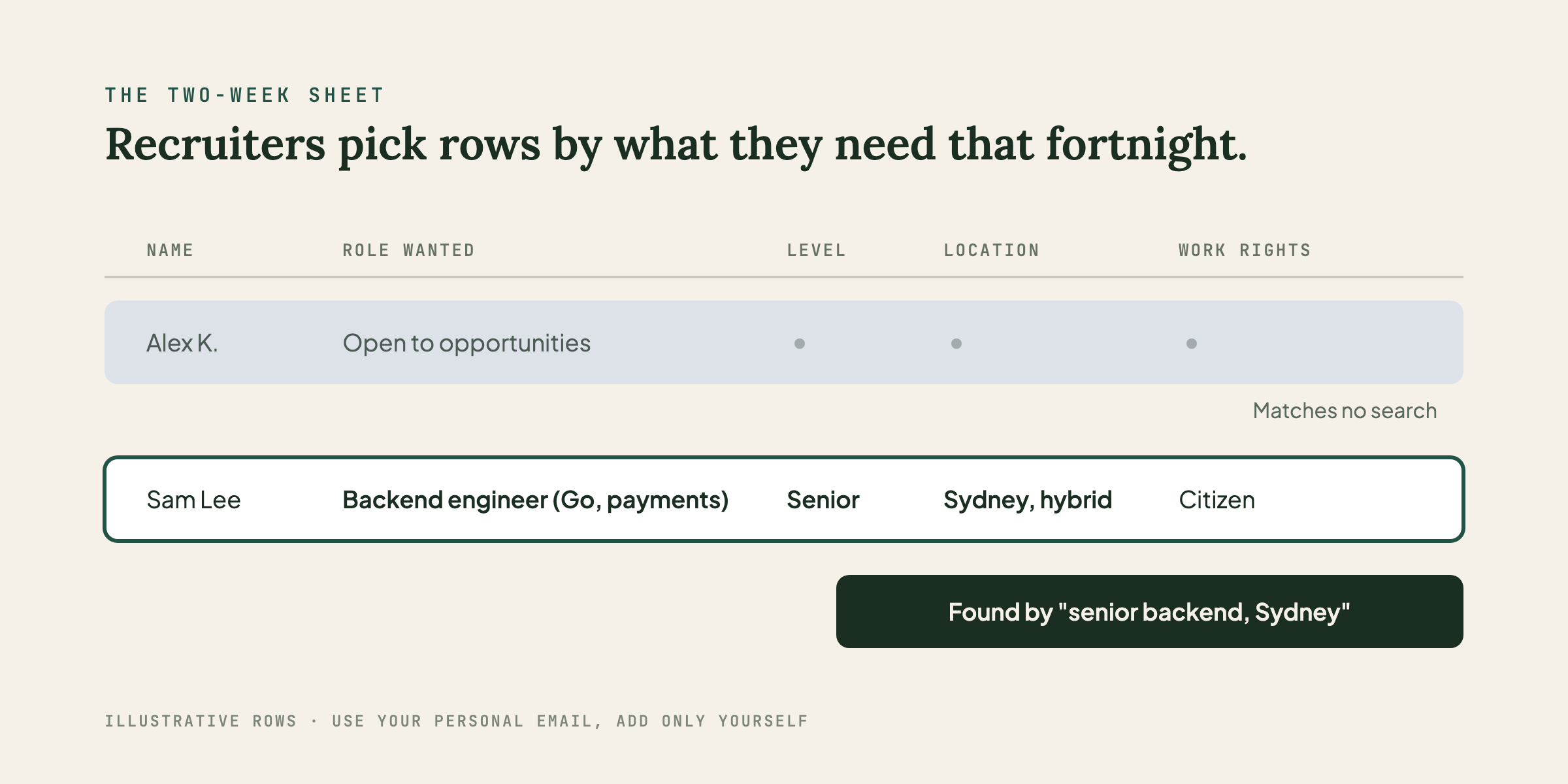
Which rows get picked comes down to demand. A recruiter with an open data engineering role goes looking for data engineers. So write your row in the words a recruiter would look for: the job title, the level, the city. It's the same way recruiters search for candidates on LinkedIn.
A row that says "open to opportunities" matches nothing. Here's the difference (illustrative rows):
Two rules for the sheet:
Use your personal email. Your work email dies on your last day, and every referral sent to it dies with it.
Only add yourself. Putting a colleague on the sheet without asking shares their personal details. It's the same mistake as Stage 1, made with good intentions.
The layoff list covers who reads the sheet, what to write in your row, and how to get picked.
The sheet doesn't wait for your CV.
Say yes to every referral. Stop cold applying.
These two sound like they clash. They don't: the referral comes first, and the application comes last.
When someone says "I've got a role you should look at," don't say no because your CV isn't ready. This is what I tell clients to say:
"Tell me about it. I'm working on my CV right now. I'll send it to you as soon as possible."
A referral puts your name in the room before anyone reads a page. That's why it's worth more than a hundred cold applications. But it always ends with "can you send me your CV?" So the CV has to be ready within a few days.
Cold applications are different. When an application goes into the company's system before anyone refers you, an employee usually can't put you forward for that role any more. And if you're turned down for one kind of role, that no can stay on your record at that company for months. That's why the applications my client sent in his first panic worried me. Each one could have closed off that kind of role at that company. And each one went out on a CV that didn't show who he was.
It's the line I give every client:
Applying is the last step, not the first.
The order is CV ready → the right person found → the referral → then the application.
What you should see: within two weeks, at least one referral conversation started, and your CV in someone's inbox within a day of them asking for it.
Stage 4: The CV and LinkedIn, done in days
The CV has one job this week. In the first few lines, it tells a recruiter what role you're going for, at what level, and with which tools.
The redundancy line. Don't hide it, and don't explain it at length. One line under your last role is enough:
Role made redundant in November 2026 as part of a company-wide restructure.
Everyone reading your CV this year knows what's been happening in Australian tech. If you leave the gap unexplained, a recruiter will guess, and the guess is usually worse than the truth.
The LinkedIn post. One client, after well over a decade at one company, started working with me before his role ended. Early on, he posted a simple "what's next for me" update: what he'd done, what he wanted next, and that he was open to conversations. He interviewed a lot and ended up at a big tech company.
The post does what the spreadsheet does, but for everyone outside your old company.
Open to Work. You can switch it on so only recruiters see it, without the green banner. That way recruiters can find you while you work out what to say publicly.
To check the CV against a real ad, put the ad and your CV side by side and highlight every requirement the top half of your CV doesn't prove. If you'd like help with that part, CV Canvas reads your CV against the exact job ad, requirement by requirement, and marks each one proven, keyword-thin (mentioned but not shown) or not on the page. Run it against one real ad and you'll see how many requirements your CV proves, the same day. Either works.
What you should see: within a week of your "what's next" post, messages or profile views from people outside your old company.
Stage 5: The interview question you're dreading
"Why are you looking?" or "Why did you leave?"
Say the word. "I was made redundant in November as part of a restructure that affected around a fifth of the company." Then move straight to what you want next.
People try to soften it, and the soft version backfires. If a reference check comes back with "Yes, he was made redundant," that's the end of it, unless you told the interviewer something different. Calling it voluntary when you didn't choose it is the version that causes trouble.
The harder follow-up is "Why was your role chosen?" Keep the answer about the cut, because that's what it was. Say how it was made (a whole team, a function, a share of the company), in one sentence, then go back to what you want next. Practise it out loud before your first interview. How to explain redundancy in an interview has two-sentence scripts for a recruiter screen and a panel.
Stage 6: The offer
Two things to check before you sign.
Your old dates. If you're still working out your notice, the new start date has to come after it. On a 482, check the new sponsorship plan against your 180-day date with your migration agent.
The new contract's restraint clause. Treasury released draft laws in September 2026 to ban non-compete clauses (the clauses that stop you joining a competitor) for workers earning under $190,100. It isn't law yet. The plan is for it to start in 2027. If you earn above that line, the ban wouldn't cover you anyway. Read the restraint before you sign, because it's the clause that shapes your next move.
Small businesses. Under 15 employees, there's no NES redundancy pay, and often no spreadsheet either. Your own network does the job the sheet would have done.
Contractors. No redundancy pay and no deed. Your clock is the market clock alone, so start on it from day one.
Dismissed for misconduct. Different rules, different rights. Talk to Fair Work or an employment lawyer first.
It's already week three or later. The sheet has probably gone cold. The referral route is still open: message former colleagues directly, one at a time. How to get a referral walks through that route step by step. The CV, LinkedIn and "what's next" steps don't change.
A role type nobody's hiring. The sheet runs on demand. If nobody needs your role type this fortnight, it won't find you, however good your row is. I don't have a neat fix for that one. The honest answer is the slower route: pick target companies, find the people, and build the referrals one at a time. It takes longer, and it's still the route that works.
The short version
Rumour: keep what's yours, write your wins from memory, forward nothing.
Day one: read the deed, write down every date, lodge JobSeeker.
First two weeks: your row on the sheet, yes to every referral, no cold applications.
Within days: a CV with the redundancy line and a "what's next" post.
Interviews: say "made redundant", then move to what's next.
Offer: check the old dates and the new restraint.
FAQ
How much redundancy pay will I get in Australia?
At least the legal minimum, which goes by years of service: 4 weeks' pay after one year, rising to 16 weeks at nine years, then 12 weeks from 10 years. Notice is paid on top. Small businesses under 15 employees don't have to pay it, and many tech companies pay well above the minimum, so check your contract.
Is redundancy pay taxed in Australia?
Part of it is tax-free. For payments from 1 July 2026, that's $13,598 plus $6,801 for every complete year of service. The amount above that is taxed at 32% if you're under 60, up to a yearly limit.
How long do I have to challenge a redundancy?
21 days from your last day, by making a claim with the Fair Work Commission. Don't sign a deed of release in the meeting. Take it home and ask how long you have to sign it.
What can I take with me when I'm made redundant?
Anything issued to you, about you: payslips, your contract, offer and promotion letters, super and share statements, and your own reviews. Code, docs, customer lists, Slack exports and anything with a colleague's details stay with the company, even if you built them. A screenshot is still a copy.
What happens to my 482 visa if I'm made redundant?
You have up to 180 days to find a new sponsor, get another visa or leave. Your employer has to tell Home Affairs within 28 days. Talk to a registered migration agent in your first week.
Should I start applying for jobs straight away?
Get your CV and LinkedIn ready first, within a few days. The referral spreadsheet that goes around after a layoff stays live for about two weeks, and a referral always ends with someone asking for your CV.