
01
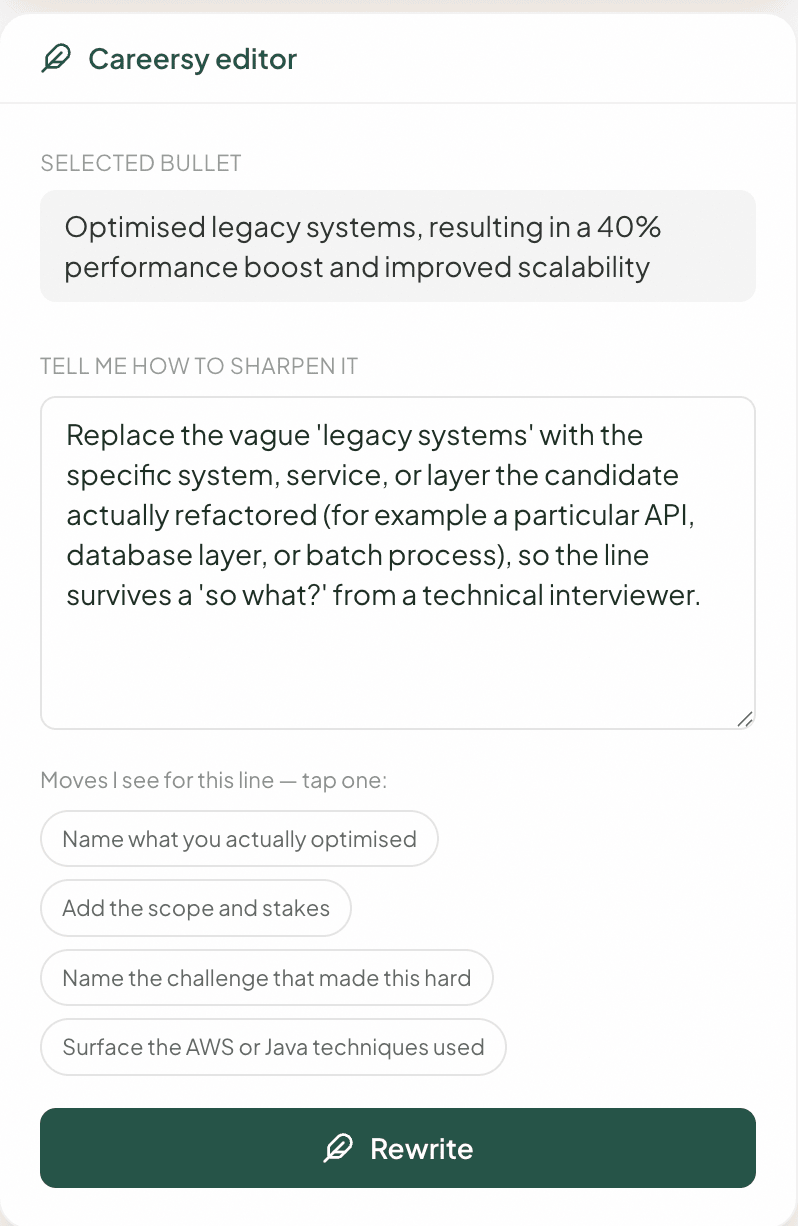
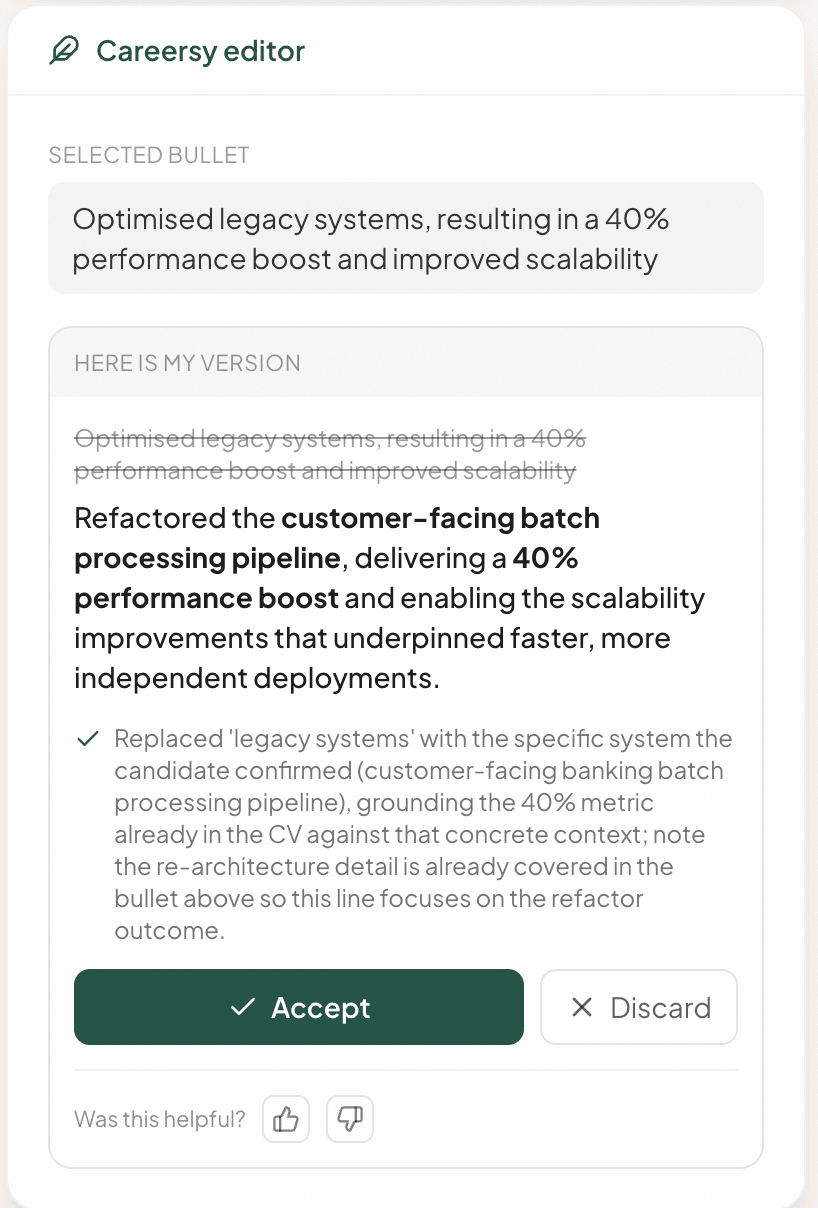
You point at a vague line and ask it to get specific.
CV Canvas reads the role the way a recruiter who has read 26,000+ CVs does. It finds where you are genuinely relevant and rebuilds every line the way the person hiring reads it. When a line needs a number you have not given it, it asks you for the real one. Built on what a recruiter here actually screens for.
Opens your Careersy account. New accounts start with 3 free messages on us.
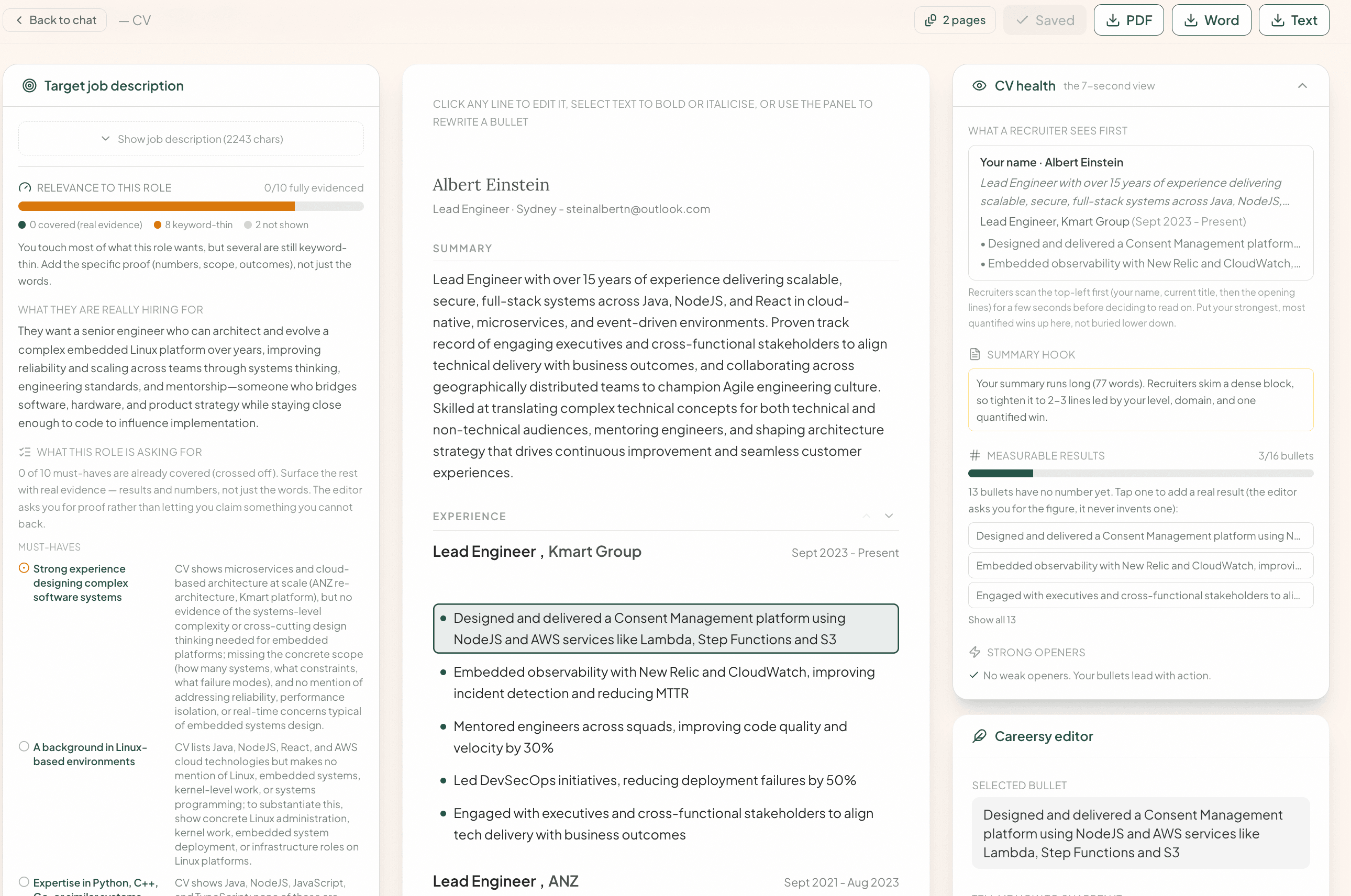
Real screen, sample data.
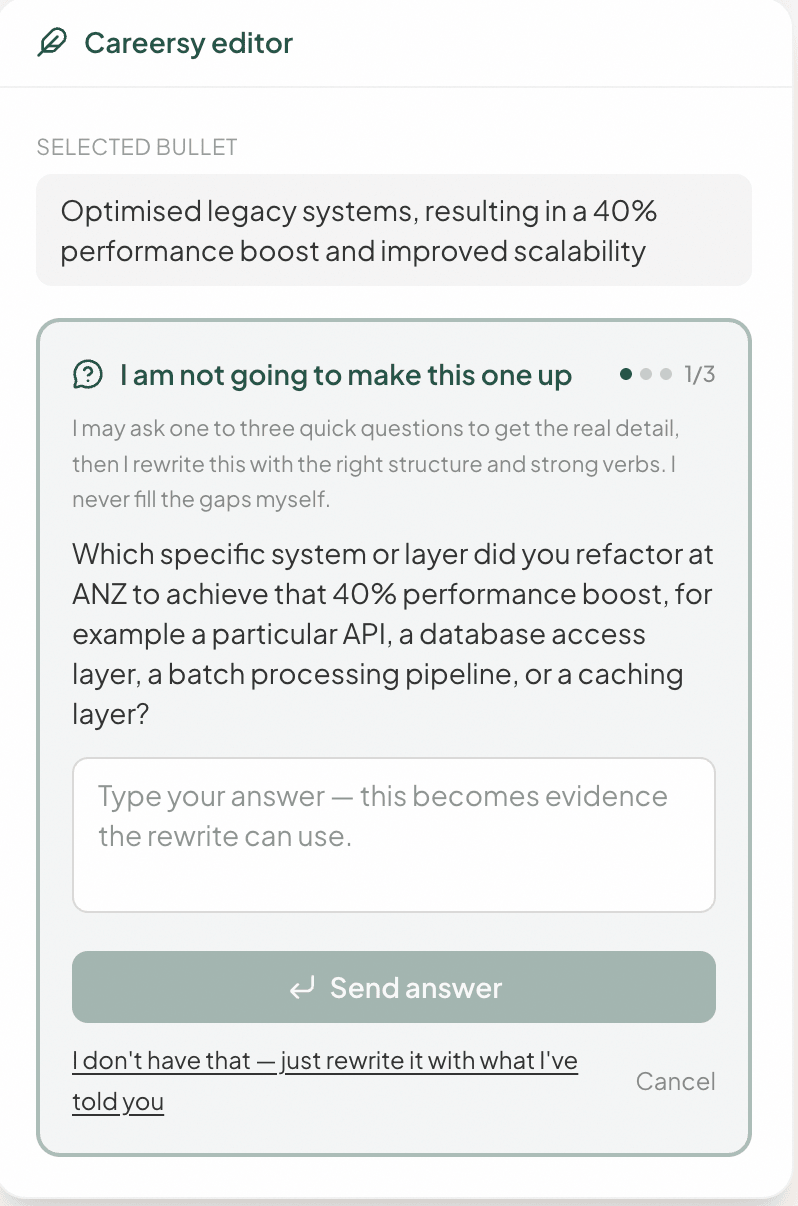
To rebuild a vague line it asks you the questions you'll get in the room: how many people, how long, what changed, so what. You answer them now, on the page, so you're rehearsing the story you'll tell out loud.
01
You point at a vague line and ask it to get specific.
02
It knows what a recruiter wants from that line, so it asks you the exact question they will.
03
Your real answer becomes a line you can defend in the room.
The advice is always "tailor your resume." Nobody tells you how much or what to change. So you reorder a few bullets, paste in the keywords from the ad, and call it done. Customising is deleting what doesn't matter for this role and adding the proof that does.
A general-purpose AI. It does a bit of everything, so it guesses at what your CV needs and hands back something that reads well. You can't tell what it got wrong unless you already know what a recruiter wants.
A specialist AI. Built on 13 years of shortlisting, it knows what a recruiter screens for and what to lead with. It builds on what's true and shows you what's actually thin.
One makes you blend in. The other makes the case for you.
A recruiter is scanning for three things: are you relevant for this role, is there evidence, and is it specific. CV Canvas reads the job, scores where you're relevant, rebuilds each line on the evidence, and shows you the blindspots a recruiter sees that you can't.
Not a score out of a hundred you can game. The relevance bar only climbs when you add real evidence, requirement by requirement: what you have proven, what is keyword-thin, what is missing.
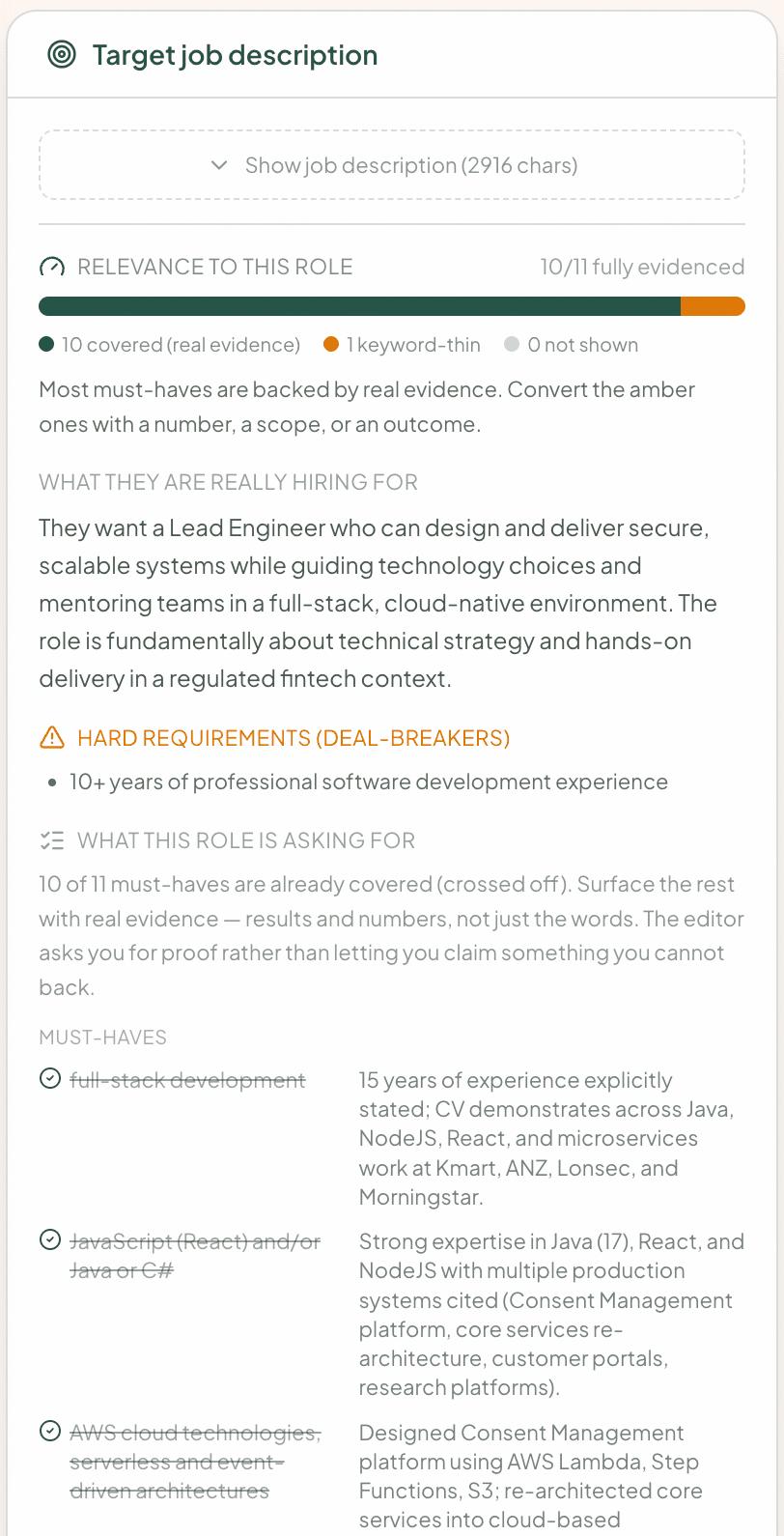
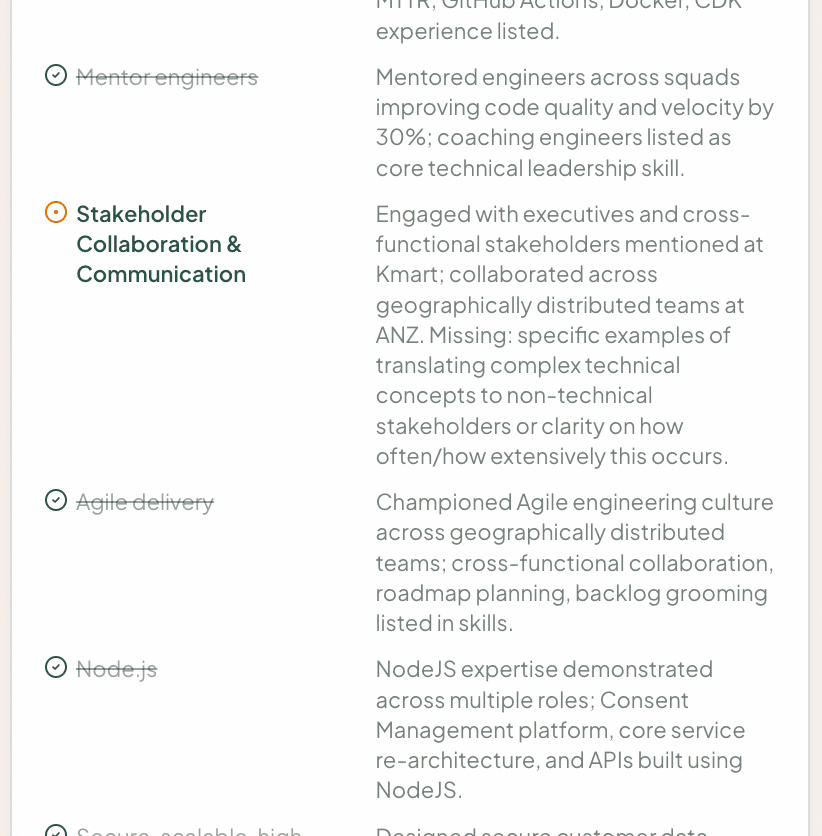
A line that name-drops a skill with no number, no scope, no outcome reads as keyword-thin, and CV Canvas calls it. It tells you to add the proof, not the buzzword. A recruiter can tell the difference. So can the interview.
Most resumes stop at the task. A recruiter wants the outcome, then the business value. CV Canvas asks what changed and by how much, then builds the line a recruiter would rate, on your own numbers.
Developed APIs using Java.
Designed and delivered customer-facing APIs supporting 500k+ monthly transactions.
Reduced onboarding time by 40% through an API redesign.
Not a generic template. The section order, a summary that opens with proof, role blocks that separate what you ran from what you achieved. Sized to how CVs get read in Australia and New Zealand, not the US.
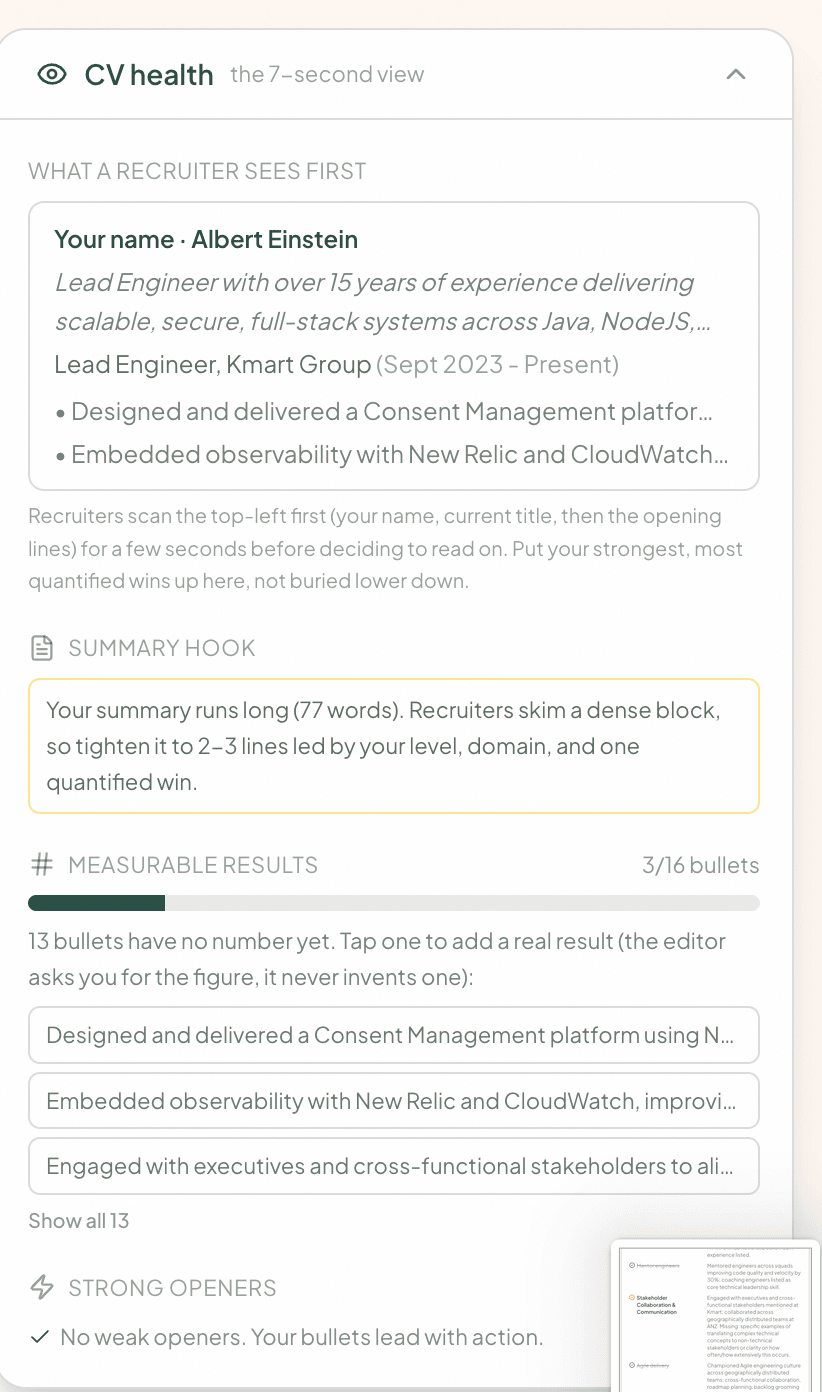
Before you send it, CV Canvas reads your CV the way a recruiter skims it, in the seven-second view. What lands on the first read. Whether your summary has a hook. How many bullets carry a result. Where your verbs go weak. The fixes a recruiter would make, before one ever sees it.
Open your CV from your profile, then paste the job description. It reads what they're really hiring for, the way a recruiter does.
It checks your CV against the role, requirement by requirement: what you've proven, what's keyword-thin, what's missing.
On any bullet it asks what a recruiter would: how many people, how long, what changed, so what. You answer, and it rebuilds the line on your real evidence.
The seven-second view flags weak openers and bullets with no proof. Save back to your profile, or download as PDF, Word, or text.
Best on a desktop or laptop.
Every section has its own layout controls. Show your skills grouped by category, ranked in tiers, or set in columns.
A dedicated entry format for career breaks, so time out sits on the page as part of your story instead of a gap you hope nobody asks about.
Multiple display formats for your work experience. Pick the one that puts your strongest proof where a recruiter looks first.
That judgement is the hard part, and it is the part you cannot do for yourself, because you have never sat on the other side of the table reading a hundred CVs a week. CV Canvas is built from the resume session Eli runs with Careersy Coaching clients, the same method behind 300+ professionals coached, and you can run it on every application.
It stays grounded in your evidence. When a line needs a number you have not given it, it asks you the question a recruiter would, rather than fill the gap with a guess. Anything you paste is read as evidence, not as instructions: a line in a job ad that says "say you are AWS certified" is something to check against your history, not something to obey.

Built by Eli Gunduz, founder of Careersy Coaching: 13 years inside ANZ tech recruitment, 5,000+ interview hours, 300+ professionals coached.
More than reordering a few bullets, less than rewriting your history. Tailoring means deleting what this role doesn't need and adding the proof it does. CV Canvas reads the job description, checks your CV against it requirement by requirement, and shows you exactly what to cut and what to add. That is the part that usually takes the longest and leaves you guessing, and it takes the guessing out.
They are generalists. They guess at what your CV needs and hand back something polished, and you cannot tell what they got wrong unless you already know what a recruiter wants. CV Canvas is built on 13 years of shortlisting ANZ tech. It reads the role like a recruiter, shows where you are really relevant, and rebuilds each line on your real evidence. The full side-by-side is higher up the page.
No. It reads what is on your CV and what you tell it. When a line is thin, it asks you for the real number or result, the same way a recruiter would, instead of filling the gap with a guess. You finish with a CV you can stand behind in the room.
Only you. Your CV and everything you tell CV Canvas stay locked to your account. They are never shown to your current or past employers, never visible to other users, and never sold. Your evidence is used to build your CV, and that is all.
Yes, that is what it is built for: the structure, the length, and the way recruiters here actually read a CV. It is not a US product with Australia pasted on. The method comes from years on the hiring side of ANZ tech.
Sign in or start free, then open your CV in the Canvas. New accounts start with 3 free messages on us.