To prepare for a job interview, ask the recruiter what the round is testing. Pick three examples from your own work that fit it. Have an AI ask you hard follow-up questions about each one, and don't let it rewrite your answers. Say your opening answers out loud. Then ask questions that get a real example back.
Last updated 5 October 2026. Every source below was checked on 5 October 2026.
In a recent mock interview, a client answered a behavioural question well. The lesson at the end was good, and almost nobody does that unprompted. I still marked the result as vague. "The whole team started using the pipelines" has no number in it, and the panel can't write that down.
That's the thing most candidates never hear. I've spent 13 years on the hiring side of tech in Australia and New Zealand, and the panels I've sat on already believe your team got things done. They're marking whether they can trust your judgment when things go wrong, and they can only mark what they can write down. Below are the six steps I run with clients before an interview, with the prompts to paste into Careersy AI, or into any AI tool with web search.
Here's the whole prep in one table, then each step in order.
| Step | What you do | How you know it's done |
|---|
| 1. Ask the recruiter | Find out what the round assesses and when you'll hear back | You can say whether it tests level or technical depth |
| 2. Research | Run one Deep Research report, then read your interviewers' own words | You can name the one problem the role is hired to fix |
| 3. Stories | Pick three, and run each through the level test, the data check and the follow-ups | Each has a number for the problem, the data source and the result |
| 4. Openers | Write answers to the five opening questions, three of which need real work, and say them out loud | You get through each three times in a row without notes |
| 5. Mock round | One round, with a retry on the weak layer | Each answer runs two to four minutes, lesson included |
| 6. Your questions | Prepare three or four that ask for evidence | Each one gets you something other than "someone left" |
How are interview answers scored in Australia?
In Australia, public-sector panels score every candidate on a common rating scale and decide by consensus from their notes. At larger tech companies, in my experience, a structured interview works the same way: each interviewer grades every answer against a written rubric.
Then the panel decides from the written notes. At a startup it often runs more on gut feel, from what I've seen. Google's own hiring guide says it often documents "what a poor, borderline, solid, and outstanding answer would cover". It also encourages interviewers to "take detailed notes of applicant responses, so they can later be reviewed throughout the hiring process" (checked October 2026). Amazon's hiring page (an undated page) says a Bar Raiser sits on the loop. That's a trained interviewer, usually from outside the hiring team. They provide written feedback and make sure every member of the loop takes part in the discussion (checked October 2026). The NSW Public Service Commission's recruitment guide tells assessors to use a common rating scale and take thorough notes. It also says to keep the notes, and to decide by consensus after each assessor explains their reasoning (August 2025). That's the public sector, but it's the clearest published description I found of how this works here.
Then, in my experience, the panel talks it through together, working from what's written down. So an interviewer who liked you but wrote nothing concrete has nothing to argue with in that room. Sometimes I hear feedback about a candidate who doesn't get through. It's a version of this: "I really like them, I think they can do the job, but I didn't get the evidence." From what I've seen, panels sometimes record or transcribe the round, with your consent, and some have an AI taking notes. That's more evidence on you than a panel had a few years ago. Canva's how we hire page says interviews may be recorded and transcribed using AI. That lets interviewers focus on getting to know you instead of only taking notes (undated page, checked October 2026). Every answer you give has one job: hand them something to write. That means the size of the problem, the call you made and why, the number that changed, and the lesson.
A positive story with a good number usually lands in the middle of that scale. In my experience on panels, what lifts it is the struggle you name, the trade-off you state, and the lesson you offer before they ask.
Step 1. What is this round for?
Before the interview is booked, ask the recruiter two things. First: "What is this round assessing? Is it level, or technical capability?" Second: "When will I hear back, and is it fine to follow up if I don't?"
The first question decides which story you bring, because the story has to be the right size for the round. From what I've seen, hiring panels sometimes turn down a candidate for a principal role instead of offering a level down. The reason is often the example: it was the wrong size for the role, so it didn't show what the level needs.
The second question means you're not waiting on a silent inbox. You've agreed when you're allowed to chase.
Step 2. How do you research the company and your interviewers?
Open Careersy AI and choose Interview Preparation. Turn on Deep Research (the binoculars button next to the message box). Then paste this in:
Prompt
I'm interviewing for this role: [paste the job ad]. Research the company for the interview. Find what the company and its leaders have said publicly in the last year: results, launches, funding, leadership changes, what they've said about how they work, and anything candidates have reported about the interview process for this kind of role.
Quote their own words where you can, give me the source and the date for each, and tell me the one problem this role is most likely being hired to fix. Only use what's in your search results. If you can't find something, say so.
Give it a minute or two. A Deep Research report counts as 3 of your free messages, so run this one once and keep the result. Without Deep Research on, it can't search the web. Treat what comes back as a reason to look closer, and check anything you'd repeat. Read the job ad yourself too. A line like "bring order to the platform" is the company telling you what's broken right now.
On our made-up company, the report ran five chapters from ten sources, and the first one was an identity check. It said it couldn't verify the company from public sources, and it listed similar names to rule out. That's what you want from a research tool: it tells you when it can't find something, instead of inventing a company.
Now ask the recruiter for the names of your interviewers. That's a normal request. For each one, read their last ten LinkedIn posts and any talk or article they've put their name to. If someone has written down how they think about their work, make that the frame of your answers. They score your story against the picture of the problem they already have in their head, and that person has told you what the picture is.
A client of mine worried that his workflow project wasn't an AI story. One of his interviewers had published a set of building blocks for rolling out AI that put people first. Inside that frame, his project became directly on-topic. Nothing was made up. The frame changed which of his true stories counted.
If one interviewer has published something, turn Deep Research off and send this in the same chat:
Prompt
One of my interviewers is [name], [title] at [company]. Here's what they've published: [paste the post, talk summary or article]. Tell me what they seem to care about most in their own words, and which of my stories would land best inside that frame. Here are my story titles: [paste your story bank titles]. Pick from my stories only. Don't invent one, and don't suggest I quote their post back to them.
This only works when the person has really written or spoken about their work. Reading their job titles and nothing else doesn't count.
Step 3. How do you pick three stories and test each one?
You need a story bank first: six or seven stories from your own work, each written as a decision you made. If you don't have one, build it with how to use AI in your job search without faking it as the ground rules, and come back.
Pick three stories for this round. They should match the themes in the job ad and the level the recruiter told you in step 1. At least one is spicy: something went wrong, and you were in the middle of it. Then run each story through three prompts in Interview Preparation, Deep Research off, with your CV attached.
First, the level test. This is the check that would have saved the candidate in step 1:
Prompt
Here's an interview story: [paste your story]. I'm targeting [target role]. Tell me honestly whether this reads as an individual contributor story or a leadership one. I want to know how many people it affected, whether I moved anyone I don't manage, and whether that is enough for the level I'm going for. If it's too narrow, say so plainly and tell me what kind of story I'd need instead. Don't soften it.
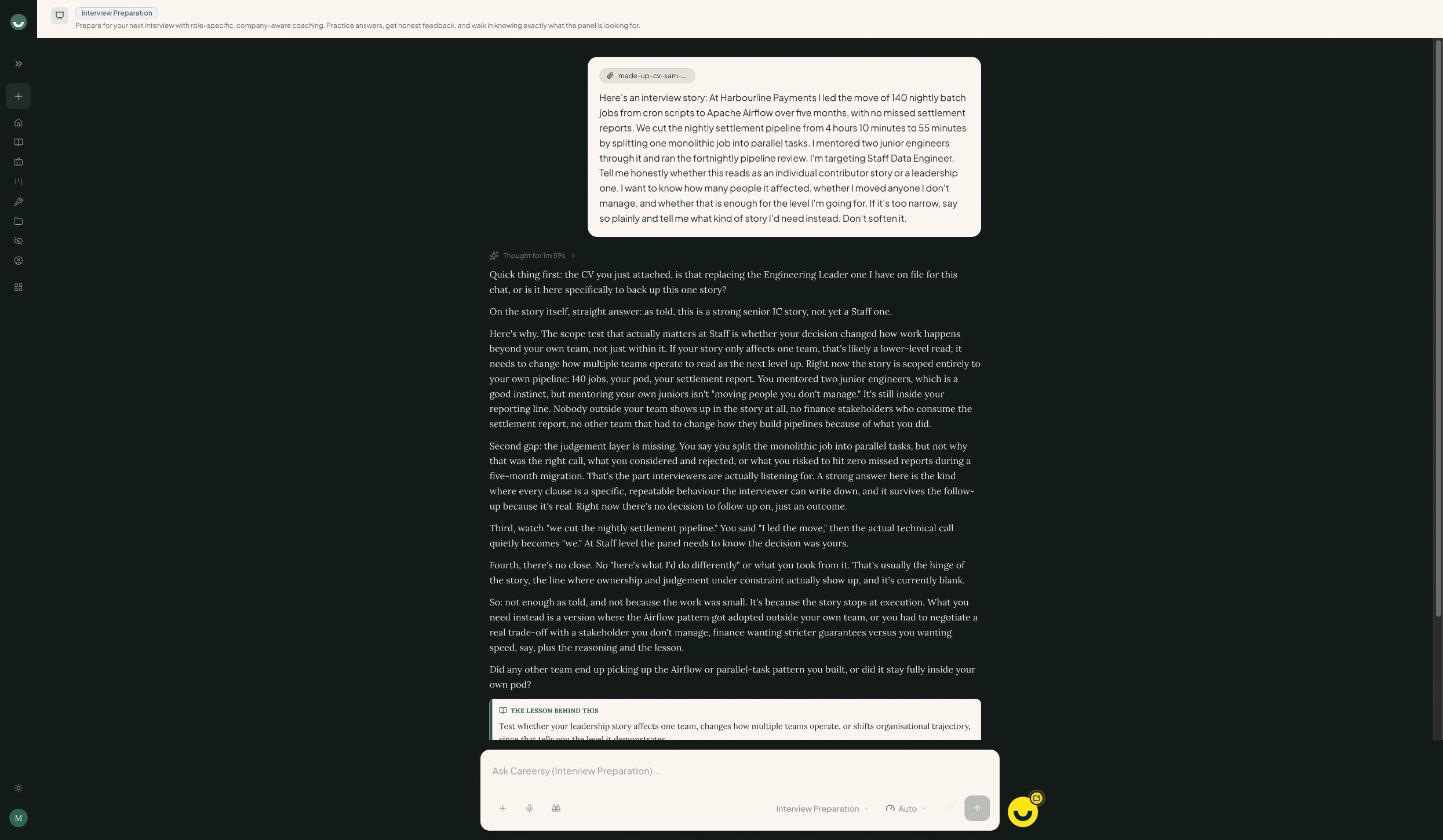
In most sessions I run, one habit shows up: "we". When you say "we", the interviewer can't tell what you did, and at senior level that's the thing they're marking. Say "I" for your decisions and "we" for what the team did.
Then the data check. At senior level and above, every story needs three numbers, and the second one is the part almost everyone skips. Here's each one, using the made-up pipeline story in the screenshots below:
- How big the problem was: "About three of our 140 nightly jobs failed every week, and someone reran them by hand before the 7am settlement report."
- Where the data came from: say it in one clause, like "I pulled the failure counts from the scheduler logs for the last three months" (an invented example)
- What the numbers showed: "The nightly run dropped from 4 hours 10 minutes to 55 minutes, with no missed reports in five months."
"The whole team started using it" is a result nobody can write down. "Six engineers, about five hours a week each" is. If all you have is a headcount, turn it into hours. Say five people spent two hours a day on manual checks. That's ten hours a day and fifty a week, a number a panel can write down.
Prompt
Here's an interview story: [paste your story]. I'm interviewing at [principal / director / head-of] level. Check it for three things: does it open with how big the problem was, does it say how I got the data, and does it say what the numbers showed. Tell me which of the three are missing, and ask me for what's missing rather than filling it in yourself. Don't estimate or invent any figure.
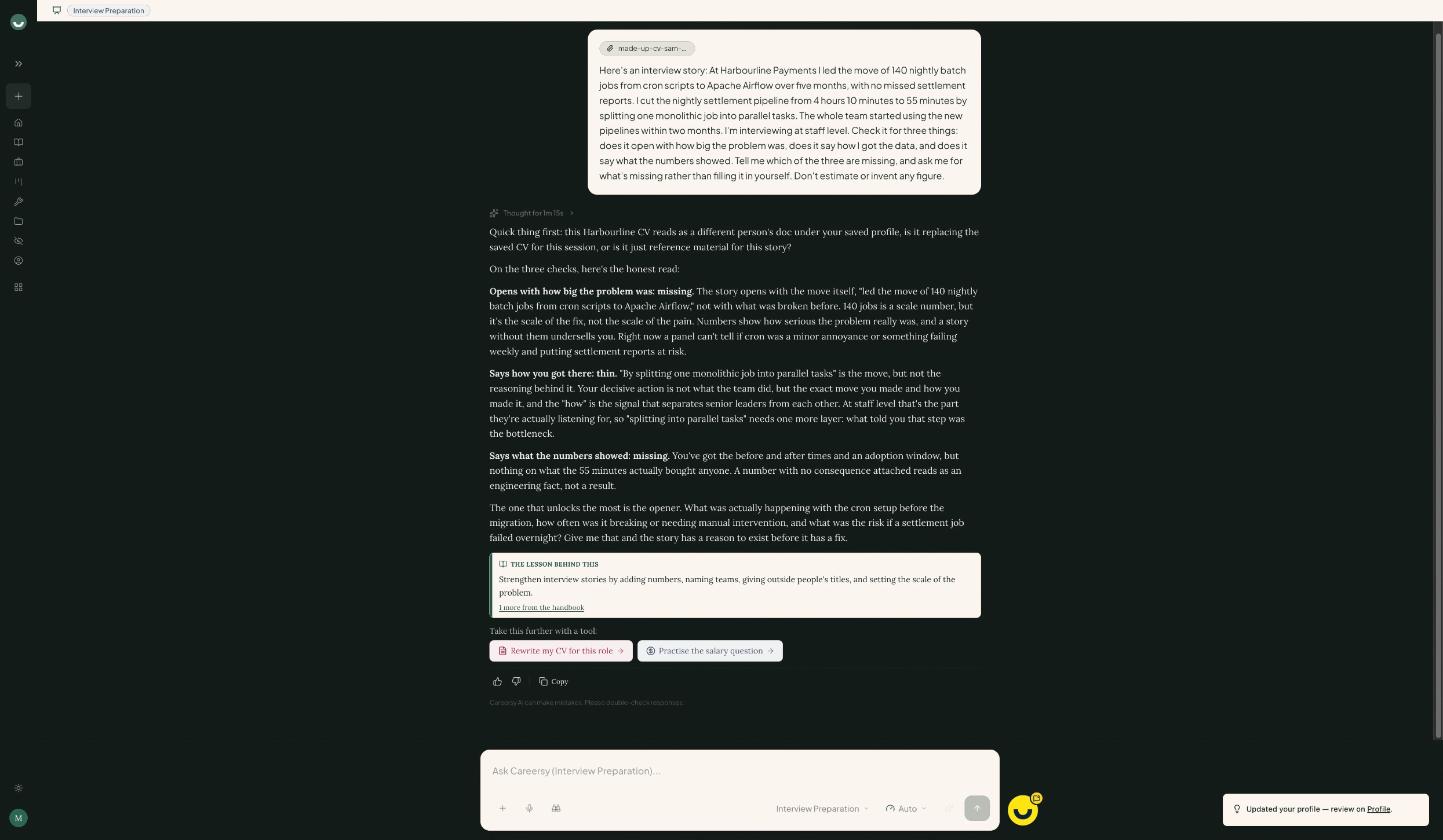
Then the hardest follow-ups, because a panel will dig underneath the story: which option you turned down, who could have overruled you, and what the data showed.
Prompt
Here's one of my interview stories: [paste your story]. I'm a [your role] at [your level], interviewing for [target role]. Act as the hiring manager and ask me the five hardest follow-up questions a panel would actually ask about this story. Ask them one at a time and wait for my answer before the next one. Don't rewrite my story, and don't add any facts I haven't given you. If something important is missing, ask me for it rather than filling it in.
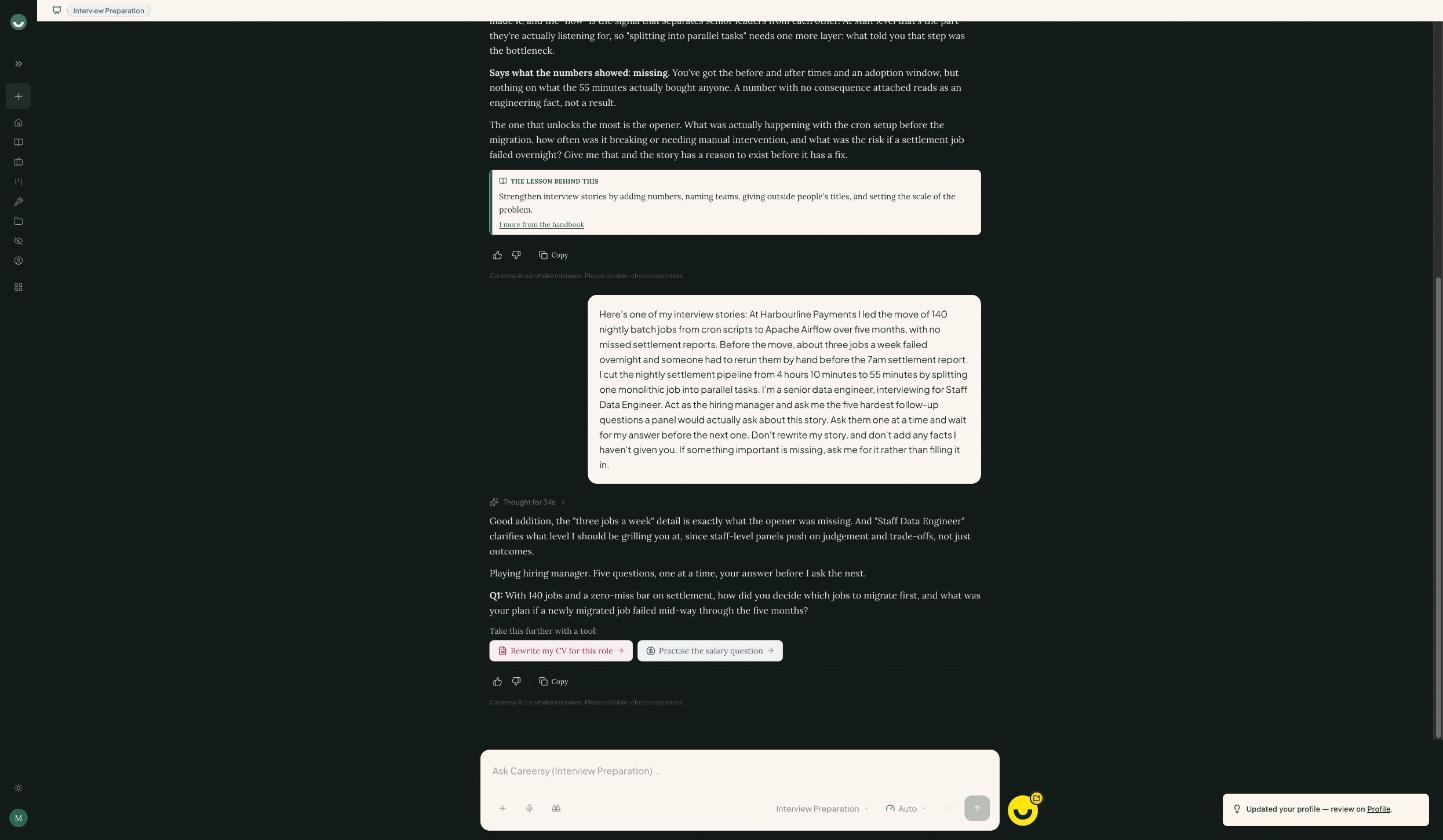
Notice the direction. Every prompt makes the AI ask and you answer. Most advice online runs it the other way: paste your notes, ask it to tighten your answer and add measurable outcomes. That hands you a number you can't back, and it falls apart on the first follow-up in the room. Answering its questions is also your first rehearsal. Tap the microphone and talk your answers through. I find clients give far more detail speaking than typing, and speaking is the skill you're about to be tested on.
How do you use AI to prepare for a job interview?
Use AI as the interviewer. It asks, you answer, and the prompt tells it not to add a fact you haven't given it. Every prompt in step 3 is built that way. Ask it for the hardest follow-up, the missing number or the weak layer, then answer out loud. Don't ask it to tighten your answer or add measurable outcomes, because a figure you can't back falls apart on the first follow-up in the room.
Step 4. How do you prepare for the opening questions?
Write one short answer to each question recruiters open with, then say each one out loud until you can get through it three times without notes. Almost every process opens with the same questions: why are you looking, what are you looking for, and tell me about yourself. Recruiters add two more: how many processes are you in, and what's your notice period. Write an answer to all five, but only three need real work: why you're looking, what you want, and tell me about yourself. The other two are facts. All five feel like warm-up, and all five are scored. Nobody has any technical evidence on you yet, so in my experience they read your level off one thing: how certain you sound about your own next move.
In Interview Preparation, send this:
Prompt
Help me prepare for the first recruiter call. Ask me, one at a time, the five questions recruiters open with: why I'm looking, what role I want, how many processes I'm in and at what stage, my notice period and when I could start, and tell me about yourself. After each answer, tell me how it would read to a recruiter screening for [target role], and give me a version that says the same thing in fewer words. Keep anything I haven't told you as a [placeholder]. Don't write my reasons for me.
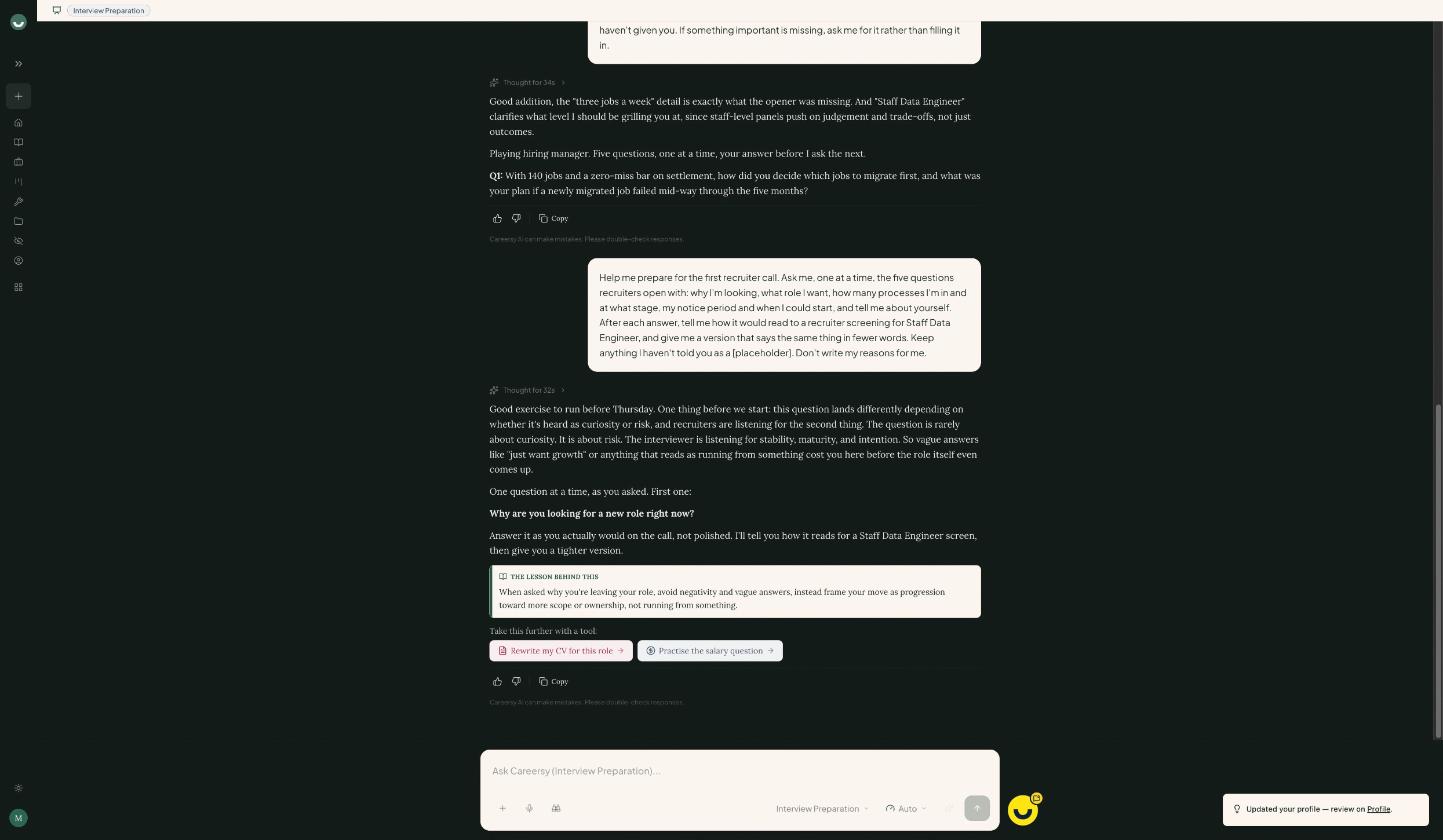
Say each opener out loud until you can get through it three times in a row without looking at your notes. Fluent means you can say it without notes. A recited paragraph sounds recited.
Two rules for "tell me about yourself". Give your current scope and what you specialise in, in three or four sentences. Don't tour your history, because that comes up later and the tour spends your opening on material nobody asked for. And if your reason for looking is a word like "scale" or "growth", find the number underneath it: how many customers, how big a market, how large a team. A vague reason is what hesitation sounds like.
Step 5. How do you run a mock round?
Run one mock round in a new Interview Preparation chat, with your three stories pasted in. Send this:
Prompt
Run a mock interview for this role: [paste the job ad]. It's a [behavioural / hiring manager / panel] round at [level]. Ask me one question at a time and wait for my answer. After each answer, tell me which of my stories fitted best, which layer was weak (the size of the problem, the decision and why, the result in numbers, or the lesson), and have me try again before you show me a full model answer. Here are my stories: [paste your three stories].
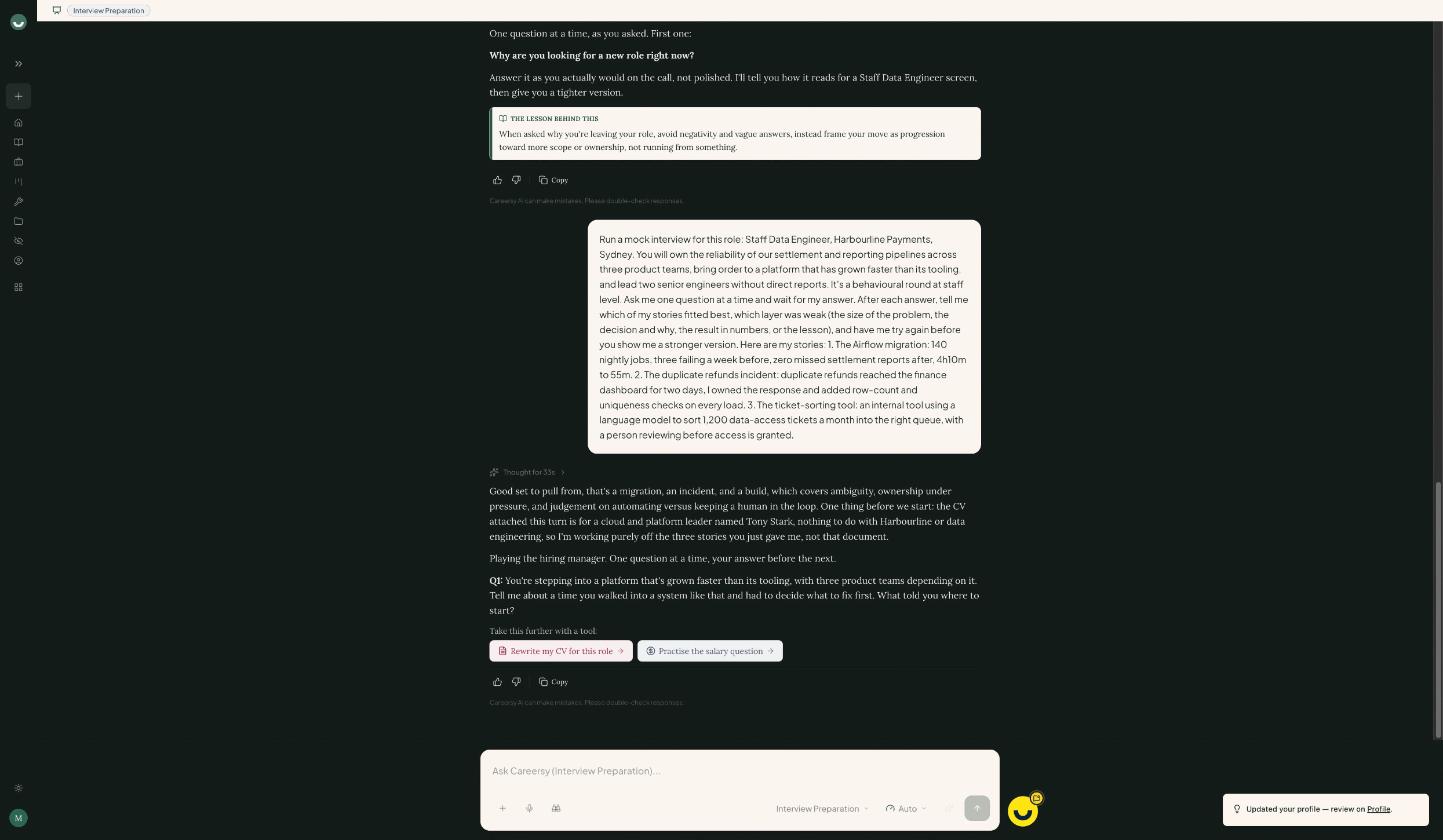
In that run, the attached CV belonged to a different saved test profile. Careersy AI said so and worked only from the three stories I'd pasted, which is what you want it to do. If your own profile holds an older CV, check what's attached before you start.
Keep each answer to two to four minutes, lesson included, and cap what you did at three actions, because the panel can't capture five. The panel is writing while you talk, and if you speak too fast or pile on detail they can't capture it, so it can't be assessed. If a question is broad, you're allowed one clarifying question before you answer: "What exactly do you want me to focus on here?" When I offered a client that choice in the same mock, he asked what exactly I wanted, and I said "well done". Answering a question you've misread costs more than the ten seconds it takes to check.
Close every story on the lesson, in one line, before they ask. From what I've seen over the years, fewer than one candidate in a hundred does this unprompted. Canva's own hiring page recommends the STARR method, where the last R is "Results & Reflection", the key takeaways (Canva). But a good lesson doesn't rescue a vague result. Get the number in first, then the lesson.
Step 6. What should you ask at the end of an interview?
End with questions that ask for evidence, because your questions get scored too. They come back in the written feedback as a judgment on how you think. So before you write one down, ask yourself what the answer actually gets you. "Why is this role open?" gets you "someone left", which is true and useless. Skip "what's the culture like?" and "what's this role expected to deliver in the next twelve months" too. In my experience, nobody on the panel can answer them with anything you can use.
Ask for evidence, not philosophy. A good question gets you a specific thing that happened. A bad one gets you an opinion or a one-line answer. Two that work on anyone in the hiring team:
"Who was the last person promoted internally on this team, and what path did they take?"
"Tell me about a recent decision where the team had to make a real trade-off. What did you choose, and why?"
If the interviewer is your hiring manager, ask about the manager. This is one I gave a senior engineer recently, who wanted to know what the next level looks like under this person:
"How do you help high achievers in your team go from one level to the next? What are some practical things you do with them?"
Listen to how they answer. One client's read, which I think holds up: a leader gives you a specific example of something they did for someone, and a manager gives you a general statement. And while they answer, they're picturing someone who thinks about growth.
In the first two minutes of the interview, say: "I've got a few questions when it suits you." Then let them pick the moment. Prepare three or four questions you actually want answered, and ask the one or two that fit the conversation.
Your prep sheet
Copy this into your own doc and fill it in before the day.
| What | Your answer | Done? |
|---|
| What is this round assessing: level or technical? | | |
| The one problem this role is being hired to fix | | |
| Interviewer names, and what each has published | | |
| Story 1, with its number and lesson | | |
| Story 2, with its number and lesson | | |
| Story 3 (the spicy one), with its number and lesson | | |
| Why I'm looking (with the number underneath it) | | |
| What I'm looking for | | |
| Tell me about yourself (current scope, three or four sentences) | | |
| Processes I'm in, and my notice period | | |
| Three or four evidence questions for the end | | |
How you know it worked
Run these the night before:
- Read each of your three stories aloud with a timer. Two to four minutes each, lesson included. If one runs long, cut how you built it and keep why you chose it.
- For each story, say the number that sizes the problem and where it came from, out loud, without looking. If you can't, that's the question you'll be asked.
- Say your three openers into your phone. If you hear "um, I guess" or "I'm open to anything", it isn't decided yet. Decide, then rewrite.
- Read your questions for the end and ask of each one: what does the answer get me? Cut any that get you nothing.
For a second opinion on the whole set, paste your three stories and three openers into Interview Preparation and send this:
Prompt
Grade each of these the way a panel would for a [role] at [level]: poor, borderline, solid or outstanding. For each one, tell me which part is weakest and the one change that would move it up a grade. Don't add any facts I haven't given you.
[paste your three stories and three openers]
Then, the same day as the interview, send the recruiter a short email. Three lines is enough, and you swap the brackets for your own details:
"Thanks for organising today. One part I'd add to: [one part where you could have gone deeper, in one line]. I'm free [days or times] for next steps."
From what I've seen, about nine in ten candidates never send this. In my view it becomes a second piece of written evidence sitting next to the interview notes. SEEK New Zealand's advice is to send it the same day or the day after (SEEK New Zealand, updated 30 September 2026).
If you're getting interviews and no offers, the problem is usually in step 3, and it's fixable. If you're not getting interviews at all, start further back with how to get a referral for a senior tech job. And if the search is wearing you down, here's how to score the part of it you control.
Where this doesn't work
- Live coding, system design and take-home rounds. These test the work itself, not your judgment about past work. The story bank doesn't help here. Practise the actual exercise.
- A one-way video interview with no human on the other end. HireVue, one of the larger vendors, said in its 2024 statement that its AI scores only what the candidate says, against a written scale (HireVue, 2024). Other products may differ, so ask the recruiter what the screen assesses and whether you can opt out.
- Graduate and early-career roles. The level test assumes you've had decisions to make. If you haven't yet, pick stories where you noticed something and acted without being asked, and skip the leadership check.
- An interviewer who hasn't written or spoken anywhere. The interviewer prompt in step 2 needs a real post, talk or article. Job titles alone aren't enough, so skip it rather than guess.
FAQ
How should I prepare for a tech interview in Australia?
Work through six steps in order. Ask the recruiter what the round assesses, then research the company. Run three stories through the level test, the data check and the hardest follow-ups. Then say your three openers out loud, run one mock round, and prepare your questions for the end. From what I've seen, panels at larger tech companies in Australia and New Zealand decide from a written record, so every answer needs a number, a decision and a lesson.
How many stories should I prepare for a behavioural interview?
Keep six or seven stories in your bank, each written as a decision you made. Pick three for each round, matched to the themes in the job ad and the level the recruiter told you the round is testing. At least one of the three should be a story where something went wrong.
How are interview answers scored?
At larger companies, in my experience, a structured interview has each interviewer grade every answer against a written rubric, then the panel decides together from the written notes. Google's hiring guide describes documenting what a poor, borderline, solid and outstanding answer looks like. In my experience, an answer moves up when it names the struggle, states the trade-off, and ends on a lesson.
What questions should I ask at the end of an interview?
Ask for evidence, not philosophy. Ask who was last promoted on the team and what path they took, or about a recent decision where the team made a real trade-off. If you're a senior engineer and the interviewer is your hiring manager, ask how they help high achievers move up a level and what practical things they do.
Can I use AI to prepare for a job interview?
Yes, if the AI asks the questions and you give the answers. Have it grill your story for the size of the problem, where your data came from, and the hardest follow-ups a panel would ask. Don't ask it to rewrite your answer or add numbers, because a figure you can't back falls apart on the first follow-up.
How do I answer "tell me about yourself"?
Give your current scope and what you specialise in, in three or four sentences. Don't walk through your career history in order, because that comes up later in the process. Sound decided, because at this point the interviewer reads your level off how certain you are about your own next move.
Do it with Careersy AI
Every prompt on this page runs in Careersy AI, mostly in Interview Preparation mode. It works out what each stage of a tech interview in Australia and New Zealand is really testing, company by company. Then it drills you on the answers until they land in the room. Don't have it yet? You can start with 10 free messages on us, no card needed, at app.careersy.ai/signup.
If you'd rather do it by hand, that works too. Give a friend your three stories and the job ad. Have them ask you the hardest follow-up they can think of after each one, with a timer running.