How to Prove You Are AI-Native (How to Become AI-Native, Part 2)
Eli Gunduz··14 min read
Share
What we changed since publishing (4 edits)⌄
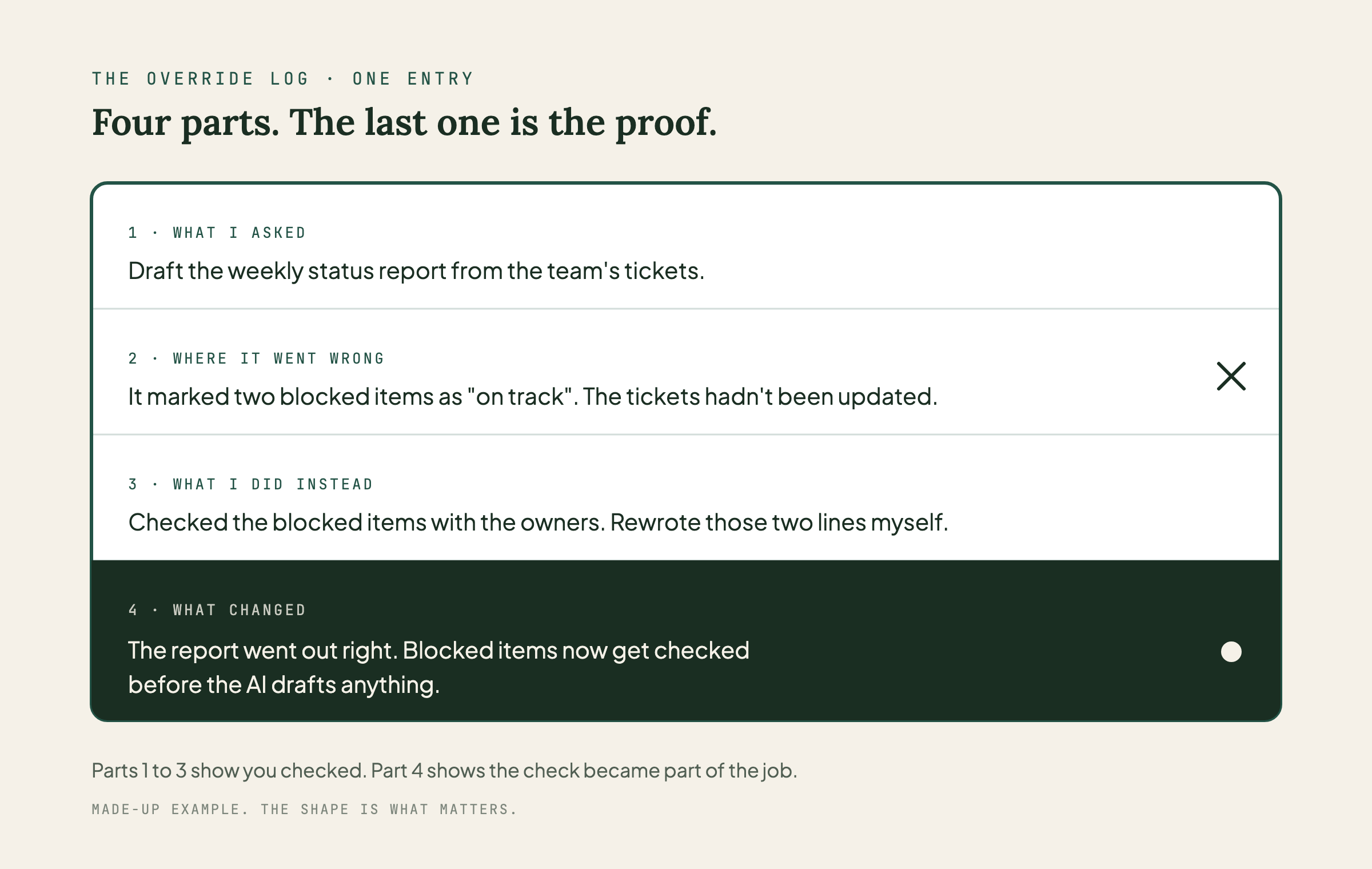
The status report example now shows the AI misreading correct tickets. Before, the tickets were out of date, so the catch was a data problem, not an AI one.
The 5.6 times figure now says what it measures: a correlation inside one week of chats, not proof that practice builds the skill.
Added that the override log is the STAR shape most interview prep teaches, and where it differs.
"Two clients this spring" became one client in October. Only one was on record.
Look at the last line. Anyone can say they use AI. Only you can say where it got it wrong, and what changed after.
Earlier this month I asked a client how they'd used AI over the last two years. They're a program manager. The answer came fast: "Absolutely nothing really much." Then, before I could say anything: "I know that that is a huge gap."
So I asked what they did with it at home, and it turned out they had agents running their to-do list and a news briefing twice a day. Then they told me about a scheduler. Their team rebuilds schedules by hand whenever something moves, so they'd tried building a helper with AI. Run it at a different time and it could give a different schedule. "I need to be able to defend my scheduling," they said. "It's not deterministic. And I, as a PM, I cannot work with that." So they moved the engine to Power Automate and some scripts, and kept AI on as "a coaching for me right now."
"Wow, what?" was all I had for a second. None of it was advanced. That's what got me. They'd walked in calling themselves a huge gap, and the thing they'd done didn't even count in their own head.
Can you tell what the model got wrong?
Part 1 of this series, How to Become AI-Native, set out a ladder with four levels, from the Avoider to the Owner. It ended on one test: can you tell what the model got wrong? A Wrapper takes what the AI gives them. A Verifier checks it. An Owner builds the check into the way the work runs.
That's the ladder. This part is about proving which level you're on to someone who's deciding whether to hire you, and who has about an hour to find out.
What are companies actually checking?
Job ads now ask for "AI-forward" or "AI-native" people, and almost none of them say what that means. A few companies have written their test down, and they line up in a way that surprised me.
Canva expects candidates to use AI tools in its engineering interviews. One of the things it scores is plain: "Can they identify and fix issues in AI-generated code?" It also names three habits it marks down: handing the AI too much, accepting what it gives you too fast, and showing off your prompts.
Zapier raised its hiring bar this year. For engineers, it rates "a lightweight assist inside a mostly unchanged workflow" as unacceptable, and its new minimum asks you to explain "where those tools break down." In its skills tests, it says it wants to see how candidates "prompt, push back on an output, and adapt."
Coinbase rebuilt its engineering interviews this year and wrote down what it watches for. One line in it is the whole argument: "sensing when to override the model."
What these tests have in common is the moment you looked at what the AI gave you and didn't take it.
So how do you get good at catching it? From what I've seen, it takes three things. Use it a lot, on real work, so you see the same mistakes come round. Learn how it works, enough to know it can sound sure and still be wrong, and give a different answer when you ask again. And know your own material deeply, because you can only catch a wrong figure in a summary if you know the source it came from. There's a hint of this in Anthropic's AI Fluency Index (February 2026): in chats where people kept going back and forth on an answer, they were 5.6 times more likely to question the AI's reasoning. It's a correlation from one week of chats, so it doesn't prove practice builds the skill, but it points the same way.
How to prove you are AI-native: the override log
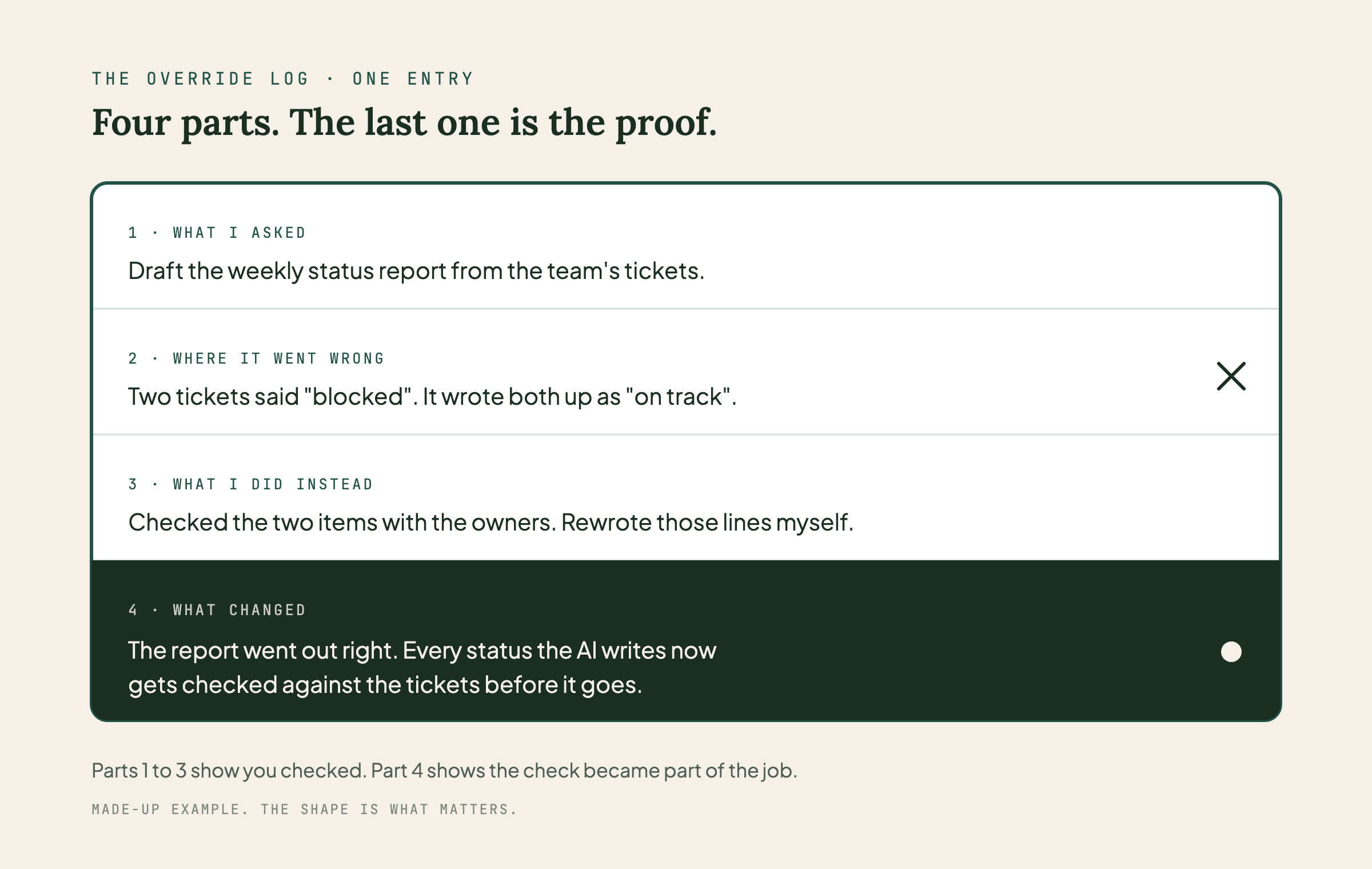
An override log is a running note of the times AI got something wrong and what you did instead. Each entry has four parts: what you asked + where it went wrong + what you did instead + what changed.
Anyone can say they use AI. Only you can say where it got it wrong.
Earlier in that session I'd told the same client to keep building on their own workflows, because "this is like an ammunition for the interviews later." The trouble is that nobody writes it down. You catch a wrong answer, fix it, and forget it by Friday. Then the interviewer asks, and all you've got is "I use it every day."
A finished entry looks like this (made up, the shape is what matters):
What I asked: draft the weekly status report from the team's tickets.
Where it went wrong: two tickets said "blocked", and it wrote both up as "on track".
What I did instead: checked the two items with the owners and rewrote those lines myself.
What changed: the report went out right, and every status the AI writes now gets checked against the tickets before it goes.
If this looks like STAR, the situation, task, action, result shape most interview prep teaches, it is. The log is where the stories come from; STAR is how you tell one.
That last line is the step from Verifier to Owner on Part 1's ladder. The check stops living in your head and becomes part of how the job runs.
Start tonight. Write three entries from the last month, about twenty minutes. If you can't find one, next time you use AI for work, check one thing it tells you against the source. That's your first entry.
What you should see: by the end of the week, three entries in a note on your phone, each with all four parts.
"How are you using AI in your day-to-day work?"
That's the question. Coinbase added it to its engineering interviews this year and said so in writing. A client I coached in October was asked it word for word in a first-round interview. They named their tools and said "we" for the rest.
That's how most people answer: a list of tools and tasks, and a "we" for what the team does. The interviewer can't tell which part was you, and the list sounds like the candidate before you.
Answer in sixty seconds, in "I": one entry from your log, then one line of range, so they hear the depth and the spread. The shape (made up):
"Day to day, I use Claude for drafting and analysis. One example. I had it drafting my weekly status report, and it wrote up two items as on track when the tickets said blocked. I checked them with the owners, rewrote those lines, and now I check every status it writes against the tickets. Beyond that, I've got it running my morning briefing and drafting the first version of my test cases."
Time it out loud. If it runs past a minute, cut the range line and keep the entry.
What you should see: you can say it to your phone's voice recorder in under ninety seconds without reading it. Then say it to one person and ask which part was you. If they can name it, the answer works.
"What did you try and abandon?"
Zapier's hiring rubric asks a version of it: "what did they start with, what did they try and abandon, how has their approach evolved?"
This is where the program manager's story wins. They tried AI on the scheduler, found it couldn't give the same answer twice, and moved the job to tools that could. Started here, hit a limit, changed the setup. It also sounds like someone who'll still be getting better in six months, which is the thing that question is really checking.
Keep one abandoned attempt in your log, with the reason you dropped it. "It wasn't deterministic, and I had to defend the result" is a complete answer.
The reason you dropped it is the proof.
Can you use AI in the interview itself?
It depends on the company, and they disagree in public. Canva expects AI in its engineering interviews. Anthropic asks for no AI in live interviews "unless we indicate otherwise," and on applications it says "create your first draft yourself, then use Claude to refine it."
So ask the rule before the day, in writing. If AI is allowed, say what you think before you ask it anything. That's Canva's own tip: "tell us what you think before getting help from AI." Then narrate the override when it happens: "It's suggesting X. I don't think that's right, because Y."
What does proof look like in your role?
The override is the proof in every role. What changes is the size of the call and who it protects. Open your role for a picture of the floor, what reads as proof, a question you might get, the red flag, and an override entry. The quotes come from the companies named. The day-to-day examples, questions and entries are made up, so you can see the shape.
Software engineer
Reads as the floor: you ask ChatGPT for a command or a syntax fix now and then, and still write most of your feature code line by line. Zapier rates "a lightweight assist inside a mostly unchanged workflow" as unacceptable for engineers.
Reads as proof: you write the tests and the comments first, let Copilot or Cursor write the boilerplate, and spend your own time on the edge cases. Canva scores whether you can "identify and fix issues in AI-generated code," and Coinbase watches "how you critique its output."
A question you might get: "Walk me through something you shipped with AI. What did you change in what it gave you?"
The red flag: AI-written code in a pull request that you can't explain when a reviewer asks why it's built that way. Zapier's unacceptable row includes engineers who "cannot clearly explain tool or model choices, limitations, or how their usage has evolved."
Your override entry: asked Copilot to write the retry logic for a webhook. It retried every error, including the ones that should fail straight away. I rewrote the condition and added a test for those cases.
Product manager
Reads as the floor: you use AI to summarise and look things up, and the spec you write afterwards looks like the ones you wrote before. Zapier's product row rules this out: "The work they do before AI and after AI looks largely the same."
Reads as proof: you put a few hundred support tickets or call notes through AI to find the main friction points, then read a sample yourself before you trust the themes. Zapier's bar is using AI "to tap into user insights (quant and qual) previously inaccessible due to technical limitations or data scale."
A question you might get: "How would you decide what goes on the roadmap next quarter?" Say where AI read the raw user data, and where you checked it.
The red flag: a spec that "reads like obvious AI slop," in Zapier's words, or the opposite, refusing AI for first drafts on principle and doing every summary by hand.
Your override entry: had Claude group 300 support tickets into themes. It put billing complaints and pricing-page confusion in one bucket. I read forty by hand, split them, and the pricing-page fix went first.
Program manager
Reads as the floor: you spend half the week chasing updates on Slack and building the status deck by hand.
Reads as proof: meeting notes turned into actions automatically, status pulled from Jira or Asana, and a check wherever the data can't be trusted. No company has published a rubric for this role that I could find, so our client's scheduler is the model: they tried AI on a real team process, found it gave a different answer each run, and moved the engine to tools that didn't.
A question you might get: "How do you run a program with dozens of stakeholders across time zones?" Say what's automated, and where you still check by hand.
The red flag: a status report straight out of AI that nobody checked before it went to leadership.
Your override entry: asked AI to rebuild the team schedule when dates moved. It gave a different schedule each run. I moved the engine to Power Automate and scripts, kept AI for coaching, and now the schedule is one I can defend.
Engineering manager
Reads as the floor: you're fluent yourself, and your team still works the old way. Zapier says that manager "doesn't meet our bar."
Reads as proof: AI takes a first pass on pull requests for style and basic security before a person reviews them, with the rules your team has learned written into it. Zapier asks managers to "redesign workflows so AI meaningfully changes how team work gets done."
A question you might get: "Your team keeps missing sprint goals because of old code. What do you do?" Before you ask for more people, say where AI could take the refactoring or the tests, and where a person still checks.
The red flag: banning AI tools outright when clear rules on what data goes in would do.
Your override entry: turned on AI review for pull requests. It approved two that broke our rules for database changes. I added the rule to the review prompt and kept a person on every database change.
Recruiter or talent partner
Reads as the floor: you do work by hand that AI could help with, and you haven't tested whether it would. Zapier's people row puts it plainly: "Skepticism is untested, not informed."
Reads as proof: "repeatable prompt templates they refine each cycle," in Zapier's words, and "AI-drafted content edited for voice." Interview notes summarised for the debrief, candidate emails drafted by AI and rewritten in your own voice.
A question you might get: "How do you use AI in your hiring process today?"
The red flag: candidate messages that read as AI-written and unedited. Candidates notice, and so does the hiring manager.
Your override entry: had AI summarise panel feedback for a debrief. It turned one interviewer's "unsure" into "positive". I went back to the raw notes, and debriefs now start from the interviewers' own words.
Head of, director
Reads as the floor: licences for everyone, and the department called AI-driven.
Reads as proof: you test where AI can carry the work before you ask for more people, and you know where it stops. Shopify's 2025 memo told teams that "before asking for more Headcount and resources," they "must demonstrate why they cannot get what they want done using AI."
A question you might get: "How will AI change your department's budget next year?" Say what AI will do, what it costs, and where a person stays.
The red flag: switching AI on for a whole job without testing where it fails.
Your override entry: tested AI as the first pass on vendor contract reviews, on twenty old contracts. It missed two auto-renewal clauses. A person still owns renewals, and AI writes the summary.
How do I put it on my CV and LinkedIn?
On your CV, one bullet per role, built from one entry, in the order of the four parts. Name the tool inside the bullet. A bare list of tools at the bottom tells a recruiter you've heard of them.
Before: "Skills: ChatGPT, Copilot, Claude."
After (made up): "Drafted weekly status reports with Claude. Caught it reporting blocked work as on track and added a check against the tickets before every send. Reports went out right for the rest of the quarter."
On LinkedIn, put your best entry in one line of your About section, or write it up as a Featured post. It's often where a recruiter reads you first.
Where this doesn't work for you
No AI at work. Build one at home. I told an engineer I coached this month exactly that. "I need to do a sandbox environment at home, put some data in it from the internet, free data, and then actually do this." It goes on the CV as a personal project, and the log works the same way.
You're sick of hearing about AI. It's the thing I hear most right now. You don't need a portfolio of agents to answer the question. One real entry beats ten tools.
The role bans AI in the interview. Ask the rule, follow it, and bring your entry to the "how do you use AI" question instead.
Want a second read first?
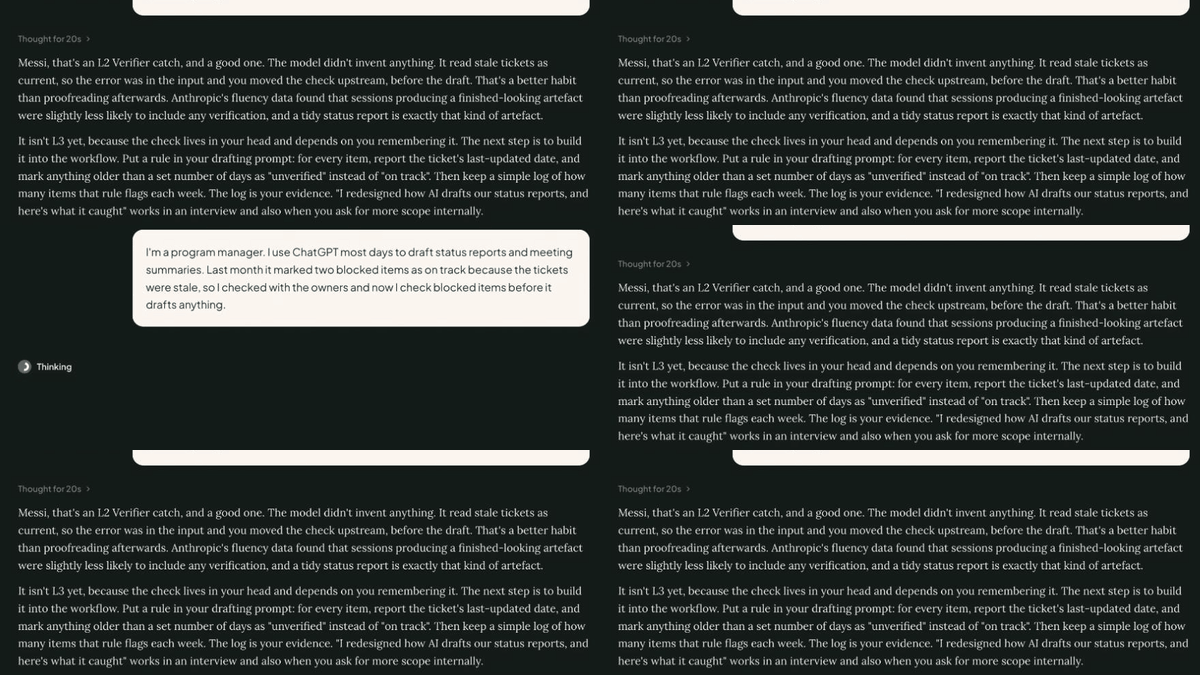
You can do all of this with a notes app. If you'd like a read on where you stand before you start, we built AI Fluency mode in Careersy AI for this. Tell it in a few lines how you use AI day to day, or paste in an entry from your log. It places you on a ladder of AI fluency, says what's missing for the next step up, and gives you the next thing to build. Below, it reads the status report example from earlier. It placed it as an L2 Verifier, the same rung Part 1 calls level two, and said why it isn't L3 yet.
The question is "How are you using AI in your day-to-day work?" and a tools list hides you.
Keep an override log: what you asked + where it went wrong + what you did instead + what changed.
Answer in sixty seconds, in "I": one entry, then one line of range.
Keep one thing you tried and abandoned, with the reason.
Ask the AI rule before any test, in writing.
FAQ
How do I answer the "How are you using AI" interview question?
Give one example in "I", in about a minute: what you asked AI to do, where it went wrong, what you did instead, and what changed. Then add one line about your other uses. Coinbase asks this question in its engineering interviews, in writing, and a client I coached in October was asked it word for word.
How to prove you are AI-native: the override log
A running note of the times AI got something wrong and what you did instead. Each entry has four parts: what you asked, where it went wrong, what you did instead, and what changed. It gives you real examples for your CV, LinkedIn and interviews.
Should I list AI tools on my CV?
Name the tool inside a bullet that shows what you did with it, rather than in a bare skills list. Write the bullet yourself first, then use AI to tidy it. Anthropic gives candidates the same advice on its careers page.
Can I use AI in a job interview?
It depends on the company. Canva expects AI in its engineering interviews, while Anthropic asks for no AI in live interviews unless it says otherwise. Ask the rule in writing before the day. If it's allowed, say what you think before you ask the AI.
What if I don't use AI at work?
Build a small project at home with free public data and use AI on it, then add it to your CV as a personal project. The override log works the same way on a home project.
interview questionsai fluencyai-forwardhow to show ai skills