To answer salary expectations in Australia, ask for their range first. If they turn it back on you, give yours in two parts: "185 to 198 base, plus super." In Australian tech the negotiation starts on that first call. Refusing to name a number doesn't protect you. It only hides whether they can pay you.
Updated 17 October 2026
This covers the first call and the salary box on a form. Negotiating the offer gets its own post.
You've probably had this call. A recruiter rings in the middle of your afternoon, and the role sounds right. A few minutes in, the question arrives: "What are your salary expectations? And what are you on right now?" Whatever you say next, the recruiter types into a note while you're still talking.
I've been on your side of that call. I was on 110. I told the recruiter I was looking for 140 to 150 base, and I never mentioned the 110. They kept going with the process, which told me they could pay it.
It can go the other way. A senior engineer I was coaching was already deep in a process. Early on, he'd told the recruiter that 170 would be okay. Then in our session he told me what he actually wanted: "I should have said my expectation is 180 to 200 plus super."
I told him straight how that sounds on the other side. He'd already confirmed 170 was okay, so a recruiter who offers 170 expects him to accept it. Once he'd said 170 out loud, the recruiter had no reason to fight internally for more budget. And he'd never find out that's what happened.
"Never say a number first" is wrong here
Say your range is 250 to 300 base, and the role tops out well below that. An honest recruiter says so on that first call: "Thanks for letting me know. That's above what we can pay. The most is 220. Are you still okay to continue?"
"Never say a number first" is the most repeated line online. In Australia the negotiation starts at the first call, not at the offer. Ask for their range first if you can. If they turn it back on you, give yours openly with the reason: "Happy to share. I just want to make sure we're not wasting each other's time."
Refusing doesn't protect you. You can lose weeks finding out what that recruiter would have told you on day one.
The ad usually won't tell you. Of 5,638 Australian and New Zealand ads Careersy AI saw in the 90 days to 17 October 2026, about six in ten of them tech roles, a salary appeared in 13%. Our provider and our own read both miss some, so treat that as a floor.
A good recruiter leads with the range. The version you'll hear most often goes like this: "Our budgeted range is AUD $150,000 to $160,000. Does that align with your expectations?"
When they give you a range, ask one more question before you answer. What has the person at the top of that range done that the person at the bottom hasn't? Listen for the things already on your CV. Then say back the part of the range your work earns, in two parts, base plus super.
What negotiation research says about the first number
Most negotiation research finds that going first helps. It also explains why asking first makes sense here.
- Going first can backfire when your number tells the other side something they can use against you (Loschelder and colleagues, 2016). On a first call the recruiter knows the band. You don't.
- Once you know their range, a range of your own still works in your favour, as long as it starts at or above your target (Ames and Mason, 2015).
- People who kept their attention on their target got better deals than people who focused on their minimum (Galinsky, Mussweiler and Medvec, 2002).
- A real alternative is your strongest card. Negotiators call it your BATNA: what you'll actually do if this deal doesn't happen (Fisher and Ury, Getting to Yes). A weak one can pull your own number down, so don't let your current salary set it (Schaerer, Swaab and Galinsky, 2015).
- Deepak Malhotra's rules for job offers include making it clear they can get you (Harvard Business Review, 2014). People only push internally for someone they believe will sign.
These are mostly lab studies, none of them from Australian tech.
What happens to your number after you say it
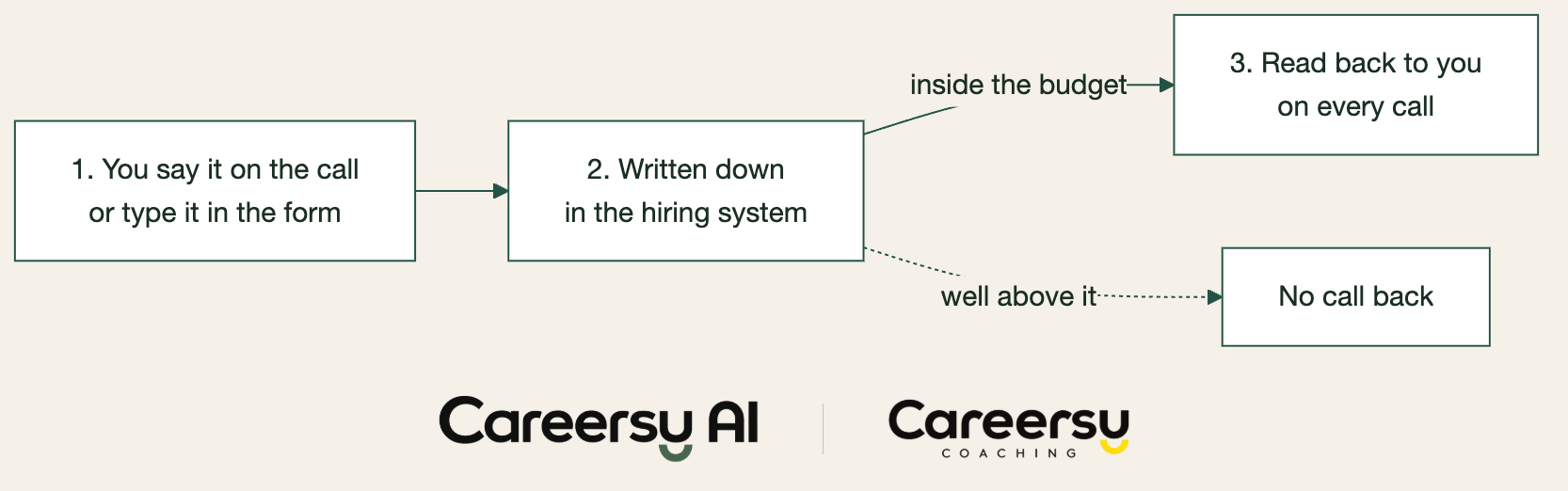
It goes into the recruiter's notes, and from there into the hiring system. On every call after that, it gets read back to you: "So you're expecting 135 to 145 before super?"
It decides one thing early: whether a recruiter calls you at all. If the budget is 160 and you wrote 220 base, there's no point calling. A recruiter with ten candidates inside the range has no reason to call. From your side, that looks like nothing coming back.
It doesn't decide your offer the way people fear. At a good company the role has a band, and your interview performance decides where in that band you land. If you interviewed well, the hiring manager pushes for top of range. One graduate I coached typed 80 because she was scared of pricing herself out. A good employer would still have offered her 95 if she earned it.
Base, package and super: the mistake that costs the most
On one coaching call, a client told me he was on 200. I asked him one question: "Is that package or base?" He said, "That's package all up."
People blur base and package. They say "170" meaning total, and the recruiter hears 170 base. Or they say "170 plus super" when the band is quoted as total package. In Australia, say it in two parts every time: "185 to 198 base, plus super."
Super is the employer's contribution to your retirement fund, and it's paid on top of base. The minimum rate, the super guarantee, has been 12% since 1 July 2025. That's from the Australian Taxation Office's super guarantee table, last updated 17 April 2026. Some pages online still quote last year's 11.5%. Since 1 July 2026, employers pay it with each payday.
| The fact | The figure | Where it's from |
|---|
| Super guarantee from 1 July 2025 | 12%, paid on top of base | ATO |
| Super guarantee, 1 July 2024 to 30 June 2025 | 11.5% | ATO |
| "185 to 198 base, plus super" as a package | 207,200 to 221,760 | Worked example at 12% |
| "170" meant as package, heard as base | 190,400 as a package, about 20K more than you meant | Worked example at 12% |
| A Senior Software Engineer or Tech Lead in Sydney | Commonly around AUD $150,000 to $180,000 base plus super. The band depends on the company | My own salary negotiation playbook. A rough anchor only |
The worked examples are illustrations. When a recruiter gives you a range, ask: "Is that plus super, or including super?"
Then there's the floor. A different client gave me his as at least 200 base, "for me to feel like I can basically breathe again." That's a survival number. A floor works better as the lowest number you'd be happy with. Say your floor and it becomes the number you'll get. So keep it to yourself and talk about your target.
Say it the way you want it written down
That note from the first call travels with you. Say it the way you'd want it written down.
- A hope gets written down as a ceiling. Say you're hoping for around 150, and the note says 150. A recruiter reads that as the most you'd want.
- One number gets written down as base. Say 170 when you mean the package, and the note says 170 base.
If they ask what you earn now, you don't have to say. "I focus on the market rate for this scope rather than past pay. Happy to discuss your range."
Seven rules for the first call
My playbook has eleven rules for negotiating. Seven of them start on the first call.
- Protect your information. Share your range on purpose, as a filter. Never share your floor, your current pay, competing terms, or how you rank the companies.
- Keep the door open. Don't commit to anything on the call.
- Stay positive. Your enthusiasm is part of what they're buying.
- Don't be the only decision-maker. Mention your partner, family, or a mentor. It takes the pressure off the call.
- Have an alternative. If you can't walk away, you're not negotiating. You're hoping. Another offer is best. Staying where you are, study, or a break also count.
- Care about more than money. Team, scope, title, start date and learning budget all count.
- Be winnable. Give them a clear path to yes.
The other four are for when an offer lands: get everything in writing, give a reason for every ask, know what they can move, and play the long game. They're for the offer post.
When the form forces one number
The graduate I mentioned asked me this: "A lot of roles I apply for, they only ask for one. Like, what's your expected base salary. Do I just give the lowest number?" She'd been typing 80, "just trying to prioritise getting a job."
Some application forms won't let you leave the salary box blank. That box is part of how your application gets screened before anyone reads your CV.
Don't put the top of the Glassdoor range. That reads as over budget. Pick the realistic mid for that company, about 5 to 10K above your true floor.
How to answer salary expectations tonight, in under 20 minutes
Say the recruiter has booked you in for tomorrow at 2. Tonight you need three numbers and one sentence.
- Write your three numbers (5 minutes). Write your absolute minimum, your realistic maximum, and the middle, which is your target. Your minimum stays with you. It never gets said out loud.
- Check the band (5 minutes). Look up that company and level on SEEK, Hays or Glassdoor. Your middle should sit inside the band. Note whether each figure is base or package, so you compare like with like.
- Write your line and say it out loud twice (5 minutes). Your range runs from your middle to your maximum. If your middle is 185 and your maximum is 198, the line is: "I'm looking at 185 to 198 base, plus super. Depending on how the process goes, I trust you'll offer the fair number in that range."
- Have your callback line ready. If they call when you're not ready: "Sorry, I can't talk right now. Can I call you back between 2 and 5?"
How you'll know it worked: the recruiter repeats your range back correctly, as base plus super, and the process keeps going. If they say "that's above our budget, we can do 181," it also worked. You found that out in week one.
The same prep in Careersy AI
Here's how a senior engineer could use Careersy AI the night before that call. It's an illustration, not a real user.
- Job Search. Run it on the role, level and city. It pulls live roles from LinkedIn and from companies' own careers pages. It scores each one 1 to 10 for fit, with the reason, the gap and a tip.
- Compensation & Negotiation. Give it the role, level, city and your three numbers. It helps you check the band, and it writes your range as "X to Y base, plus super".
- Interview Preparation. Ask it for a mock recruiter screen with the salary question, so you say your line out loud before anyone types it into a note.
Doing it by hand works too: the steps above are the same prep.
Where this won't hold
The catch is smaller companies with no fixed band. They treat your number as the target.
At a company like that, the bottom of your range can become the offer. Because your range starts at your middle, that's still a number above your floor. I'd still give the range, because hiding it only costs you weeks. But I can't promise it's free there. From outside, you often can't tell which kind of company you're talking to until the offer arrives.
Say your floor and it becomes the number you'll get. So keep it to yourself and talk about your target.
FAQ
How do I answer "what are your salary expectations" in Australia?
Ask for their range first. If they turn it back on you, give yours in two parts, from your middle number to your maximum: "185 to 198 base, plus super."
Does salary include super in Australia?
Usually not when it's called base. Super is paid on top of base, at a minimum of 12% since 1 July 2025. "Package" or "total package" usually includes it. When you're given a range, ask: "Is that plus super, or including super?"
What should I put in the desired salary box on an application form?
Put the realistic mid for that company, about 5 to 10K above your true floor, and write it as base. The top of the Glassdoor range reads as over budget.
What's different for New Zealand readers?
KiwiSaver works differently from super. The employer minimum has been 3.5% of gross pay since 1 April 2026, and it goes to 4% from 1 April 2028. You and the employer can agree a total package that includes KiwiSaver. If nothing is agreed, it's paid on top. So ask: "Is that plus KiwiSaver, or including it?" (Inland Revenue)