To negotiate a job offer in Australia, don't say yes or no on the call. Thank them, say when you'll come back, and confirm every part of the offer by email that day. Then send one counter: one to three asks, each with a reason, and a clear way to say yes.
Updated 17 October 2026
This covers the offer, from the call to the signed contract. The first call, where the salary question comes up, has its own post.
"We're excited to offer you the role."
The recruiter sounds pleased, and so are you. Then comes a number, and you're not sure if it's the base or the whole package. Then a pause. They're waiting to hear what you think.
It's tempting to fill that pause with yes. After five rounds, yes feels like relief.
I've taken the wrong offer myself. I once took a job for the title and an offer 30% above what I was making. I'd seen some mixed Glassdoor reviews, and I told myself they were probably just disgruntled ex-employees. By week four I knew I'd got it wrong. I never asked how the team handled conflict.
On the call, say thank you and a time
The costliest mistake at offer stage is saying yes or no on the call. The fix is one line: "Thank you, I'm excited. I'll come back to you by Thursday 5pm."
A yes ends the negotiation before you've seen the whole offer. A no gives away something you could have traded.
Then confirm every part of the offer by email the same day, including whether super is on top. A verbal offer you accept can already be a contract, and verbal terms are hard to prove (Victoria Legal Aid). The email is your record.
Hi [Name],
Great to speak today. I'm excited about the role and the team. To confirm what I captured: base $X (plus super, or including super?), bonus Y%, sign-on $Z, equity [units and vesting], annual leave [weeks], relocation [amount], start date [TBC].
I'll come back to you by Thursday 5pm.
And don't resign until you have the written contract and every condition, like reference checks, is cleared. If an accepted offer is pulled after you've resigned, what you can recover is usually small, often about your notice period's pay (Sprintlaw). Check your contract.
When the offer comes with a 48-hour deadline
A 48-hour deadline is an exploding offer, and it can end up setting your whole timeline. In lab studies, short deadlines didn't win employers more acceptances, and they cost goodwill (Lau, Bart, Bearden and Tsetlin, 2014). Ask for 7 to 14 days, and give the reason:
"I'm excited about the role, but I can't make a decision this big in 48 hours while I talk it through with my partner. If we can extend it by 7 to 14 days, I'll give you a clear answer by then."
If they won't move at all, treat it as a non-offer. The 7 to 14 days is my own rule of thumb. Nobody has published a figure on how often extensions are granted.
What happens inside the company when you counter
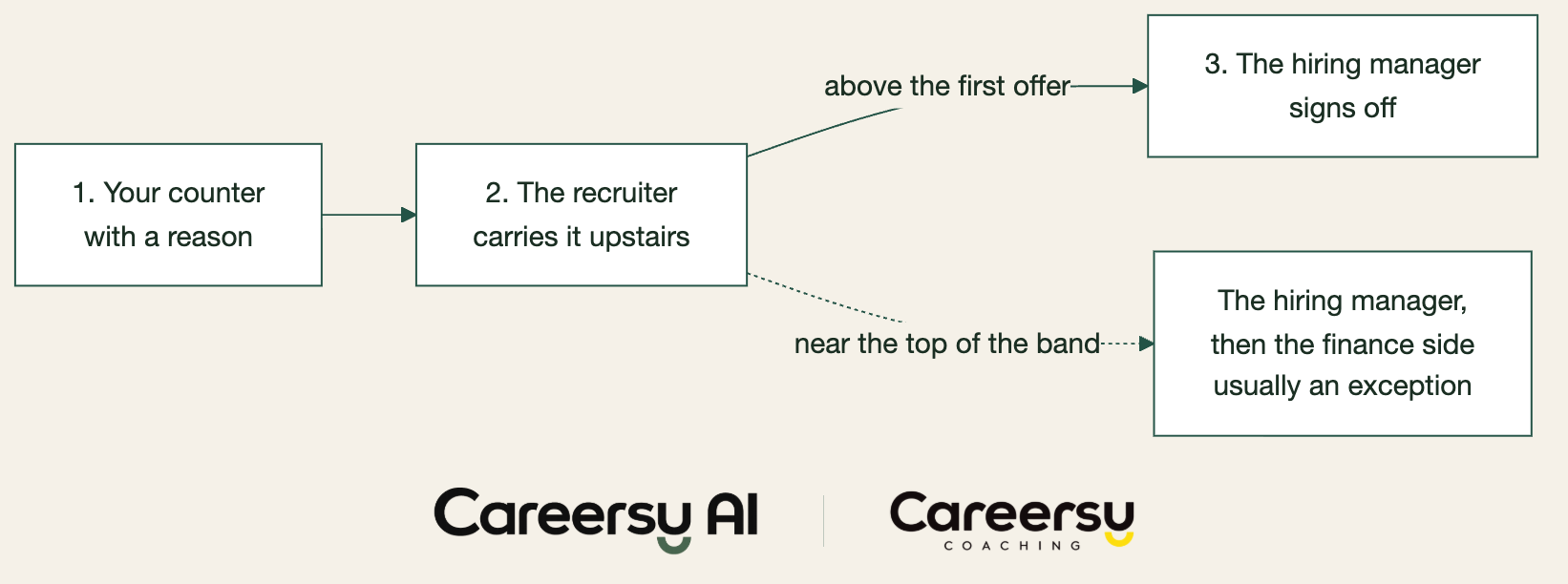
"We need to give more, otherwise we won't get him." A recruiter can only say that to a hiring manager if you've given them the material.
The recruiter works inside a band. Anything above the first offer needs extra sign-off: from the hiring manager first, and for anything near the top of the band, from the finance side. Top-of-band numbers usually need an exception, so they're rare.
From what I've seen over the years, there's usually room in a first offer, often 10 to 15 percent. Robert Half's 2026 survey of 500 Australian hiring managers lands close to that. Four in ten said they'd go 6 to 10% above their first offer. 29% would go 11 to 15%, and 16% only 5% or less (IT Brief, 24 February 2026).
So the recruiter doesn't decide your counter. They carry it to someone who does, with only what you've handed them to argue with:
- You interviewed well. That's what the line above rests on.
- You gave a reason for the ask. Relocation, scope, a mortgage deposit.
- You mentioned your other processes, so there's something to take to the panel.
- You're winnable. "If you can do X, I'll sign by Friday" is easy to sell internally.
What negotiation research says about the counter
- Adding arguments to an offer backfired when counter-arguments were easy to find (Maaravi, Ganzach and Pazy, 2011). "An offer elsewhere at 190" is hard to argue with. "I think I'm worth more" is easy.
- How the negotiation felt predicted job satisfaction a year later, and the money won had no visible effect (Curhan, Elfenbein and Kilduff, 2009). Be firm on the number and warm in the tone.
None of these is Australian, and several are lab studies.
What moves, and what doesn't
A client was practising a recruiter call with me, and I played the recruiter. I asked if he wanted relocation support, and he said no on the spot. I stopped him, and he said: "Don't say no immediately." He'd given away something he could have traded later.
From easiest to hardest, from what I've seen over the years:
- Relocation and learning budget.
- Equity and sign-on. One-off money, often from a separate budget.
- Team, project, title and start date. Usually the hiring manager's call.
- Leave and bonus percentage. Harder.
- Base. Hardest, because it recurs, it's banded, and people compare.
Relocation sits at the easy end, so a no on the spot gives away the easiest yes in the offer. A cash relocation allowance is taxed as your income. Removal costs your employer pays directly can be exempt from fringe benefits tax (ATO). So ask: "Could you pay the movers directly?"
Base or sign-on
The same client told me how he'd handled an offer earlier in his career. The company offered him a chunky signing bonus. He said: "I need you to raise the base salary by X, and then I'm fine with that, because then that's in my range." They did. His words to me: "I've made much more money out of that than if I just got a chunk of cash at the beginning."
Take base when you expect to stay two years or more. Every future raise is a percentage of base, so it compounds.
Take sign-on when the band blocks base, or when you're not sure you'll stay. An 8K base increase can get blocked when a 15 to 25K sign-on gets approved on the spot. The sign-on is one-off money, often from a separate budget. If you'll stay less than two years, a sign-on usually puts more cash in your hand.
The maths behind the two years, and one survey I'll come back to:
| The fact | The figure | Where it's from |
|---|
| 8K more base, with 3.7% yearly rises (the 2026 median for Australian tech, Aon) and 12% super on top | 18.3K more after 2 years, 27.9K after 3 | Worked example, my arithmetic |
| When that 8K overtakes a 15K sign-on | About 1.7 years | Worked example |
| When it overtakes a 25K sign-on | About 2.7 years | Worked example |
| What Australian hiring managers offer when your number is out of range | Flexibility 56%, bonus 55%, development 52%, sign-on 28%, leave 25%, equity 13% | Robert Half 2026, 500 managers |
So two years holds for a mid-size sign-on. For a big one, the line is closer to three. The worked examples are illustrations, with super counted on the base, none assumed on the sign-on, and before any bonus.
A sign-on is easiest to argue for when you're walking away from money. That means a bonus you'd lose by leaving before its payment date, unvested equity, or long service leave you haven't reached yet. Your accrued annual leave isn't on that list, because it's paid out when you resign. Bring the vesting statement or the bonus plan, so the recruiter has something to show the approver.
Check for a clawback: you repay the sign-on if you resign within a set period, commonly 12 months. Ask whether it's pro-rated, whether it applies if you're made redundant, and whether super is paid on it. Check your contract.
RSUs are usually taxed when they vest (ATO). Ask what happens to unvested units if you leave, and get advice on the equity before you weigh it.
With another offer, or without one
"If you get an offer there, now you have actual leverage." I said that to a client about a contract role that wasn't their target. They were keeping it in play anyway.
A real competing offer is the only thing a budget responds to. Use it plainly: "I have an offer from another company at X. Your role is the one I keep coming back to. Can we get closer to Y?" Don't share its full terms, or how you rank the companies.
And don't make one up. An invented competing offer in a market this size is found out.
With no other offer, you still have an alternative. Staying put, contracting, or a short break all count, so say so lightly. Move the ask to non-cash items: sign-on, leave, team, a six-month review. And keep a role you're less keen on in play, the way that client did.
How to negotiate a job offer before your deadline
Say the offer came in today, and you said you'd come back by Thursday 5pm.
- Send the confirmation email (10 minutes). The one above, the same day.
- Answer this before you counter (2 minutes). Would you take this job if the money matched what you earn today? If you can't say yes, sort that out first.
- Put your value log on one page (15 minutes). A value log is a running record of your results with numbers. Pick the two or three that match what this team said it needs. A recruiter can quote a number to an approver.
- Pick one to three asks, each with a reason that's hard to argue with (10 minutes). A competing offer, a bonus you'd lose with its payment date, scope that grew in the interviews. Batch them into one email, because asking piece by piece wears people out.
- Write the counter with a way to yes (10 minutes). End on the line that makes you winnable.
Hi [Name],
Thanks again for the offer. I'm excited about [the team or the work].
Two changes would let me sign. A base of [Y], because [the scope grew to include X]. And a sign-on of [Z], to cover the bonus I'd lose by leaving before [its payment date].
If you can do both, I'll sign by Friday.
If base looks tight, offer two packages that are worth the same to you: "A base of [X] with a [15K] sign-on, or a base of [Z] with none. Either works for me." The one they pick tells you which budget is tight. In experiments, equal packages offered together beat a single counter (Leonardelli and colleagues, 2019).
- Say it out loud before they call (10 minutes). The recruiter may ring you back with their answer.
I rehearsed this with a client. His range was 185 to 198 base, and his real floor was 180. I played the recruiter and came back with: "Our budget is 181." His answer, out loud, was "I'd probably take it, to be honest."
The plan we practised kept the yes off the call and asked for something on top: "If you can't get to that number, don't worry. I'm a lot more interested in the role and the scope. Is there anything we could put on top? A learning budget, a sign-on, or a review of my salary in six months once I've performed well." That was a rehearsal.
The same counter in Careersy AI
Here's how a senior engineer could use it before the deadline. The engineer is made up.
- Compensation & Negotiation. Paste the offer. It quotes your numbers back, can check the base against a named, dated salary guide, and won't build a counter around a competing offer you don't have.
- Draft Message. Ask for the counter email. It drafts two versions you can send, and it won't add a number you haven't given it.
- Interview Preparation. Ask for a mock recruiter screen where the salary question comes up, and practise your line out loud.
Doing it by hand works too: the six steps above are the same work.
How you'll know it worked: the reply tells you what can move. A revised offer in writing, or "base is banded, but we can do the sign-on." Either way, you know where the budget sits.
Where this won't hold
My order puts the sign-on near the easy end. Robert Half's survey doesn't quite agree. It asked Australian hiring managers what they'd offer when a candidate's number is out of range. Flexibility (56%) and a bonus (55%) came up about twice as often as a sign-on (28%) (IT Brief, 24 February 2026).
Both can be true. The survey asks what managers offer. It doesn't ask what gets approved when a candidate asks for a sign-on with a reason, and no survey does. So the sign-on is still worth asking for when you're walking away from money. But at a company that doesn't reach for one, flexibility or a development budget may be the easier yes. From outside, you can't tell which kind of company it is until you ask.
Counter with no reason, and you've given the recruiter nothing to argue with.
FAQ
How do I negotiate a job offer in Australia?
Don't say yes or no on the call. Give a time you'll come back, and confirm the offer by email that day. Then send one counter: one to three asks, each with a reason.
Can a job offer be withdrawn if I negotiate?
It can, but it's rare. In a 2024 US study, about 1,500 people with hiring experience had made roughly 27 offers each over their careers. On average, 1.73 were withdrawn after the candidate negotiated. The study linked withdrawals more to rude or inappropriate behaviour than to the asking (Hart, Bear and Ren, via George Mason University). Ask politely, with reasons, and in one go.
How much above the offer should I counter?
There's often room above a first offer, and the band decides how much. Robert Half surveyed 500 Australian hiring managers in 2026. Four in ten said they'd go 6 to 10% above their first offer. 29% would go 11 to 15%, and 16% only 5% or less (IT Brief, 24 February 2026). Ask for a number your reason can carry.
Should I take a sign-on bonus or a higher base salary?
Take base if you expect to stay two years or more against a mid-size sign-on. Against a 25K one, make that closer to three years. Every future raise is a percentage of base. Take a sign-on if the band blocks base or you might leave sooner, and check the clawback.
Can I negotiate the non-compete clause in my offer?
Yes, and it's worth it, because a reasonable restraint is still enforceable in Australia. The proposed ban covers people earning up to $190,100, and it was still an exposure draft when submissions closed on 2 October 2026 (Allens, 28 September 2026). Ask to shorten or narrow it, and read the notice clause too.