The best way to get a referral for a senior tech job is to ask before you apply. Once you apply, many companies won't let anyone inside refer you for that role. So find three people there first: the hiring manager, someone doing the job, and the recruiter. Get talking with one question about their work, then ask.
A client messaged me this week, completely out of ideas. Every senior role they wanted seemed to close through referrals, and they didn't know anyone inside. Right now I'm working with three other people stuck on exactly the same thing.
Here's the thing though. When a senior role seems to go to referrals only, the door usually isn't locked. Someone inside put a name forward early, and that name got looked at first. Below are the seven steps, with the exact prompts to run in Careersy AI, or in any AI tool you like.
Why applying first can stop a referral
Once you apply, the company's hiring system records you as a direct applicant. At a lot of companies, that means nobody inside can refer you for that role any more, or the referral stops counting. BTP Group's published referral policy, from an Australian employer, says anyone who applied in the last three months isn't eligible to be referred. One large tech company's published policy gives you two weeks after applying. Plenty give you no window at all. (The policies in this section were checked in September 2026.)
Most people close that door themselves on day one, because applying feels like progress.
Applying to a job should be the last step, not the first.
Referrals also get moved along faster. The same BTP Group policy, from 2022, tells staff that referred candidates should hear from the recruiting team within 72 hours. Cold applications get ranked. Referrals get read.
And here's the part that makes cold asks fail. Some companies tell their staff straight out not to refer people they don't know. GitLab's public handbook defines a referral as someone you've worked with or know well, and a stranger gets pointed to the jobs page (checked September 2026). So when you message someone you've never spoken to and ask for a referral, "please apply directly" isn't a brush-off. It's the policy. The steps below make sure you're not a stranger by the time you ask.
Step 1. Write your list of twenty companies
Ten you'd really want to work at, then ten you'd happily take. Twenty is enough that one company freezing hiring doesn't sink you, and few enough that you'll look into each one properly. Nobody can refer you at a company where nobody knows you. The list tells you where to start.
To see which of the twenty might hire at your level soon, open Careersy AI, choose Company Targeting, turn on Deep Research (the binoculars button), and paste this in:
Prompt
Here are the twenty companies I want to work at: [paste your list]. I'm a [your role] at [your level], looking in [your city].
For each company, look for signs they'll be hiring at my level in the next few months: funding they've raised, new leaders who've joined, teams growing, open roles like mine, or cuts. Then rank them from most to least likely to hire someone like me soon, with one line on why.
Only use what's in your search results. If you can't find anything recent on a company, say so. Don't guess.
Without Deep Research on, it can't search the web, and it'll tell you that rather than guess. With it on, give it a couple of minutes. Scroll to the section on how to prioritise, that's where the ranking is. Treat what it finds as a reason to look closer, not as proof. Using a different AI tool? Turn its web search on first, or it will guess.
Step 2. Mark who's hiring right now
Check each company's careers page and LinkedIn Jobs, and put a yes against any company with a role you'd fit. Start with the yeses, because someone you know at a company hiring this month can turn into an interview quickly. The rest go into step 7.
Step 3. Find your people there, in this order
Open each company's LinkedIn page and click People. It shows which of your connections work there. Someone you've worked with is the best person to ask, because they can say what you're like to work with. If it's been a while, reconnect before you mention a role: "Hey, it's been a long time. I saw you're at [company]. What's it like working there?"
Nobody you know? Find three people, in this order:
- The hiring manager, or whoever the role would report to
- A peer, someone doing the job today
- The recruiter
Most people message the recruiter first, because it feels like the official door. But recruiters usually don't refer people. They can pull your profile out of the pile, which helps, so they stay on the list, just last. A peer can refer you. So can the hiring manager, and they can move before the job is even advertised. (If you want to see how recruiters find people, read how recruiters search for candidates.)
To find them, search the job title in quotation marks on the People tab, like "engineering manager". At a big company you'll sometimes guess the wrong manager. That costs you one note.
Step 4. Warm them up, find something to ask, then write the note
Spend a few days commenting on their posts. Add a real thought, like a question or something from your own work, not "Great post". That way, when your connection request arrives, they've already seen your name.
Then read their profile properly before you write anything. You're looking for one thing you'd like to ask them about: a post they wrote, a project, a move they made. Write down what you found and the question it makes you want to ask. If there's nothing real there, pick a different person, because a note with nothing real in it reads like everyone else's.
Here's the kind of note that goes nowhere:
"I'm a senior engineer, I'm very good with [stack], would love to connect if you have any jobs open."
A good note does three things, in under 200 characters, because the person reading decides in about a second whether it's worth anything:
- One real detail from their profile or posts. Not "I'm impressed by your profile". I've replied to notes like that asking what exactly caught their eye, and heard nothing back.
- One question they're the right person to answer. People find a question hard to leave hanging, so you get a reply instead of a silent accept.
- No job yet. You're asking about their work. The job comes once you're talking.
Now open Careersy AI, choose Draft Message, and paste in what you found:
Prompt
I want to connect with [their name], a [their title] at [company]. Here's their profile: [paste their About section, recent posts and experience].
Here's what I found that I want to ask about: [the detail]. And here's my question: [your question].
First, tell me if that's a strong hook. The strongest ones are something we share (a past employer, a university, a bootcamp), a move they've just made, or their own words from a post. If there's a stronger one in their profile, point it out.
Then write the note. Lead with the question, keep it under 200 characters, don't mention a job, and use only what's in their profile and this message.
Here's what came back when we tested it with a made-up profile. It checks the hook first, then writes the note:
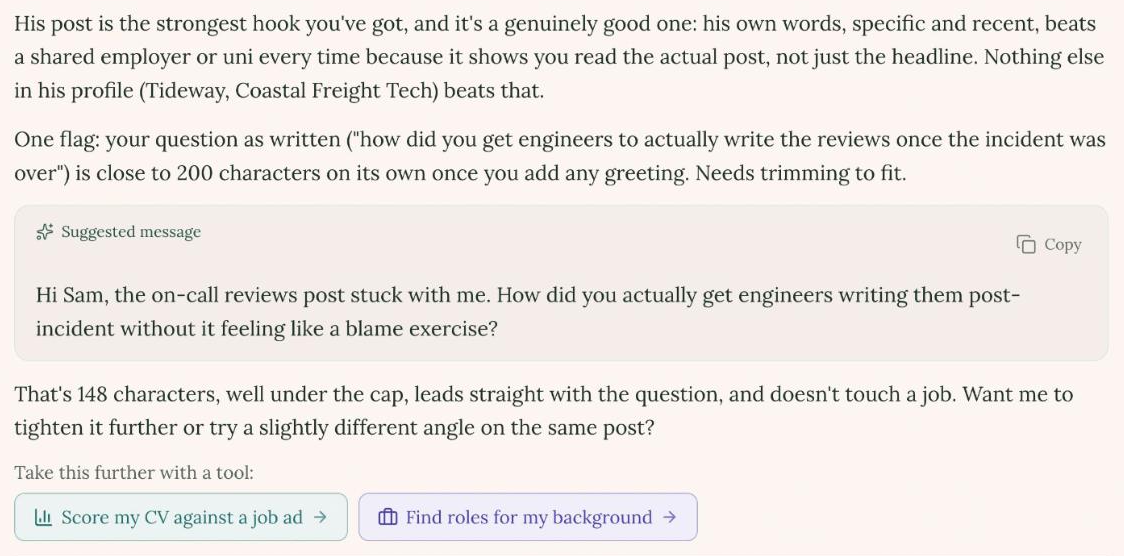
Change anything in the note you wouldn't say out loud. The question has to come from you, though. AI can tidy the wording, but only you know why that detail caught your eye. (There's more on where AI helps and where it doesn't in how to use AI in your job search without faking it.)
Step 5. Ask for the referral, with two reasons from the ad
Once you're talking and there's a live role, ask plainly. This is how I tell clients to say it:
"There are two reasons why I think I'm a good fit. I have done this and that. Would you be open to referring me internally? Or would you be open to having a quick chat about it?"
Swap "this and that" for your two reasons. The best ones name a problem the company actually has, then tie it to something you've fixed before. To find that problem, open a new chat in Company Targeting, turn on Deep Research, and send this:
Prompt
Research [company] for this role: [paste the job ad]. Find what the company and its leaders have said publicly in the last year: announcements, funding, launches, interviews, posts. Quote their own words where you can.
The report covers the whole company. To get the one thing you need, turn Deep Research off and send this in the same chat:
Prompt
Using only that research: what's the one problem this role is most likely being hired to fix? Quote the company's own words that point to it, then give me one line I could use in a referral ask. Tell me which parts are your guess.
Don't skip reading the job ad yourself, either. A line like "leave things in better shape than you found them" is the company telling you what's broken right now.
Then open Draft Message, attach your CV, and paste this in:
Prompt
Draft a LinkedIn message asking [their name], a [their title] at [company], to refer me for this role: [paste the job ad]. We've already talked about [what you talked about], and the company recently [the news you found].
Open by picking up our last conversation, or congratulate them on the news. Say I'm thinking about my next move and saw this role. Give two reasons I fit, each matching something in the ad to something from my CV. End by asking if they'd be comfortable referring me internally, or who the best person to speak to would be.
Use only facts from my CV and this chat. Anything you don't know, leave as [?]. Don't invent numbers or results.
It may ask you a couple of quick questions first, like what you've led and how you know the person. Answer them, because that's the detail it can't get from your CV.
Here's a test run with a made-up CV. It matches two lines from the ad to the CV, then flags the one claim the CV can't back up:
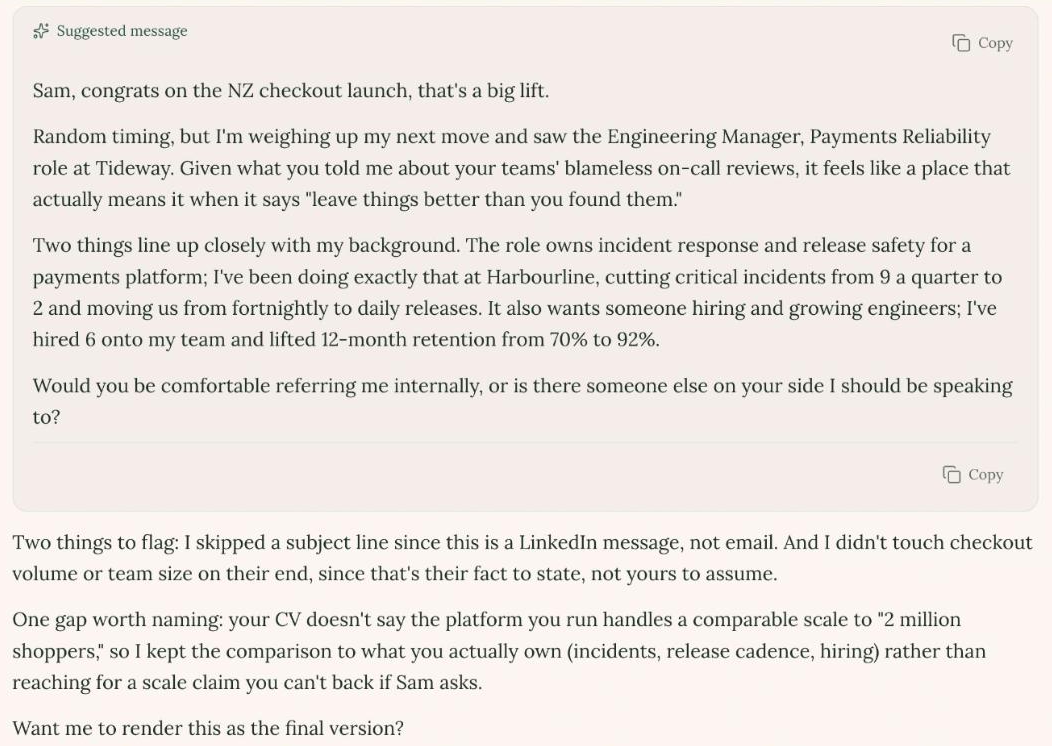
Fill every [?] yourself, then rewrite it in your own words so it sounds like the chat you've already had. If it warns you a reason stretches what you've actually done, take that seriously. Only one real reason? Send one. A made-up second reason falls apart the moment they ask about it. And the worst answer you'll get is "please apply directly".
Step 6. Apply within two days, whatever happens
The referral is a bonus, not a condition. Ask a couple of people, give it a day or two, then apply either way, because early applicants get looked at first. Waiting a fortnight for a reply can cost you the role.
Step 7. Keep planting while you wait
For the companies with nothing open, connect with one or two people a day who hold your exact title there. Ask one simple question about their work, then let it go. No follow-up, no job talk.
"Imagine you have a huge garden in front of you. You just planted a seed in the ground. And then forget about it."
When one of those companies advertises, you don't apply cold. You message the person you already spoke to. Something like: "We were talking a few weeks ago, and funny enough, a role's just come up." There's never enough time to build that relationship after the ad goes up, so you build it before.
Your target list
Copy this into a spreadsheet and extend it to twenty rows.
| Company | Hiring now? | Hiring manager | Peer | Recruiter | Commenting since | Note sent | Referral asked | Applied on |
|---|
| 1 | | | | | | | | |
| 2 | | | | | | | | |
| 3 | | | | | | | | |
How you know it's working
By the end of tonight, you should have:
- Twenty companies, with the ones hiring right now marked
- A hiring manager, a peer and a recruiter written down by name at the first three companies on your list
- A real comment on at least one of their posts
Before any note goes out, read it aloud and check four things:
- It's under 200 characters
- It names one real thing from their profile
- It ends on a question they're the right person to answer
- It doesn't mention the job
A week after your first ten notes, count how many accepted and how many replied. An accepted request only puts you in their network. A reply starts a conversation, and you can only ask for a referral inside one. If they're accepting but not replying, your question is too easy to skip. Make it about something only that person would know.
Your own LinkedIn profile is the first thing each of these people will click. If it isn't ready, start with why your LinkedIn profile is invisible to recruiter searches. And if your direct applications are going nowhere too, here's why applications get no response in Australia.
Where this doesn't work
- Government and public sector roles. Hiring runs on a formal merit process, so a referral won't move you. Put the effort into the selection criteria instead.
- A recruitment agency already sent your CV in. That usually counts as your application for that role. Use the route for the next role at the same company.
- You applied last week. Ask anyway, because some companies allow a short window. Just don't count on the referral being recorded.
- Small companies with no referral programme. Skip straight to the hiring manager. At twenty people, they are the process.
FAQ
How do I get a referral if I don't know anyone at the company?
Get known before you ask. Find the hiring manager, a peer and the recruiter, comment on their posts for a few days, then send a short connection note with one real question about their work. Ask for the referral only once you're talking and a role is open.
Does applying first stop someone referring me?
Often, yes. At many companies, once you've applied directly, a referral for that role is either blocked or doesn't count. Some allow a short window after you apply. Ask before you apply, then apply within two days either way.
Who should I contact first at a company?
The hiring manager, then a peer doing the job today, then the recruiter. A recruiter usually can't refer you, but can pull your profile out of the pile, so they go last.
How long should a LinkedIn connection note be?
Under 200 characters. One real detail from their profile, one question they're the right person to answer, and no mention of a job.
What should I say when I ask for a referral?
Give two reasons you fit, and match each one to something in the job ad. Then ask if they'd be comfortable referring you internally, or who the best person to speak to would be. If you only have one real reason, send one.
How long should I wait for a referral before applying?
A day or two. The referral helps, but early applicants get looked at first, so apply within two days whether or not you've heard back.
Do it with Careersy AI
Every prompt on this page runs in Careersy AI. Company Targeting looks for funding rounds, team growth and leadership moves, so you can target a company before the role is posted. Draft Message writes the note and the referral ask from your actual CV. Don't have it yet? You can start free with 3 credits, no card needed, at app.careersy.ai/signup.
If you'd rather do it by hand, that works too. The table above and one hour a day in your calendar is the whole system.