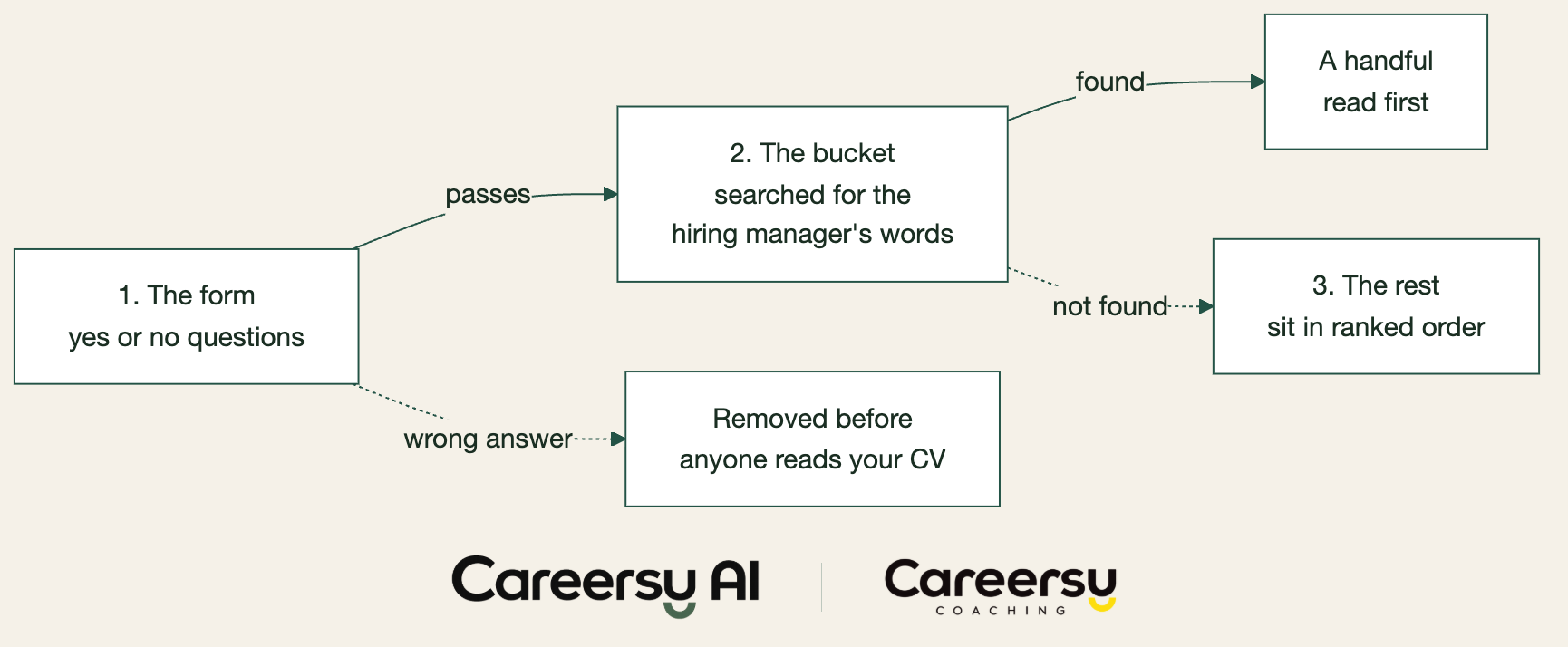
In Australian and New Zealand tech, how job applications are screened comes down to the form first. Answer no to a knockout question, like full working rights, and you're removed before anyone opens your CV. Everything else lands in one pile. When it runs to hundreds, a recruiter searches for the hiring manager's words and reads only what comes back.
Updated 17 October 2026
This is about getting onto the shortlist. The police check, reference checks and work-rights check after an offer are a separate step, and they're not covered here.
You've probably lived the other half of this. You send an application for a role that fits you point for point. Either a no lands in your inbox before you've closed the tab, or nothing comes back at all, for weeks. Neither one tells you why.
I turned my screen round on a coaching call once and showed a client what a recruiter sees inside an applicant tracking system. That's the software that stores every application for a role. He'd been reading my posts about it for a while. "I knew this was going on," he said, "but I never actually seen one of these systems before."
I showed him how a recruiter searches a pile of a couple of hundred applications for three things the hiring manager asked for. I told him a search like that takes the list down to five, maybe three. Then I asked him what he thought happens to the other 200.
He thought about it. "I put them on a backlog. And if the five don't work out, then maybe I'll go back to them at some point. Maybe."
He'd worked out in ten seconds what most advice online never says. It also explains how 90 applications can produce nothing at all.
How job applications are screened in Australia, in order
1. The form
This is where you actually get auto-rejected. Screening questions are the yes or no questions at the start of the application. "Do you have full working rights in Australia?" "Do you have a minimum of five years' experience?" Answer no to a knockout question, and the system removes you automatically. That's the real filter, and most people never see it happen.
The hiring team picks those must-have answers before the ad goes live. Greenhouse, one of the common systems, says its auto-reject filters are set and controlled by recruiters themselves.
This is where a temporary visa bites hardest. People with visa restrictions tend to get rejected very quickly. The work-rights question sits near the top of the form, and the employer can mark "yes" as a must-have. So if the no arrives minutes after you hit submit, that came from the form. Nobody had opened your CV yet.
2. The bucket
Recruiters have a name for the pile: the bucket. Everything that passes the form goes into it, and nothing in it has been read yet.
Picture the person on the other side. Seven roles open, 80 new applications since last week, 40 tabs already up. A recruiter with 800 applications doesn't read 800 CVs. They search the whole bucket first, using the phrases the hiring manager gave them when they agreed what the role needs. For a data role that might be Spark, Airflow and "microservices to monolithic". My prediction to that client was that a search like this takes a couple of hundred applications down to a handful.
A handful is usually enough. A recruiter rarely needs more than five or six people in the process, because one of five or six tends to get the job.
The search is literal. If you've run Terraform, write Terraform. "Infrastructure as code tooling" won't come back when the search is for Terraform. Nobody searches for "stakeholder engagement" either. The tools, the systems and the outcomes are what a search can find.
AI is moving into this step too. In April, SmartRecruiters, the second most common system in the ads below, announced an AI match that sub-scores applicants on education, skills and experience.
3. The order the rest sit in
Most applications never come out of the search. What happens to them next depends on the recruiter, and there's no hard rule. On a busy week, your application isn't being judged. It's a row nobody has opened yet.
I had a role once with a few hundred applications. Through the week, whenever I had some time, I went back into the bucket and went through it one by one, rejecting as I went. At some point I'd had enough. The system ranked them by how closely they matched the ad, and the low-ranked ones sat in the bottom tier.
The AI technically didn't reject you. But the AI 100% influenced the human.
Most recruiters I've spoken to say they don't even look at the match score, because it's too blunt to be useful. Recruiter Lee Harding has written that most recruiters know how bad these scores are and "don't even use them". I believe them. It still influences the person reading, consciously or not, and I'm sure of that. If you're the recruiter reading this, you know the moment: 4:30 on a Tuesday afternoon, 40 tabs open, a pile you can't finish, and a list that's already sorted.
The systems behind the ads we saw
Which system your application goes into depends on the employer. You can usually tell from the web address of the apply page. In the 90 days to 17 October 2026, Careersy AI's job search collected 2,031 Australian and New Zealand ads that link straight to an employer's careers page. This is what sat behind them.
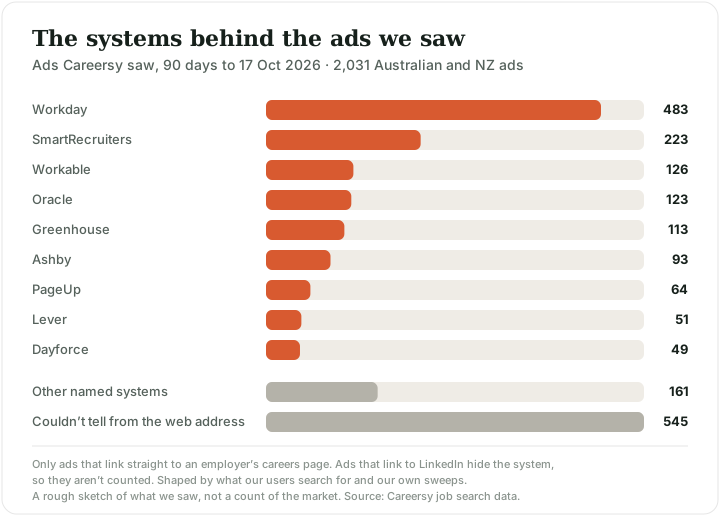
How to read it. These are ads Careersy saw, shaped by what our users search for and by our own market sweeps. By the data provider's own labels, about half are tech, software or data roles. Another 3,593 ads in the same window linked to LinkedIn instead. LinkedIn hides the system behind the ad, so those aren't counted. A system that runs on an employer's own careers address can't be identified this way either, so some of those sit inside the 545. One data provider crawled all of it, so treat the order as a rough sketch of what we saw, not a count of the market.
There are somewhere between 60 and 100-plus of these systems in use, and likely hundreds more if you count niche and regional tools. Every one works differently, and every company sets up its own. That's why no outside tool can tell you that you "passed the ATS". It's a database. A filing system. Your job is to get stored in it correctly, and then to be easy to read for the person who opens your file.
Three checks before your next application
1. Read the form as the filter. Read every yes or no question twice before you submit, because one wrong click removes you before your CV counts. If you're on a temporary visa, put your work rights in the first lines of your CV as well, so a recruiter who does read it isn't left guessing. What you should see: if rejections were arriving minutes after you applied and they stop, the form was the problem.
2. Run the search on yourself. Open the ad and write down the four or five things it names: tools, systems, outcomes. Open your CV as a PDF. Press Ctrl+F (Cmd+F on a Mac) and search each one exactly as the ad spells it. Every one that's true of you should come back at least once. A true one that comes back empty is a line to rewrite tonight. One that isn't true of you stays out, because a CV that echoes the whole ad reads like it was made up to get through. What you should see: send your next two applications with every true match findable, and compare the replies with your last two.
3. Pass the read that comes straight after. The search gets you into the pile, and a person reads you straight after. Words dropped in without the work behind them get you found and then dropped, which is worse than never being found. Look at the same PDF and ask: does a stranger know exactly what I do, who I do it for, and what result I get? Cover your name and give the top third to someone who doesn't know your job. If there's nobody around tonight, Careersy's free CV Score runs a similar read. You paste your CV, and it needs no job ad and no account. It scores the CV out of 100 across five things a recruiter reads for, including how big the work was and whether your numbers land. What you should see: they can name your role and one result you got. If they can't, start there.
Where this won't hold
It's recruiter by recruiter. Some go back into the bucket. Some only ever open the top of the list. You can't tell from outside which one you've got, so the checks above are built for the busy one.
And I don't fully trust the ranking myself. Over the years I've pulled people out of the bottom tier who were obviously right for the role once a human actually read them. The keywords just hadn't caught them. That same ranking is the one I stopped scrolling past on a long week. Both of those are true, and I can't tell you which recruiter you'll get.
A small pile doesn't save you either. Some recruiters run the keyword search on a pile of 30.
And the order is changing. Greenhouse's Talent Matching now sorts applicants into match categories, though Greenhouse says it doesn't auto-reject anyone. SmartRecruiters now sells sub-scores built to standardise ranking. The more the order comes from a model, the less a Ctrl+F on your own CV tells you about where you'll sit. Nobody outside those companies can yet say how much a sub-score moves a recruiter's reading order.
A search either finds your words or it doesn't.
FAQ
Does an ATS automatically reject my CV in Australia?
Rarely. What removes you automatically is usually an answer on the form, a knockout question such as full working rights, set by the hiring team. Your CV goes into the pile and waits to be searched or read.
Do recruiters use AI to screen job applications?
Some systems now rank or sub-score applications with AI. SmartRecruiters announced sub-scores in April 2026, and Greenhouse's Talent Matching sorts applicants into match categories without auto-rejecting anyone. In the systems I've shown clients, a person still moves you to the next stage.
Should I copy every keyword from the job ad into my CV?
No. Put the ad's exact words in where they're true of you, inside a line that shows the work. A CV that repeats every line of the ad looks like it was made up to get through, and the person reading straight after the search will see it.
Is this the same as pre-employment screening?
No. Pre-employment screening usually means the checks after an offer: police checks, references and confirming your work rights. This post covers the earlier screen, the one that decides who gets a call at all.
Will a 482 visa get my application filtered out automatically?
It can, at the form. If the employer has marked full working rights as a must-have and you answer no, the system removes you before anyone reads your CV. Answer exactly what the question asks, and state your visa and work rights plainly near the top of your CV.
Which applicant tracking systems do Australian employers use?
Careersy AI collected 2,031 Australian and New Zealand ads that linked to a careers page in the 90 days to 17 October 2026. The most common system we could identify was Workday (483), then SmartRecruiters (223), Workable (126), Oracle (123) and Greenhouse (113). Ads posted through LinkedIn hide the system, so they aren't counted.