"A recent profile update does not itself prove fit and is not a meaningful qualification boost."
That is not my line. That is an agentic AI sourcing tool, the kind that now runs a real candidate search end to end, when I made it explain its own ranking to me.
I'd just watched it work. I gave it a real brief, Sydney, Engineering Manager, frontend and backend, design systems ownership, and five minutes later it handed back a ranked shortlist built entirely from public LinkedIn data. So I spent the next hour doing what I do with any new hiring tool. I tried to break it, question by question, until it ran out of polished answers.
AI Discoverability is how findable your profile is to the systems that now sit between you and a recruiter, before a human ever opens it. Two layers do this work today: the AI-assisted search recruiters run inside LinkedIn, and agentic sourcing tools like the one I tested, which read public profiles the way a researcher would and rank you against a brief. Both decide whether a human ever sees your name.
Qualified, and completely invisible
A senior engineer showed me his search recently. Eight years in, a track record that holds up, applying steadily for months. Almost nothing back. He was certain his resume was the problem.
His resume was fine.
So we searched for him the way a recruiter actually does. We described his target role in a sentence and looked at who came back. He wasn't on the first page of results. He wasn't on the third. A qualified person, sitting in a blind spot he didn't know was there.
He's not unusual. This is most of what I hear:
"I am not getting any interview calls despite submitting hundreds of applications where the job requirements align with my background."
"I fail to understand where my skills are lacking."
Skills usually aren't the gap. The market just never saw them clearly enough to judge.
The search stopped counting keywords
For years, recruiter search was literal. Type "Kubernetes", get the profiles with the word "Kubernetes" on them. Match the keywords and you surfaced.
That's not what trips a modern filter anymore, and the tool was specific about why. It doesn't count how many times a term appears. It checks whether the term is bound to a role, a date, and an outcome. "Engineering Manager, design systems, frontend, backend, cloud, AI, cybersecurity, product, UX" reads as a term cloud and gets discounted, whatever the job actually was. "Owned the design-system roadmap across six product teams, partnered with Accessibility" is the same discipline, attached to real work, and it gets trusted.
Stuffing was never really about how many keywords you used. It's about whether a stranger reading the sentence could tell what you actually did.
Three jobs, not two systems
Here's the reframe that changed how I read every profile after that session. Candidates treat "get found by recruiters" as one problem. The tool sees it as three, and it uses this exact language for them: discovery, qualification, ranking.
Discovery is whether you show up in the search at all. That's your title, your location, your keywords. Qualification is whether the evidence in your experience section actually proves the brief. Ranking is where you land against everyone else who qualified. A skills tag that says "Design Systems" gets you discovered. A sentence that says what you owned and who it was for is what gets you ranked.
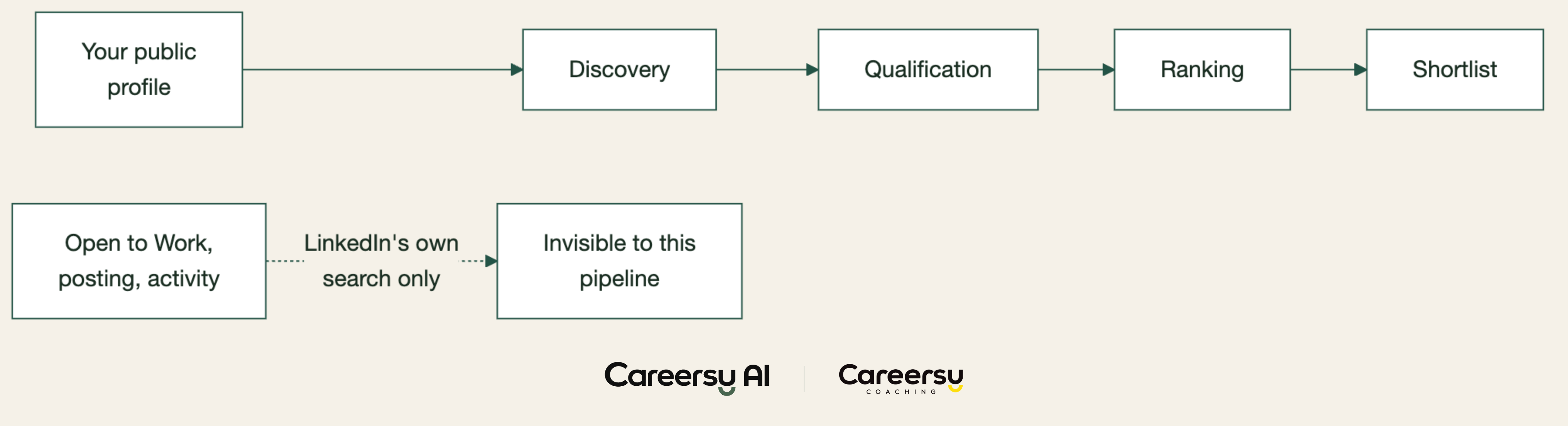
Most profile advice only ever touches discovery. So I pushed on the part everyone actually worries about: does posting more help, does turning on Open to Work help, does editing your profile every week keep you visible. The tool was flat about it. None of that moves its ranking at all. Open to Work is a signal recruiters see inside LinkedIn's own paid product, a separate pipeline this kind of tool never reads. Posting frequency, connection count, follower count, none of it factors into how it orders a shortlist. It reads your public profile the same way whether you posted yesterday or a year ago.
That's most of the advice you've been given about staying visible, and it's aimed at a mechanism this class of tool doesn't even use.
What actually moves you is recency of relevant responsibility. Managing a platform team right now outranks having done it eight years ago. A three-year-old bullet with real scope in it beats a profile you edited this morning with nothing new written into it.
How to make yourself legible
Six changes, ordered by how much they actually move your ranking. None of them touch your real experience.
1. Read your headline as a sentence.
"Engineering leader | Cloud | DevOps | Builder" is keyword soup. A model reads it as noise. Write what you'd actually say out loud: "Cloud architect leading platform migrations for fintech teams." Plain language is the language the search now speaks.
2. Rebuild your About around the search.
Most About sections are a personal essay. Make yours the answer to the query a recruiter would type: what you do, at what level, in what domain, and what it produced. The first three lines carry the most weight, so put the role and the proof there, not your origin story.
3. Format for an eight-second skim.
A model and a rushed recruiter want the same things: numbers and named systems. "Led a team" is invisible. "Led 6 engineers migrating 40 services to AWS" is legible. Concrete nouns and figures are what a search can grab and a skim can catch.
4. Match your title to the job you want.
This is the one that sinks senior people without them ever noticing why. If you do architect-level work but your profile says "Senior Engineer", a search for "cloud architect" can skip straight past you. Name the role you're already doing.
5. Fix your current role, not your activity.
Go into the job you hold right now and write what you actually own, in a sentence a stranger could act on: what you managed, how many people, what shipped because of it. That is the one edit the ranking actually reads. Posting about it does not substitute for writing it down.
6. Test it with an LLM first.
Paste your profile into ChatGPT and ask: "If a recruiter searched for [your target role], would this profile come up, and what's missing?" You'll get an unsentimental read of how a machine parses you. That's the read that now happens before any human's.
What this looks like done for you
Careersy AI's AI Discoverability check scores how visible you are to the AI sourcing tools recruiters actually run, names what is keeping you out of the results, and shows you what to change to start showing up.
I built it because I kept doing this read by hand and finding the same thing. The problem was rarely the person. The system reading them first couldn't tell what they were, and no one had ever told them that system was there. Years of watching how hiring actually works taught me how short and fixable that list of problems usually is.
You don't need a perfect profile
The engineer from the start never touched his resume. We rewrote his headline, restructured his About, and changed his title to match the work he was already doing. Within a couple of weeks he was turning up in searches that had skipped him for months.
He didn't get more qualified. He got legible.
You don't need a perfect profile. You need one sentence in your current role that would survive being turned into a search filter. Go find it tonight.
Run the check on your own profile →
FAQ
Does updating my LinkedIn profile more often help me show up in AI-assisted searches?
Not by itself. The profile-update timestamp carries close to no direct weight in how these tools rank a candidate. What moves the ranking is new substantive content in your experience section, current scope, team size, outcomes, not the fact that you touched the page today.
Does posting on LinkedIn or turning on Open to Work help me rank higher in an AI sourcing tool's results?
No, for a tool reading your public profile from outside LinkedIn. Open to Work, connection count, follower count and posting frequency are signals inside LinkedIn's own recruiter product, a separate system. An external AI sourcing tool reading your public profile does not use any of them to rank you.
What counts as keyword stuffing now?
Usually not what people assume. Modern filters don't penalise you for how many keywords appear, they check whether each one is tied to a specific role, date and outcome. A skills list full of terms with no supporting detail underneath gets discounted, not counted.