The tech job market in Australia and New Zealand, November 2026
Eli Gunduz··9 min read
Share
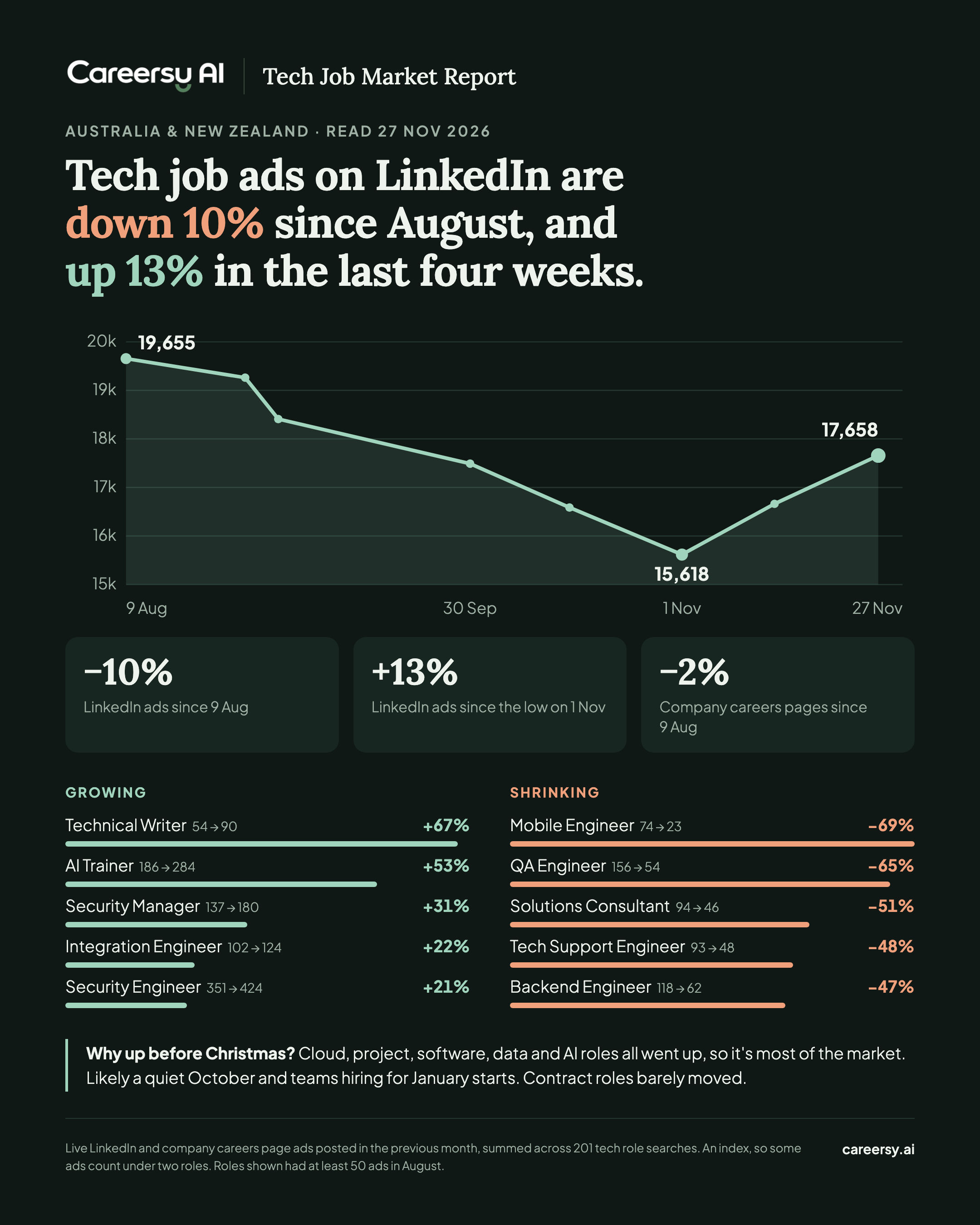
Tech ads since August. LinkedIn ads fell until 1 November, then rose again. Company career sites barely moved.
Since August, Careersy AI, the AI I'm building to help job seekers, has been counting the live tech job ads across Australia and New Zealand every two weeks. It runs the same 201 role searches each time, on LinkedIn and on company career sites. One ad can show up under two roles, so the totals show which way things are moving, not an exact number of ads.
I started it because most of what people hear about the job market is a headline or a feeling. When you're the one applying, you deserve to know whether it's you or the market, and which roles are actually growing. Here's what I'd point out if we were going through it together.
Fewer tech ads on LinkedIn, not on company websites
Tech ads on LinkedIn are down 10% since August. They dropped every time we counted until 1 November. Then they went up 13% in four weeks. If your search felt slow in October, it wasn't in your head. There were fewer ads to apply to.
Ads on company career sites barely moved. They're down 2% over the same months. LinkedIn still has about three times as many ads, so it's still the main place to look. But some employers post on their own careers page first, and some only post there. If LinkedIn is the only place you look, you'll miss those roles. And LinkedIn is where ads dropped the most.
What you can do: pick ten companies you'd love to work for. Go to each company's own website and find their jobs page. Look for roles like yours. Then check whether those same jobs are on LinkedIn. If some aren't, those are jobs that people who only search LinkedIn will never see. Keep checking those company pages every week.
Why tech ads went up in November
This is the part most people want to know first. We'll never know for sure, because an ad doesn't say why it was posted. So here's what we know, then my best guesses and what backs each one.
What we know: LinkedIn tech ads dropped at every count from August to 1 November, about 20% in all. The government's own count says the same thing. Jobs and Skills Australia found tech job ads hit a record low in October, as reported by ACS Information Age. So the low point wasn't just our count.
Then ads went up at both counts in November, 13% in all. Cloud, project and delivery, software, data and AI roles all went up. Only engineering leadership and graduate roles went down. So it's most of the market, not one area.
My best guesses, most likely first:
Hiring that was put off came back. Some of the roles that dropped the most came back the most. Software engineering ads dropped 31% to 1 November, then went up 14%. Data ads dropped 24%, then went up 19%. But not every role came back. QA and IT support both dropped more than a quarter and barely moved in November. So some teams have started hiring again, and some roles are still shrinking.
Teams want people signed before the break. That's usual at the end of the year, so people can start in January. But the ads don't tell us. Only about 1 in 300 November ads mention a January start, so I can't back this one with our numbers.
Budget left over at the end of the year. If that were the main reason, you'd expect mostly contract roles. Contract roles were about 1 in 5 LinkedIn tech ads in October, and about the same in November. So contracts went up about as much as everything else. Budget could still be part of it, but the rise isn't mainly contracts.
One more thing. Company careers pages didn't show the rise. We counted them at the end of September and again on 27 November, and they were a little lower. So the rise we can see is on LinkedIn. That's not a surprise. An ad on LinkedIn or a job board runs for a set time, 30 days for example, and then it expires. An ad on a company's own careers page usually stays up until the job is filled or someone takes it down. So company pages hold older ads as well as new ones, and their numbers move more slowly. LinkedIn shows a drop or a rise sooner. The next count will show whether company pages catch up. The government's November numbers come out in mid-December, and I'll check ours against them then.
What you can do: apply now. The usual advice is to wait until January. But there are 13% more tech ads on LinkedIn than four weeks ago, whatever the reason, and they're open now.
The tech roles that grew
Cyber security grew the most of any group of roles, up 17%. Security engineer ads went from 351 to 424. Security manager ads went up 31%. AI trainer roles went from 186 to 284. Technical writer ads went up too, from 54 to 90. That's a small number to start from, so it's a good sign, but don't read too much into the percentage.
What you can do: if part of your work overlaps one of these roles, put that role's name in your LinkedIn headline and near the top of your CV. Recruiters find people by searching for job titles. If the words aren't on your profile, you won't come up in their search.
The tech roles that shrank
Mobile engineering dropped the most, from 74 ads to 23. QA engineer ads dropped 65%. Backend engineers, analytics engineers, technical support engineers and solutions consultants each lost about half their ads. Looking at bigger groups of roles, technical sales and customer roles dropped 33%. Quality engineering and IT support both dropped 26%.
If your role is on this list, I know that's hard to read.
What you can do: before you decide your field is shrinking, check whether the work has moved to a different title. Search your own title, then the two titles closest to it, and compare how many ads each one has. If a nearby title has more ads and the work matches what you do, search under that title too. You can do this by hand in a few minutes. Market Radar in Careersy AI also tracks how many jobs are open for your role in your location, if you'd rather not count.
Tech jobs by city
Canberra was the only city where ads went up, by 5%. Sydney and Melbourne were both down 17%. We count cities on LinkedIn once a month, so those numbers are a couple of weeks behind the national ones, and they miss most of the November rise.
What you can do: if you're in Sydney or Melbourne, don't read the drop as a reason to stop. Those two cities still have far more tech ads than anywhere else. Set your job alerts for your city plus remote, because about 1 in 10 ads is fully remote, and those are open to you wherever you live.
What tech job ads ask for
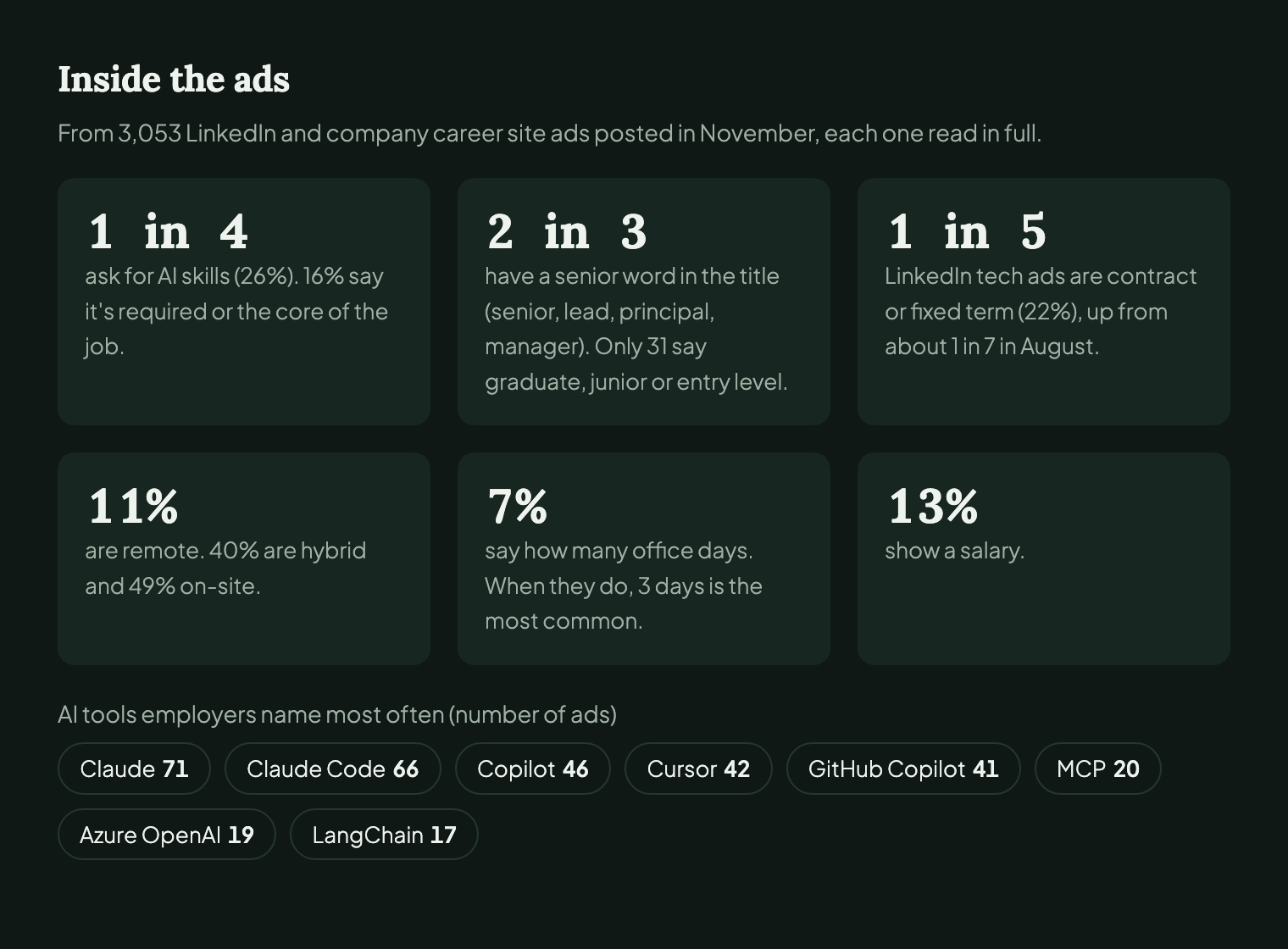
We also read 3,053 of the ads posted in November, all the way through. Here's what stood out.
About 1 in 4 ask for AI skills. For about 1 in 6, it's a must-have or the main part of the job. The tools named most often are Claude, Claude Code, Copilot and Cursor.
Two in three have a senior word in the title, like senior, lead, principal or manager. Only 31 of the 3,053 said graduate, junior or entry level. Some of our searches are for senior roles by name, so the real share is a bit lower. If you're early in your career and finding it hard, this is a big part of why.
About 1 in 5 LinkedIn tech ads is a contract or fixed-term role, up from about 1 in 7 in August. Only 13% show a salary. And only 7% say how many days you need to be in the office.
What you can do: add one line to your CV about how you've used AI in your work, and what it changed. For example: "Used ChatGPT to draft test cases, which cut my prep time from two days to half a day." There's more on that in how to prove you're AI-native. If you've been ruling out contract roles, look at them again. There are more of them than in August, and a contract can turn into a permanent role. And since most ads don't say the office days or the salary, ask about both in your first call, so you don't find out at the final interview.
What these numbers can't tell you
An ad is not a hire. We count ads, not the people who got the jobs.
Four months is also too short to tell a real slowdown from the usual spring and summer pattern. We started in August, so there's no last November to compare with yet.
And if you're sending applications and nothing comes back, a slower market is part of it. It isn't all of it, and this count can't tell you how much is the market and how much is your CV.
The short version
Check company careers pages, not only LinkedIn.
If a growing role overlaps your work, put its name in your headline and CV.
Search your title and the two closest to it before you decide your field is shrinking.
Apply now, not in January.
Set your job alerts for your city plus remote.
Add one line to your CV about how you've used AI and what it changed.
Is the tech job market in Australia getting better or worse?
Both, depending on when you look. Tech ads on LinkedIn are down 10% since August. But they've gone up 13% in the four weeks since 1 November, and the rise covers most of the market.
Which tech roles are growing in Australia and New Zealand?
Cyber security grew the most of any group of roles, up 17%. Security engineer ads went from 351 to 424, and security manager ads went up 31%. AI trainer roles went from 186 to 284.
Why did tech job ads go up in November?
We'll never know for sure. The best-backed guess is that hiring put off in October came back: the roles that dropped most mostly came back most, and the government's count put October at a record low. Company careers pages didn't show the rise.
Should I wait until January to apply for tech jobs?
No. There are 13% more tech ads on LinkedIn than four weeks ago, and they're open now.
How many tech job ads ask for AI skills?
About 1 in 4 of the 3,053 November ads we read. For about 1 in 6, it's a must-have or the main part of the job.
How were these numbers counted?
Careersy AI runs the same 201 tech role searches every two weeks on LinkedIn and company career sites in Australia and New Zealand, starting 9 August 2026. One ad can count under two roles, so the totals show which way things are moving, not an exact number of ads.
tech job marketaustralianew zealandjob market reportlinkedin jobs