Australia just ranked second globally for tech job losses. Sydney ranked third. In the first ten weeks of 2026, more than 4,450 Australian tech and corporate roles were cut. Atlassian let 1,600 go, WiseTech cut 2,000, Telstra 650, and CBA trimmed hundreds while posting a record profit.
On top of that, 65% of recruiters now rely on AI to source and screen candidates. LinkedIn's own AI claims it reduces profile reviews by 81%. You are being filtered out by a model before a human ever sees your name.
This is the shape of the shift Ryan Roslansky, LinkedIn's CEO, and Aneesh Raman, his chief economic opportunity officer, describe in their March 2026 book Open to Work. Backed by data from over a billion professionals on LinkedIn, they argue we are moving out of the knowledge economy and into what they call the innovation economy. "Work is going to change, work is not going to end," Raman puts it. "The knowledge economy is on the way out." Work is changing shape faster than the career playbook you inherited can adapt to.
If you are applying into this and not getting anywhere, the problem is not the market. The problem is that you are still trying to win the 2022 job search in 2026.
This is not another piece telling you to "tailor your resume" and "network more." Most of what passes for job search advice in 2026 is making the situation worse, because it treats the problem as a behaviour problem when it is actually an identity problem, dressed in a market that has changed underneath your feet.
I have been on the hiring side of the Australian and New Zealand tech market for 13+ years. I have made hundreds of shortlisting decisions and put in 5,000+ interview hours, at Atlassian, Airwallex, Mantel Group, and TOM Executive, recruiting for companies including Macquarie Bank, CBA, Westpac, Woolworths, and Pepper Finance. The patterns I am about to lay out are not theory. They are what I see, on repeat, in the candidates who break through and the ones who don't.
This applies whether you're a graduate trying to land your first role or a director making a lateral move. The trap and the fix have the same shape. Sometimes the trap is harder at the entry level, because the work AI is absorbing fastest is exactly the kind of work juniors used to do to prove themselves.
I want to share seven ideas on behaviour change, psychology, and the actual mechanics of the 2026 tech job market, so that you can launch yourself toward the next role without quitting after six weeks.
This is comprehensive, so bookmark it and set aside a Sunday. The protocol in Section VI takes roughly one day to complete, and the effects last far longer than that.
Let's begin.
I. You're applying as who you are, not as who'd be hired
When tech professionals set out to land a new role, whether you're a graduate looking for the first job or a director making a lateral move, you tend to focus on one of two levers.
- Changing what they do, more applications, more polish on the CV (least important, second order).
- Changing who they are, so that the application reads as something other than what it currently reads as (most important, first order).
Most candidates pick the first lever. They send 200 applications. They iterate on the CV three times. They post twice on LinkedIn. They wait, they stop posting, and they go back to the same loop.
It is not a discipline problem. It is a foundation problem.
Think of someone you know who landed the role you want. The graduate who got into a competitive associate program when most of the cohort got nothing. The peer who jumped from senior to staff. The director who pulled off a lateral into a new domain. Do you think they were grinding to look like that level? They could not see themselves as anything else. The way they spoke, the decisions they referenced, the problems they brought up unprompted, all of it read as someone who had already been operating at that level for a long time.
To you, that might look like polish. To them, it is the only way they can describe their work, because that is who they are.
Here is the sentence most candidates miss:
If you want a specific role, you must have the identity that produces that role long before you get it.
I do not believe the graduate who says they want a role at Atlassian or Canva when their CV reads as a CS undergrad with three uncoordinated projects. I do not believe the senior engineer who says they want a Staff role but still describes their work in terms of "what I built" rather than "what I decided." Different floors, same gap. The words they use about themselves don't line up with the role they're aiming for, and that gap is exactly what a recruiter sees first.
Candidates don't get filtered out because they are unqualified. They get filtered out because their CV and LinkedIn read as one level below where they are pointing, or one role-shape sideways from what they actually want. The market never sees them as a candidate for the role they're actually aiming at.
This is the gap the AI Discoverability mode is built to surface. It runs your profile and CV through the same search and ranking logic the recruiter-side AI tools use, and it shows you the specific lines that read as "the person you used to be" rather than "the person you are trying to become." That gap is fixable. It is just usually invisible from inside.
You say you want the next role. Your actions, and the words you use about your work, show otherwise for a reason. It is not a discipline thing. It goes deeper.
II. You aren't getting hired because part of you doesn't want to be
Trust only movement. Life happens at the level of events, not of words.
Alfred Adler
If you want to understand why your job search is stuck, understand this: all behaviour is goal-directed. Including the behaviour that looks self-defeating.
This is uncomfortable, so most people skim past it. Stay with me.
You take a step forward because you want to reach a location. You open the laptop because you want to start work. These are obvious goals. But many of your goals are unconscious, and the unconscious ones are the ones running your job search.
If you cannot stop sending generic applications to roles you do not really want, you might tell yourself it is a discipline problem or a market problem. The actual goal underneath that behaviour is usually one of:
- Looking like you are trying, without exposing what you actually want
- Avoiding the judgment of putting your real positioning out there and being rejected
- Maintaining your identity as a hard worker, even though the hard work is going into the wrong shape
- Protecting yourself from the discovery that you might not be at the level you assumed
These are not character flaws. They are intelligent adaptations to a painful situation. You found a way to keep moving without risking the deeper rejection. The cost is that you stay where you are for years.
Real change in a job search requires changing the unconscious goal. Not the surface goal of "get a new role." The deeper goal of "stay safe from being seen wanting something I might not get."
This is the work most career advice does not do, because it is unflattering. It is also the work that separates the candidates who break out from the ones who keep grinding.
The first move is to be honest about what your job-search behaviour is actually producing for you right now. If you have been applying for six months with no traction and you have not changed your CV's positioning, your LinkedIn headline, or your target list in any meaningful way, you are not "trying and failing." You are succeeding at a goal you are not admitting. The goal is to keep applying without ever exposing what you really want, so you can stay disappointed but safe.
Careersy AI's CV Enhancement mode reads your CV through three lenses, the ATS that parses it, the recruiter who skims it in eight seconds, and the hiring manager who signs off on the level. It is uncomfortable to read because it shows you, in flat language, what the document is actually signalling to all three. Not what you intended to signal. What it signals.
If you can see what your CV is doing, you can decide if it is doing what you want. If you cannot see what it is doing, you cannot.
III. You aren't getting hired because you're afraid to be that person
The important thing is that it does not matter where you got the idea. If you have accepted an idea, and further, if you are firmly convinced that idea is true, it has the same power over you as the hypnotist's words have over the hypnotized subject.
Maxwell Maltz
Here is how identity is built, and how it gets stuck:
You take a job. You get good at it. You receive feedback that confirms you are good at it. You repeat until the behaviour automates and the label sticks. "I am a senior backend engineer." "I am an experienced PM." You start to defend that label, because identity, once formed, defends itself.
Then the market shifts. AI changes what senior backend engineers do. The job you trained for is being absorbed by tools. The next level up, Staff, requires you to operate as someone who decides what gets built, not someone who builds what is decided. And you cannot make that move because to make it you would have to let go of being "the person who builds things really well."
When the body feels threatened, fight or flight kicks in.
When the identity feels threatened, the same thing happens.
You feel the stress. You double down on the old positioning. You apply to more senior-backend-engineer roles, even though half of them are getting consolidated or replaced. You tell yourself you are being practical. What you are actually doing is protecting the identity that the market is increasingly not asking for.
This is why "level-up" advice usually fails. It treats the question as a skill question. The question is actually an identity question. "Am I willing to stop being the person I have been good at being, in order to become someone the next ten years of this industry will actually want?"
Most people, when faced with that question, freeze. Then they go back to applying.
The graduate who would be a great junior at a top tech company is afraid to write the title they want on their LinkedIn because they haven't done that job yet. The senior IC who would be a great Staff Engineer is afraid to write "Staff Engineer" on their headline because they're not Staff Engineer yet. Same trap, different floor. Nobody searches for "almost ready." The role you want is the identity you would have to give up first.
This is the part where most of the people I work with admit, after a few sessions, that they have been job-searching for the role they already had, hoping someone else would notice they had grown out of it. Nobody does. Not because they are unkind. Because the market does not see candidates. It sees the words candidates use about themselves.
IV. The job you want exists at a different level of agency
So Good They Can't Ignore You: career capital is the rare and valuable skills that create the rare and valuable opportunities.
Cal Newport
Career identity develops in predictable stages, in the same way personal identity does. The stage you are at determines the roles you can see, the offers you take seriously, and the moves that feel impossible.
But the path through these stages isn't a straight ladder. As Roslansky and Raman point out in Open to Work, the career ladder is a relic of the industrial age, built for a world where jobs stayed the same and skills lasted decades. Today's career path is more like a climbing wall: multiple routes up, sideways moves that build new skills, sometimes going down to find a stronger foothold. The best climbers design their own route instead of borrowing someone else's.

Most of the people I work with are stuck somewhere between stages two and four below, whether they're four years into their career or fourteen, and the gap to five is what feels uncrossable.
1. Survivor. Any job. Decisions are made out of fear of unemployment. Common at the very start of a career or after a long gap. Head down, anxious, will accept anything.
2. Conformer. The role expected of you. The CS grad applying to graduate programs because that's what CS grads do. The Senior Engineer staying senior because that's what ten years in tech is "supposed" to make you. Career decisions track the expectations of family, university friends, and the company hierarchy.
3. Achiever. The role that earns respect: title chasing, salary chasing, brand chasing. Stage three is the most common plateau in tech, whether you're four years in or fourteen. Everything is calibrated to external validation. You are still on the conveyor belt, just a faster one.
4. Builder. The role that compounds your career capital. The Cal Newport stage. You start picking roles based on the skills, problems, and people they will expose you to, not the title or the brand. This is where the real career leverage starts to accumulate, but it requires giving up the validation logic from stage three.
5. Architect. The role that lets you shape the system. You start choosing scope over salary, problems over titles, ownership over politics. This stage looks expensive from the outside (you pass on bigger numbers) and is where the real long-term value compounds.
6. Founder. The role that does not exist yet. You make it. Could be a company, could be a job title that did not exist when you started, could be a function inside an existing org. The work is creating the seat, not finding one.
This is where Roslansky and Raman's argument lands hardest. In Open to Work, drawing on data from over a billion professionals on LinkedIn, they describe the shift from the knowledge economy, where deep but narrow expertise inside a known function was the win, to the innovation economy, where the human capabilities they call the 5Cs become the new hard skills. The 5Cs: curiosity, courage, creativity, compassion, communication. Their argument is that as AI absorbs the intellectual mechanics of work, the value left over is the part of the work AI cannot do, and that part is shaped by those five.
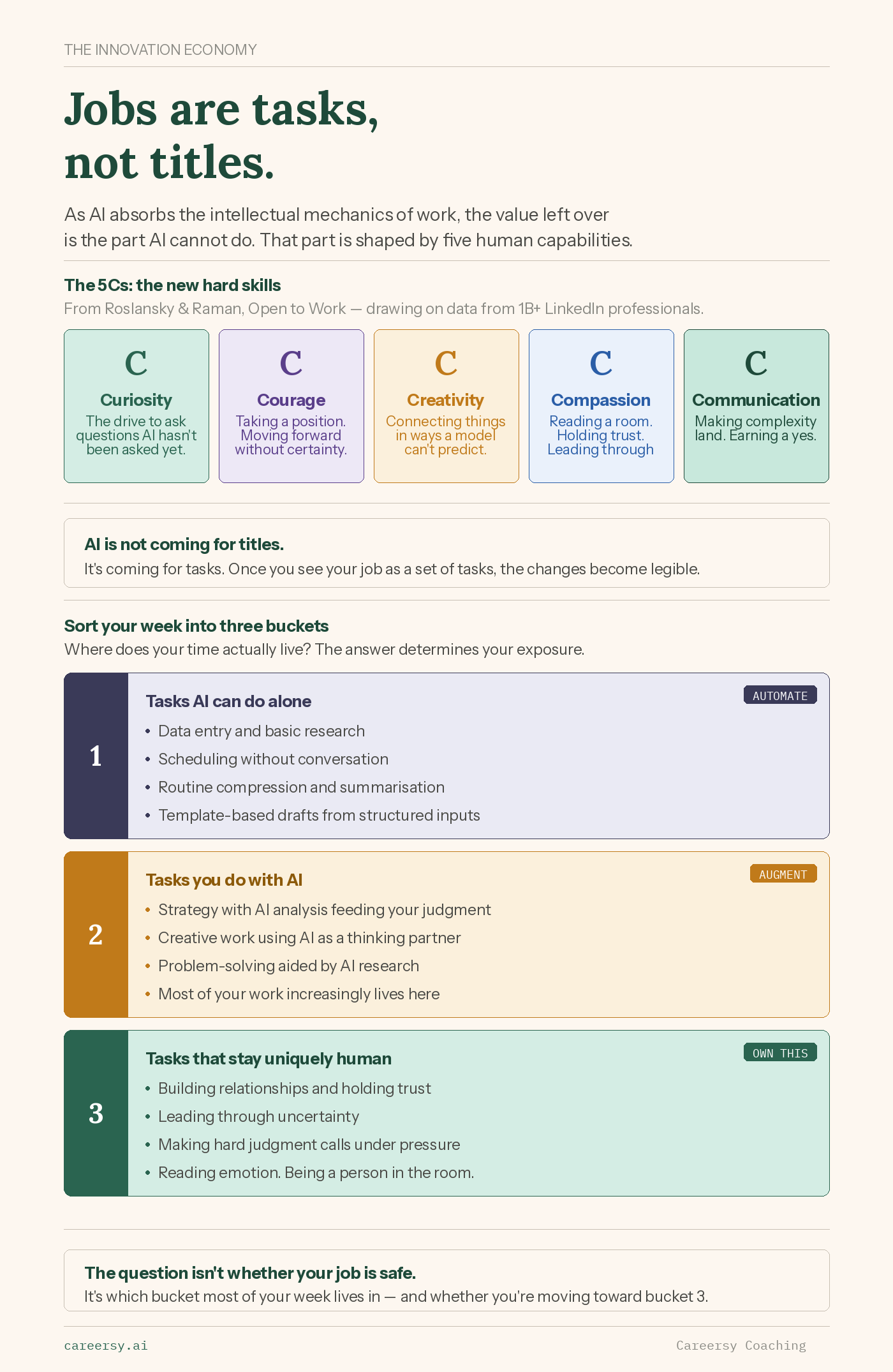
Their second insight pairs with the first, and it's the one I'd ask you to sit with: jobs are tasks, not titles. For decades you've defined yourself by your title (engineer, designer, PM, manager), because the title told the company where to slot you. But AI is coming for tasks. Once you see your job as a set of tasks rather than a label, the changes become legible. Roslansky and Raman ask you to sort the tasks that fill your week into three buckets:
- Bucket 1: tasks AI can do alone. Data entry, basic research, scheduling without conversation, the routine compression work.
- Bucket 2: tasks you do with AI. Strategy with AI analysis, creative work with AI tools, problem-solving aided by AI research. Most of your work will increasingly live here.
- Bucket 3: tasks that stay uniquely human. Building relationships, leading through uncertainty, making hard judgment calls, anything that needs you to read emotion or hold someone's trust.
Think of those three buckets as a conveyor belt: Bucket 1 disappears, Bucket 2 expands, Bucket 3 deepens. The career work in 2026 isn't about defending your title. It's about deliberately moving your time from Bucket 1 to Bucket 2, and freeing the space that creates to do more Bucket 3 work, because that is where the durable value lives.
Map that onto the career-stage ladder. Stage three (Achiever) was built for the knowledge economy. The signals that got you ahead there, predictable title progression, deep but narrow expertise, fluency inside one function, are exactly the signals AI is best at compressing. Stage four (Builder) is where the innovation economy starts to reward you, because the work that compounds there is the work that requires judgment AI can't make and decisions AI can't own. Cal Newport calls the underlying asset career capital. Roslansky and Raman call it the 5Cs. Naval Ravikant called it specific knowledge in his 2018 "How to Get Rich" thread: "knowledge that you cannot be trained for, and it cannot be outsourced or automated." Three labels, one through-line: the value that accumulates is the human side.
Most of the candidates who come to me are in stage three and frustrated. Their CV is built for stage three. Their LinkedIn headline is stage three. Their target list is stage three. They are applying for roles that other stage threes are also applying for, in a market that has more stage threes than it has roles for, and they cannot see why they are not winning.
A better stage three CV will not get you out. The way out is the slow, identity-level work of moving to stage four. Picking the role that builds the next decade of capability, even if the title is sideways or the comp is flat. Writing your LinkedIn to reflect the work you want to be known for, not the work you are escaping.
The 2026 tech market is harsh on stage three. It is kind to stage four and above. The candidates I see breaking through right now are not the ones who got better at applying. They are the ones who changed who they were applying as.
V. Career intelligence is the ability to get hired
The only real test of intelligence is if you get what you want out of life.
Naval Ravikant
There is a formula for landing a tech role in 2026.
One ingredient is agency: how likely you are to actually act.
One ingredient is opportunity: the live ANZ job feed, the network you have, the visa status you bring.
The last ingredient is intelligence, in the cybernetic sense.
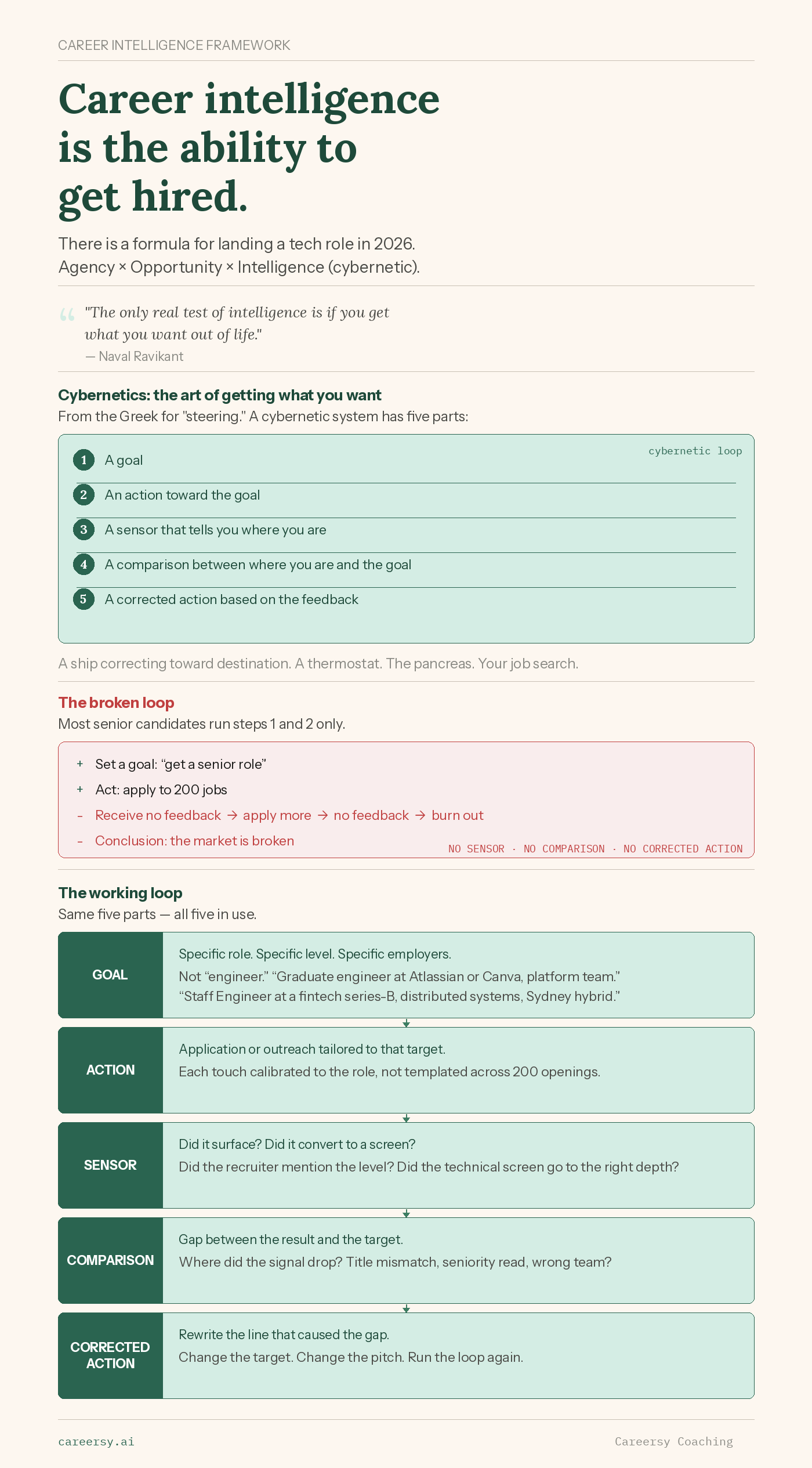
Cybernetics is the Greek word for "steering." It is also called "the art of getting what you want." A cybernetic system has five parts:
- A goal
- An action toward the goal
- A sensor that tells you where you are
- A comparison between where you are and the goal
- A corrected action based on the feedback
A ship that drifts off course and corrects toward its destination, a thermostat, the pancreas. Your job search.
Or, more often, not your job search. Because the broken loop most senior candidates run looks like this:
Set a goal ("get a senior role"). Act on it by applying to 200 jobs. Receive no feedback, apply more, receive no feedback, burn out, and decide the market is broken.
There is no sensor, no comparison, no corrected action. The loop has steps 1 and 2 only. What that produces is a stress response with a job board attached.
The working loop looks different:
- Goal: a specific role, at a specific level, with specific employers. Not "engineer" or "product manager." "Graduate engineer at Atlassian or Canva, platform team." "Staff Engineer at a fintech series-B with distributed systems work, in Sydney, hybrid." Different levels, same precision.
- Action: an application or outreach tailored to that target.
- Sensor: did it surface, did it convert to a screen, did the recruiter mention the level, did the technical screen go to the right depth.
- Comparison: gap between the result and the target.
- Corrected action: rewrite the line that caused the gap, change the target, change the pitch.
Most candidates skip the sensor. They send applications into a void and never check what came back, except as a binary "interview / silence." That is not a sensor. That is a yes-or-no light, and the no-light gives you no information to correct with.
This is the entire reason Careersy AI exists. The product is a sensor for the job search. The AI Discoverability mode shows you how findable you are to recruiter-side AI tools so you can see what the market sees. The CV Enhancement mode shows you what the document is signalling. The Smart Job Search and Opportunity Intelligence modes cross-reference the active sponsor list and the people who actually decide hires against your target role, so you stop pouring applications into employers who never had any intention of considering you. Each one closes the loop that most candidates leave open.
A search without feedback is a wager. And in this market, the wager is not paying.
The shift from broken loop to working loop is the highest-leverage thing you can do in your job search in 2026. It does not require a new CV. It requires a new way of running the same week.
VI. How to launch your next job search in 1 day
The best moves in my own career, and in the careers of every senior candidate I have ever seen break out, started with a build-up of tension, then one day that broke the pattern.
There are three phases.
Dissonance. You stop being able to live with the gap between where you are and where you want to be. The gap gets uncomfortable enough that the cost of staying outweighs the cost of changing.
Uncertainty. You don't yet know what to do. Most people retreat back into the old behaviour here. The ones who break through tolerate the uncertainty.
Discovery. You see a direction with enough clarity that the noise drops away. Six years of progress fit into the next six months because there is nothing else in your head.
This protocol is built to compress those three phases into a single day. You set aside a Sunday, take a pen and paper, and do the work below.
I cannot promise this will work for everyone. I can promise it has worked for every senior candidate I have seen take it seriously.
Part 1: Morning, the career excavation (90 minutes)
The goal of the morning is to create a brutally honest picture of the career you do not want, then a clear sketch of the career you do.
Get a pen and paper. No laptop, no AI: the friction is the point.
Anti-vision questions (work through all of them):
- If nothing changes in your career for the next five years, describe an average Tuesday. Where do you wake up. What does your body feel like. What is the first thing you think about. Who are you working with. What do you do between 9am and 6pm. How do you feel at 10pm.
- Now do the same exercise for ten years out. What did you not become. What career-defining role did you not get to. Who gave up on you. What do people in your industry say about you when you are not in the room.
- You are at the end of your career. You took the safe path. You never broke the pattern. What did you never let yourself try. What did the safety cost.
- Who in your industry is already five or ten years ahead on the same trajectory you are on? What do you feel when you think about becoming them.
- What identity would you have to give up to actually move? Finish this sentence: "I am the type of person who…" What would it cost you socially to no longer be that person.
- What is the most embarrassing reason you have not made the move? The one that makes you sound weak or scared rather than reasonable.
- If your current job-search behaviour is a form of self-protection, what exactly are you protecting? What is that protection costing you in career capital.
If you answered those honestly, you will feel a specific kind of discomfort. That discomfort is the energy. Do not waste it.
Vision questions (turn the energy toward something):
- Forget what is realistic. If you could be in a different role in three years, what does an average Tuesday look like. Same level of detail as the anti-vision question.
- What would you have to believe about yourself for that role to feel natural rather than forced. Write the identity statement. "I am the type of person who…"
- What is one thing you would do this week, today even, if you were already that person.
- Why do you work? Not the easy answer. What is actually driving you to show up each day? Financial security, purpose, autonomy, the people, something else.
- What do you uniquely do? What is the combination of skills, experiences, and instincts only you bring?
- Where are you going? What problems do you want to solve, and who do you want to solve them with?
The last three are Roslansky and Raman's climbing-wall questions from Open to Work. They are the ones that help you design your own route up instead of borrowing someone else's.
Then one more exercise. Take a fresh page. Write down the dozen tasks that take up most of your work week. Not your job description. Not your goals. The actual things you do day to day. Now sort them into the three buckets from Section IV (Bucket 1 is what AI does alone, Bucket 2 is what you do with AI, Bucket 3 is uniquely human work). Look at the sort. Which Bucket 1 tasks are still eating your week? Which Bucket 3 tasks are you starving for time on? That gap is the work to do. The career direction isn't about defending your title against AI. It is about deliberately moving your time from Bucket 1 to Bucket 2 and freeing the space to deepen Bucket 3.
By the end of the morning, you should have a clearer picture of the career you are running from and the career you are running toward than you have had in years. That is enough for now.
Part 2: Daytime, interrupting the autopilot
The morning's work is undone the moment you go back to scrolling job boards on autopilot. So we are not going to let you go back to autopilot.
Right now, open your phone and set six reminders for today. Include the question text in each reminder so you cannot avoid it when it goes off.
- 11am. What am I avoiding right now by doing what I am doing.
- 1pm. If someone watched the last two hours of my job search, what would they conclude I actually want from my career.
- 3pm. Am I moving toward the career I hate or the career I want.
- 5pm. What is the most important thing I am pretending is not important.
- 7pm. What did I do today out of identity protection rather than genuine desire.
- 9pm. When did I feel most alive in my work this year. When did I feel most dead.
Each ping is two minutes. Sit with the question. Write the answer in the same notebook. Do not let the day swallow the morning's work.
If you want to push further, schedule three additional questions for commute or walks:
- What would change if I stopped needing people to see me as [the identity I wrote in the morning].
- Where in my career am I trading aliveness for safety.
- What is the smallest version of the person I want to become that I could be tomorrow.
These questions are not magic. They just refuse to let you forget what you uncovered in the morning. That is what most career resets miss. The clarity does not stick on its own. You have to refuse to let it slip.
Part 3: Evening, synthesis and the 1-month plan
You have anti-vision, you have vision, you have a day of interruptions. Now you turn it into a plan.
Take ten minutes for each question.
- After today, what feels most true about why you have been stuck.
- What is the actual enemy. Not the market, not the recruiters, not the AI. The internal pattern or belief that has been running the show.
- Write a single sentence that captures the career you refuse to let yourself have. This is your anti-vision compressed. It should make you feel something.
- Write a single sentence that captures what you are building toward, knowing it will evolve. This is your vision MVP.
Now the goals. Not goals for the sake of achievement, the way a productivity book would frame them. Goals as points of view. Lenses you put on to walk into a job-search week as the person you are becoming rather than the person you have been.
- One-year lens. What would have to be true in one year for you to know you broke the old pattern. One concrete thing: a title, a salary band, a specific employer, a category of work.
- One-month lens. What would have to be true in one month for the one-year lens to remain possible. What positioning work, what target-list work, what skill investment.
- Daily lens. What are two or three actions you can timeblock tomorrow that the person you are becoming would simply do.
That last one is the most important. Two or three. Not ten. The person you are becoming does the small actions consistently. That is how the identity actually shifts.
This is where the Careersy AI workflow starts to do real lifting. The Career Direction mode sits with you on the synthesis. It takes your vision MVP, your one-year lens, and your honest current state, and it surfaces the gap between where you are and where you are going as a specific list of positioning, targeting, and skill investments, not a vague aspiration. It is the system that takes the Sunday work and turns it into a Monday plan.
If you make it through all three parts in a day, you will have done more career work than 99% of people in tech do in a year. Most career advice will tell you the work is in the applications. The work is here. The applications are the easy part once this is done.
VII. Turn your job search into a system
The optimal state of inner experience is one in which there is order in consciousness. This happens when psychic energy is invested in realistic goals, and when skills match the opportunities for action.
Mihaly Csikszentmihalyi
You now have the components. The last step is to turn them into a system you can run every week, not a one-time exercise.
Take a fresh page. Write down these six things.
- Anti-vision. The career you refuse to have. One sentence.
- Vision. The career you are building toward, knowing it will evolve.
- One-year goal. The concrete thing that will be true if you broke the pattern.
- One-month project. The specific positioning, targeting, and skill work that makes the one-year goal possible.
- Daily levers. Two or three actions that the person you are becoming would just do.
- Constraints. What you will not sacrifice to get there.
These six are not a planner. They are a game.
Your vision is how you win. Until the game evolves, which it will.
Your anti-vision is what is at stake. The career you end up with if you lose interest.
Your one-year goal is the mission.
Your one-month project is the boss fight.
Your daily levers are the quests.
Your constraints are the rules. The limitations that force you to be creative instead of brute-forcing.
These six act as a force field around your attention. The longer you run inside them, the stronger it gets. After a few months, applications you used to send out of habit feel wrong. Outreach you used to skip feels obvious. The market that ignored you starts responding, because the candidate you are showing them is a different one from the candidate you were six months ago.
This is what the full Careersy AI workflow is built to support. The eleven modes are the game engine.
- AI Discoverability is the recruiter-side mirror. It shows you the gap.
- CV Enhancement rewrites the document so it signals the level you are operating at.
- Smart Job Search runs the target list against the live ANZ market and the active sponsor list.
- Opportunity Intelligence finds the specific decision-makers worth approaching for the roles you want.
- Interview Preparation runs you through the screens for the level you are targeting, not the level you are leaving.
- Salary Negotiation holds the constraints when the offer comes.
- Career Direction sits with you on the bigger picture when something starts to drift.
Each one closes a feedback loop most senior candidates leave open. None of them replace the morning excavation in Section VI. They sit on top of it. The excavation gives you the game. The product makes the game playable in a week instead of a year.
The 2026 market does not reward effort
It rewards the candidates who saw the shift earlier than the rest and changed who they were as a result.
AI is going to keep eating the parts of tech work that look like execution. The roles that stay are the roles that require judgment, ownership, decisions made under uncertainty, the things AI is still bad at. The candidates who land those roles in 2026 are the ones whose CV, LinkedIn, and self-description already read as judgment, ownership, decision-making.
What Roslansky and Raman remind us at the end of Open to Work is the other side of that coin. When AI handles the standard, your differences become your competitive advantage. The combination of failures and wins that taught you resilience. The unconventional connections you make between ideas. The years you "wasted" in a different career that gave you a perspective nobody on a straight path could have. For your entire career you've probably been told to smooth those edges to make yourself more marketable. In a world where AI can replicate the standard approach, those edges are exactly what make you irreplaceable.
You can compete with AI for execution work, and most candidates will, and most candidates will lose. Or you can let the day you are reading this be the day the pattern broke.
Set aside Sunday, run the protocol, put the system in your notebook. Run it for a month and see what moves.
Careersy AI is built for the ANZ tech market specifically, the recruiter-side logic, the visa rules, the AI screening reality, and for the people the market is overlooking despite real capability, whether they are entering tech or twenty years in. It opens to its first 100 early-bird members on June 5. Claim your spot →
FAQ
How is the tech job market in Australia in 2026?
Hard. Australia ranks second globally for tech job losses in 2026, and Sydney ranks third in absolute jobs cut. In the first ten weeks of 2026 alone, more than 4,450 Australian tech and corporate roles were eliminated, including 1,600 at Atlassian, 2,000 at WiseTech, and 650 at Telstra. At the same time, 92% of companies say they plan to hire this year, but 55% also expect further layoffs, and 44% cite AI as the primary driver. The market is uneven: some segments are flooded with strong local candidates while specific categories (cybersecurity, cloud, AI engineering) are growing.
How are AI tools being used in tech recruiting in 2026?
Widely. 43% of HR teams now use AI in recruiting (up from 26% in 2024), and 65% of recruiters rely on AI tools to source, screen, and match candidates. LinkedIn's AI claims to reduce profile reviews by 81% and save 1.5 hours per role. Most senior candidates are now ranked by an AI before any human reads their CV. If your CV and LinkedIn are not written for that ranking pass, you do not make the shortlist, regardless of capability.
Why am I not getting interviews even though I am qualified?
Usually it is a signal problem, not a capability problem. A recruiter receives 200 to 500 applications per role and shortlists five to seven. If your CV does not make the case in about ten seconds, you do not advance. In 2026 there is also an AI pass before the recruiter even sees you, and that pass rewards specific signals: clear seniority markers, concrete numbers, decision-oriented language, and CSOL-aligned occupation titles for visa cases. Generic, responsibility-listing CVs do not clear that pass.
Do I need to "learn AI" to keep my tech job in 2026?
You need to operate above the parts of tech work that AI is absorbing, not compete with it. That means judgment, ownership, decisions under uncertainty, system design, hiring and team-building. LinkedIn's CEO Ryan Roslansky and Aneesh Raman call these capabilities the 5Cs in their March 2026 book Open to Work: curiosity, courage, creativity, compassion, communication. Their argument is that these are the new hard skills as AI absorbs the old ones. The candidates who land in this market are the ones who can describe their work in those terms on a CV, not the ones who add "AI" to their skills section. The shift is identity-level, not keyword-level.
How long does the 1-day reset in this article actually take?
One Sunday. The morning excavation is 90 minutes. The autopilot interrupts are two minutes each, six times during the day. The evening synthesis is another 60 minutes. The rest of the day you live with the questions. The most common feedback I get from people who run the protocol is "I should have done this six months ago." The protocol is the unlock that makes the work possible.