What AI at work actually looks like from the hiring side, and where it leaves you. The first edition, for ANZ tech.
Every week, someone asks us a version of the same question. They type it into Careersy AI, or they bring it to a Careersy coaching session. Is AI going to take my job?
It is the wrong question, and we understand why people ask it. The headlines have spent two years arguing about a future nobody can see yet, mostly by interviewing each other. The data on what is actually happening is out there, scattered across the US Census, the Federal Reserve, Stanford and McKinsey. What is missing is anyone translating it from the side that decides your next job. Our founder spent more than thirteen years on the hiring side of ANZ tech, so that is the read we can give you. We pulled every credible measure of how companies and people really use AI, checked them against each other, and worked out what each one means when a recruiter is looking at you. This is the first Careersy AI-Native Report. We will run it again, and watch it move.
The first thing the data does is kill the binary. "Using AI" and "being built around AI" are not the same thing, the way a gym membership and a pull-up are not the same thing.
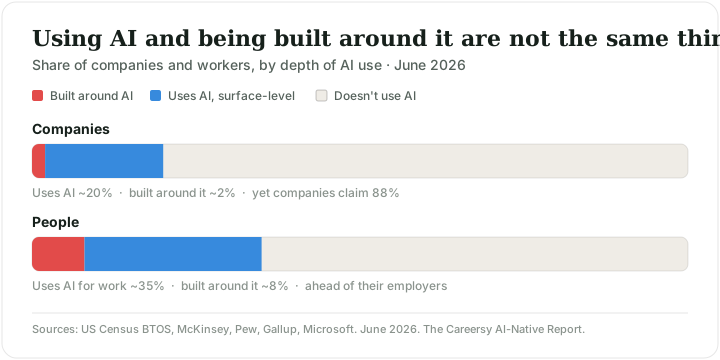
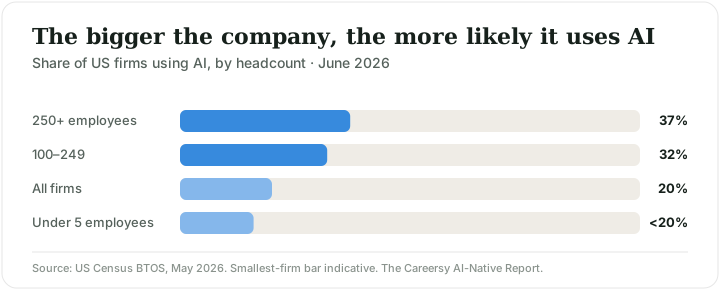
Counting every business in the United States, about one in five uses AI at all.[1] Among the firms that do, only about 7 percent have fully rebuilt around it, meaning you could not pull the tool out without the work breaking.[2] Across the whole economy that is roughly one company in fifty. Workers are a bit further along. Somewhere around a third use AI for their job in some form, though the estimates run from a fifth to nearly two in five depending on how you ask,[4][5] and about one in twelve has genuinely rebuilt how they work around it.[6]
The thin red sliver in that chart is the part everyone is panicking about. The wide pale space is the part nobody mentions.
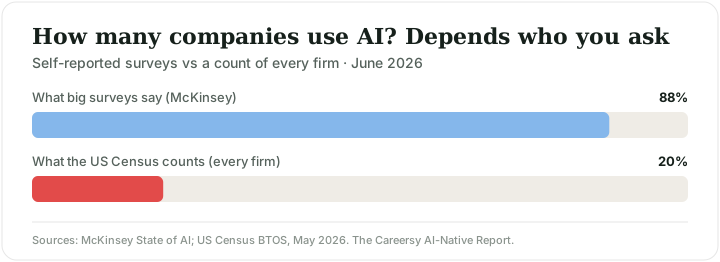
One number tells you this is real and not another hot take. Ask the big consulting surveys and 88 percent of companies "use AI."[2] Ask the US Census Bureau, which counts every firm instead of the ones who volunteer to answer, and the figure is about 20 percent.[1] Both are true. The 88 percent is large enterprises describing themselves, which is about as reliable as asking people how often they floss. The 20 percent is the whole economy, most of which is small and has not started.
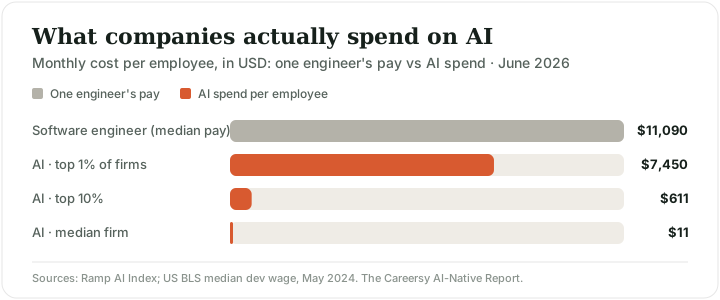
The honest number sits closer to the Census, and the spending settles it. The median company spends about 11 US dollars per employee per month on AI, which buys one licence that sits in a browser tab, unopened, slowly accruing guilt. The top one percent spend 7,500.[3] There is almost nothing in between.
Most of the hard numbers here are American, because the US runs a business census we don't. We treat the US as the leading indicator ANZ tends to follow, and anchor locally where we can. In Australia the picture rhymes: the National AI Centre puts small-business adoption around 43 percent,[7] but the same definitional gap applies, and the depth thins out fast once you ask what people actually do with it rather than whether they have logged in once.
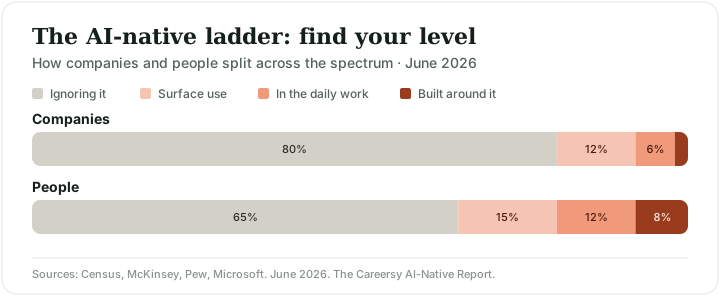
It works like a ladder, and almost everyone is standing lower on it than they think. Four levels.
Ignoring it. You do not use AI, or your workplace has blocked it for security reasons while everyone uses it on their phones anyway.
Surface use. A chat window you open now and then for a draft, then edit heavily so it stops sounding like a chat window.
In the daily work. It is part of how you actually get things done.
Built around it. Take it away and your day stops working.
Find yourself on it honestly. Then find your employer, because the most useful finding in here is this. Individuals are further up the ladder than the companies they work for. Roughly 8 percent of workers are built around AI, against about 2 percent of companies. This is not our hunch. The St. Louis Fed found the same worker-versus-firm gap,[11] IBM's 2026 study of leaders put numbers on it,[12] and Microsoft traced the cause: the organisation, not the person, is usually what holds adoption back.[6] So if you have already rewired how you work while your employer's tooling budget and official policy lag a year behind, you are an asset your own company has not finished pricing. And if you have not, understand this clearly. The people getting ahead of you are not smarter than you. They just moved up a level while everyone else argued about robots.
Those levels now have money attached, which is new. Jensen Huang, who runs Nvidia, said in March that if one of his 500,000 dollar engineers did not burn at least 250,000 dollars of AI tokens a year, he would be "deeply alarmed."[8] He sells the chips, so discount the source accordingly. But the behaviour it points to is real, so read it as a candidate. For years the safe signal was doing more with less. Now, inside the companies near the top, using little of the tool is the thing that gets you noticed, and not in a good way. Your employer is starting to keep two budgets, people and tokens, and you are being measured against both whether or not anyone has told you.
We did not take any single survey's word for this. The Census says one in five firms.[1] Ramp's card-spending data says the median is one seat.[3] Pew says 65 percent of workers barely touch it.[4] Microsoft puts only 19 percent of the workers it studied in its "frontier" zone.[6] Different people, different agendas, all pointing at the same shape: a fat bottom and a thin top. That convergence is why we trust it.
Here is where our read differs from the consultancies', because we have sat in the rooms they study from the outside. We were built by recruiters, not technologists. A year ago, the intake call where a recruiter and a hiring manager decide who they actually want was about scope and stack. Now, within the first ten minutes, almost every hiring manager asks some version of how this person works with AI. They are working out which level you are at, and whether you can talk about it like an adult instead of reading from a brochure. None of the reports above will tell you that, because none of them are written by the people screening you.
What moves you up a level is one honest sentence you can say out loud. "I now do this specific thing faster and better because of how I use these tools, and this other part is the judgment only I bring." That sentence is the whole game. It is what the performance review is feeling for, and it is what the hiring manager is listening for in that call. Practise it out loud beforehand, until it stops sounding like a hostage statement.
If you want somewhere to start this week, take the most repetitive part of your job, the part you could do in your sleep, and hand it to a model properly. Keep the judgment. Then practise the sentence.
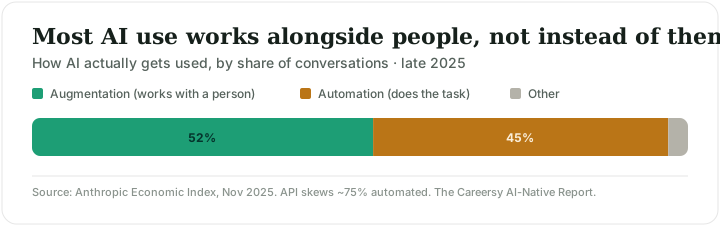
A word on what this report does not do. It does not prove AI is destroying jobs, whatever your feed implied this morning. The early employment data, including Anthropic's own labor-market research,[9] shows no clear collapse yet, only a faint slowdown in hiring for the youngest workers. And when researchers watch how AI actually gets used, most of it is augmentation rather than automation. Anthropic's usage data puts it at 52 percent working alongside a person against 45 percent doing the task for them.[10] The tool is mostly making people better, rather than replacing them. The depth figures inside each level are estimates, stitched from surveys that count slightly different things, and we have marked them where they are soft. This is a snapshot of adoption today. It does not forecast what happens to jobs.
This is the June 2026 baseline. The point of a report like this is that it moves, so we will run it again, and watch the red slivers grow. For now the shared understanding is this. Almost nobody is built around AI yet. The ladder is real, and the top is nearly empty. The climb is wide open. Pick your level, then take one step up.
Methodology: this report aggregates public data, listed below, and reads it from the hiring side. The same gaps turn up in the St. Louis Fed's and IBM's 2026 work and in McKinsey's, so this is consensus, not a hot take. Approach modelled on Anthropic's Labor Market Impacts research, which measures what AI is doing now rather than waiting for the employment data to settle the argument.
Want to see which level your CV puts you on in a recruiter's search? That is what Careersy AI was built for. See how you're read.
FAQ
How many companies actually use AI in 2026?
It depends who you count. Industry surveys put it at 88 percent, but those poll large enterprises that opt in. The US Census, which counts every firm, finds about 20 percent. And of the firms that do use AI, only around 7 percent have rebuilt their work around it. So the honest answer is that roughly a fifth of companies use AI, and almost none are built around it.
What does it mean to be "AI-native"?
It is not a yes-or-no badge. It works like a ladder. At the bottom you ignore AI; one level up you use it now and then for a draft; higher, it is part of your daily work; at the top you are built around it, meaning if you took the tool away your work would grind to a halt. Most people and most companies sit lower on that ladder than they think.
Are individual workers ahead of their companies on AI?
Yes. Roughly 8 percent of workers are built around AI, against about 2 percent of companies. The St. Louis Fed and IBM found the same gap, and Microsoft traced the cause: the organisation, not the person, is usually what holds adoption back. If you have rewired how you work faster than your employer has, you are an asset your company has not finished pricing.
Is AI taking jobs in 2026?
There is no clear evidence of a job collapse yet. Anthropic's labor-market research finds only a faint slowdown in hiring for the youngest workers, and most AI use is augmentation, working alongside a person, rather than automation, doing the task for them. The real shift is different: you are increasingly measured by how well you use AI, not by whether AI replaces you.
How many Australian businesses use AI?
Australia's National AI Centre puts small-business adoption around 43 percent, though the figure swings with how you define "use." As with the global numbers, broad use is one thing and real integration is another. Most of that 43 percent is surface-level, not rebuilt around AI.
References and notes
- US Census Bureau, Business Trends and Outlook Survey (AI use by businesses), May 2026. census.gov
- McKinsey & Company, The State of AI, 2025-2026. mckinsey.com
- Ramp, AI Index, June 2026 (card-spend data across 70,000+ US businesses). ramp.com
- Pew Research Center, Americans and AI, June 2026. pewresearch.org
- Gallup, AI use among employed adults, January 2026 (reported by Fortune). fortune.com
- Microsoft, 2026 Work Trend Index. microsoft.com
- National AI Centre (Australia), AI adoption insights: December 2025 to February 2026. ai.gov.au
- Jensen Huang, remarks at GTC 2026 and on the All-In Podcast, March 2026 (reported by Tom's Hardware). tomshardware.com
- Anthropic, Labor Market Impacts of AI: a new measure and early evidence. anthropic.com
- Anthropic, Economic Index (augmentation vs automation), January 2026. anthropic.com
- Federal Reserve Bank of St. Louis, "Measuring AI Adoption among Firms: How You Ask Matters," June 2026. stlouisfed.org
- IBM, 2026 CEO Study (the AI adoption gap: about 85% of employees have access to AI at work, around 25% use it regularly). ibm.com
Notes on the estimates:
- The ~2% of all firms "built around AI" is derived, not measured: about 7% of AI-using firms are fully scaled [2], applied to the ~20% of firms that use AI at all [1]. We treat it as an estimate.
- For individuals, "uses AI for work" runs from roughly 21% to 38% across surveys depending on the definition [4][5]; we cite the range rather than a single point.
- The "under 5 employees" bar on the company-size chart is shown indicatively below the 20% line; the Census reports "under 20%" for that group without an exact figure [1].
- Augmentation-versus-automation figures are consumer Claude.ai usage; enterprise API use skews roughly 75% automated [10].